Norway
- Who issues it
- Sjøfartsdirektoratet [Norwegian Maritime Authority]; Norsk Test AS issues Båtførerbevis and ICC on its behalf.
- Minimum age
- 16 years
- Buoyage
- IALA region A
- Collision rules
- Sjøveisreglene
Do you need a licence?
On Norwegian boats below 15 metres in Norwegian sea or inland waters, if you were born from 1 January 1980, you need a licence above 8 metres or 25 hp.
You don't need one for:
- if you were born before 1 January 1980, a Norwegian boat below 15 metres in Norwegian sea or inland waters
- if you were born from 1 January 1980, a boat below 15 metres, up to 8 metres and 25 hp
The licence starts at 16; under 16, you are limited to 8 metres and 10 hp. At 15 to 24 metres you need D5L or D5LA from 18, and craft capable of 50 knots or more also need a high-speed licence from 18.
Båtførerbevis · Boating licence
From 16
- What it lets you do
- Norwegian pleasure craft below 15 m in Norwegian waters; no engine-power limit. An additional certificate is required for craft capable of 50+ knots.
- How you get it
- Electronic theory: 50 questions in 60 minutes; 80% overall and at most 2 errors in essential topics. No practical test.
- Where to study
- Read the guideStudy it in Academy
Internasjonalt båtførersertifikat (ICC) · International Certificate of Competence
From 16- What it lets you do
- Coastal certificate for motorboats, sailboats or both, according to the practical test; Norwegian craft below 15 m. Local rules apply abroad.
- How you get it
- Boating theory or accepted qualification; motor/sail practical test, with motorboat exemptions for deck/D5L certificates. Health declaration required.
- Where to study
- Study it in Academy
Høyhastighetsbevis · High-speed licence
From 18
- What it lets you do
- Add-on for Norwegian pleasure boats or jet skis below 24 m capable of 50 knots or more; separate boat and jet-ski endorsements.
- How you get it
- Required theory and boat/jet-ski practical training. Theory test: 30 multiple-choice questions in 40 minutes; at least 90% correct.
- Where to study
- Study it in Academy
Fritidsskippersertifikat (D5L) · Pleasure craft skipper certificate
From 18- What it lets you do
- Pleasure craft up to 24 m: Norwegian coast within 20 nautical miles of baselines, plus specified Swedish, Danish and German waters (stor kystfart).
- How you get it
- Six written exams: at least 40% in each and safe passage planning. Two practical modules; approved experience or a separate checkout; medical certificate.
- Where to study
- Study it in Academy
Fritidsskippersertifikat med utvidet fartsområde (D5LA) · Pleasure craft skipper certificate with extended operating area
From 18- What it lets you do
- Norwegian pleasure craft up to 24 m in all waters; check acceptance with foreign authorities before sailing abroad.
- How you get it
- D5L plus 45 teaching periods (45 minutes each) and a four-hour written exam: at least 40% and safe passage planning.
- Where to study
- Study it in Academy
Professional deck titles
Kompetansesertifikat dekksoffiser klasse 6 (D6)
STCW II/3- What it lets you do
- On small coasting cargo ships under 500 GT, you can stand watch or serve as chief mate on ships under 24 m. You can be master on ships under 15 m, or under 24 m when you meet the additional age and service requirements.
- Where to study
- Study it in Academy
Kompetansesertifikat dekksoffiser klasse 5 (D5)
STCW II/3- What it lets you do
- You can serve as watch officer or chief mate on ships under 500 GT in North Sea and Baltic trade. You can become master after meeting the additional age and service requirements.
- Where to study
- Study it in Academy
Kompetansesertifikat dekksoffiser klasse 4 (D4)
STCW II/1- What it lets you do
- This lets you serve worldwide as a watch officer, or as chief mate on ships under 500 GT in North Sea and Baltic trade. With the additional age and service requirements, you can be master there.
- Where to study
- Study it in Academy
Kompetansesertifikat dekksoffiser klasse 3 (D3)
STCW II/2- What it lets you do
- You can serve worldwide as a watch officer or as chief mate on ships up to 3,000 GT. Once you have the qualifying age and service, you can be master on ships up to 3,000 GT.
- Where to study
- Study it in Academy
Kompetansesertifikat dekksoffiser klasse 2 (D2)
STCW II/2- What it lets you do
- You can serve worldwide as chief mate on ships of any tonnage. You can be master on ships up to 500 GT in North Sea and Baltic trade, or on ships up to 3,000 GT with the required service.
- Where to study
- Study it in Academy
Kompetansesertifikat dekksoffiser klasse 1 (D1)
STCW II/2- What it lets you do
- You can be master of ships of any size, anywhere in the world. This certificate carries the title sjøkaptein.
- Where to study
- Study it in Academy
Radio certificates
Short Range Certificate (SRC)
SRC- What it lets you do
- You can use marine VHF on pleasure craft and on commercial vessels that require D6 or lower.
- Where to study
- Study it in Academy
Long Range Certificate (LRC)
LRC- What it lets you do
- You can use marine radio, including MF and HF, on pleasure craft and commercial vessels that require D6 or lower.
- Where to study
- Study it in Academy
Restricted Operator’s Certificate (ROC)
ROC- What it lets you do
- You can operate GMDSS radio in sea area A1. It does not cover MF/HF operation.
- Where to study
- Study it in Academy
General Operator Certificate (GOC)
GOC- What it lets you do
- You can operate all GMDSS radio equipment on every type of vessel in sea areas A1–A4.
- Where to study
- Study it in Academy
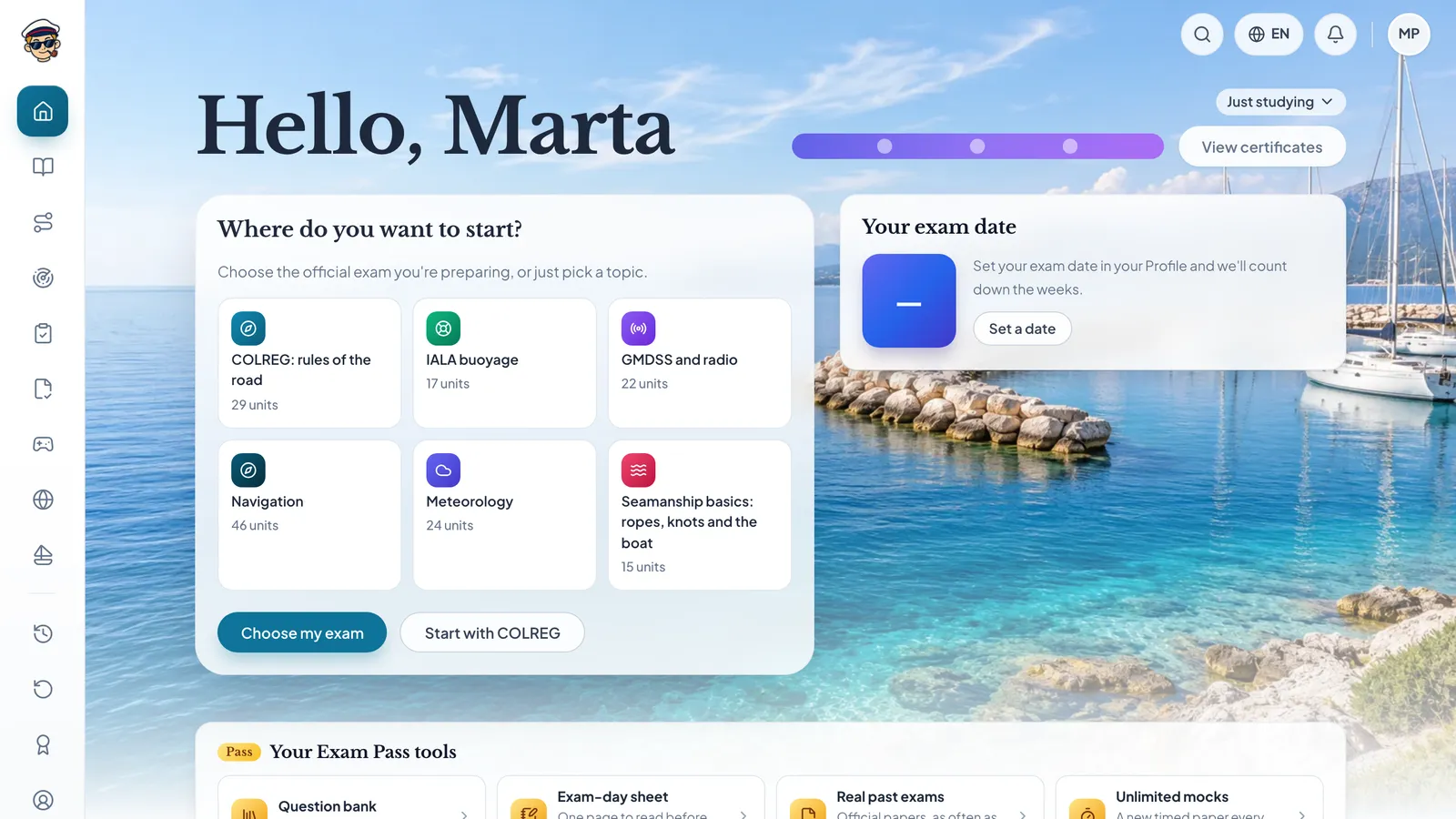
Ready to study for it?
The Academy is free with an account: lessons for every topic, timed mocks marked like the real exam, and your progress saved.
Official sources: Sjøfartsdirektoratet — Informasjon om båtførerbevis og båtførerprøven · Sjøfartsdirektoratet — Regulations on minimum age and boating licences, No. 259 (English translation, amended June 2025) · Sjøfartsdirektoratet — Informasjon om fritidsskippersertifikat · Sjøfartsdirektoratet — Regulations on qualifications and certificates for seafarers, No. 1523 (English translation, amended May 2026) · Sjøfartsdirektoratet — Radiosertifikat · Sjøfartsdirektoratet — Emneplan høyhastighetsbevis, version 1.8 (16 July 2025)