
Manoeuvring and ship handling · Level R2 · 3 parts · about 8 min
Anchoring manoeuvres: choosing a spot, letting go and the anchor watch
3 short parts: Choose the spot · Letting go · Anchor watch. Each part explains the idea, then gives the points to remember, the common mistakes, a worked case and a practice question; the Academy unit adds all 18 check questions.
1 · Choose the spot
Choosing an anchorage: shelter, bottom, depth, room and the rules
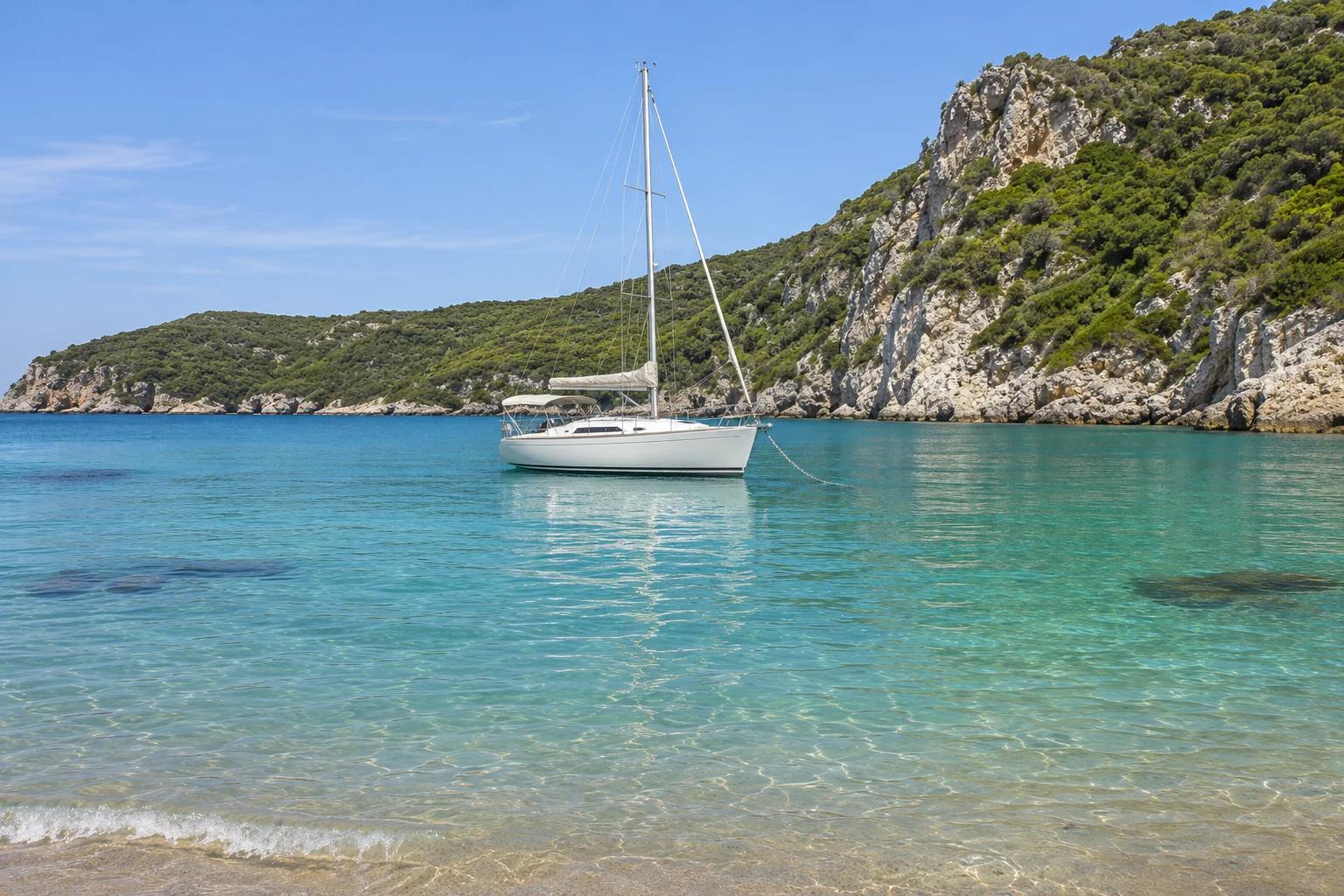
A good anchorage is sheltered from the forecast wind and swell, has a bottom that holds, enough water at low tide, room to swing and no ban on anchoring.
Shelter first
Pick a spot with land between you and the forecast wind and swell, not just the wind blowing now. On Portugal's west coast the summer nortada blows from the north or north-west, and the Atlantic swell usually comes from the north-west, so bays open to the south give the best shelter. Ask what happens if the wind shifts during your stay.
Bottom
The chart shows the nature of the bottom. Sand and mud usually hold well. Rock, stones and weed hold badly and can foul the anchor. Avoid seagrass meadows: anchors and chain tear them up, and some are protected.
Depth with the tide
Check the depth at low water: you must stay afloat when the boat swings. Check it at high water too: the length of chain you let out depends on the greatest depth. The anchoring calculator works the length out from the high-water depth and the height of the bow roller.
Room and rules
You swing in a circle around the anchor, so keep clear of other boats, rocks and the shore. Do not anchor in a fairway, over charted cables or pipelines, inside the 300 m reserved for bathers at a bathing beach, or in marked or protected areas. DL 93/2018 art. 30 requires you to anchor in line with the official charts, the Capitania editais and the notices to mariners.
Key figures
- Shelter
- From the forecast wind and swell, not today's
- Good holding
- Sand and mud
- Poor holding
- Rock, stones, weed; avoid seagrass
- Depth checks
- Low water to stay afloat; high water for scope
- Rules
- Charts, Capitania editais, notices (DL 93/2018 art. 30)
Remember
- Shelter from the forecast wind and swell, including a likely wind shift.
- Sand or mud; avoid rock, weed and seagrass.
- Enough water at low tide; scope from the high-tide depth.
- No anchoring in fairways, over cables, in bathing zones or where an edital forbids it.
Common mistakes
Wrong: If it is calm now, the bay is a good anchorage.
Right: Choose shelter from the forecast wind and swell. Today's calm can turn into a lee shore tonight.
Wrong: Anchoring is allowed anywhere that is not a harbour.
Right: Charts, Capitania editais and protected-area rules can forbid it. Check them before you go.
Wrong: Measure the depth when you arrive and that is enough.
Right: Check the low-water depth to stay afloat and the high-water depth to work out the chain.
Worked case
Summer on the west coast. The forecast is nortada, force 5 from the north-north-west, all afternoon. You can anchor in a bay open to the north with a sandy bottom, or in a bay open to the south, behind a headland, with sand patches between rocks. Which do you choose, and what do you check?
Show the answer
The bay open to the south: the headland gives shelter from the north-north-westerly and its swell. In the north-facing bay the shore would be downwind of you, a lee shore. Drop the anchor on a sand patch, never on rock. Check the low-water depth so you stay afloat, work out the chain from the high-water depth, and keep swinging room from the rocks. Read the local edital and any protected-area rules first.
Practice question
Which bottom usually gives the best holding for a recreational boat's anchor?
- Smooth rock
- Sand or mud
- Thick weed
- Loose stones
Show the answer
Answer: B. Sand and mud let the anchor dig in. Rock, stones and weed hold badly or foul the anchor.
2 · Letting go
The anchoring manoeuvre: approach, let go, pay out and set the anchor
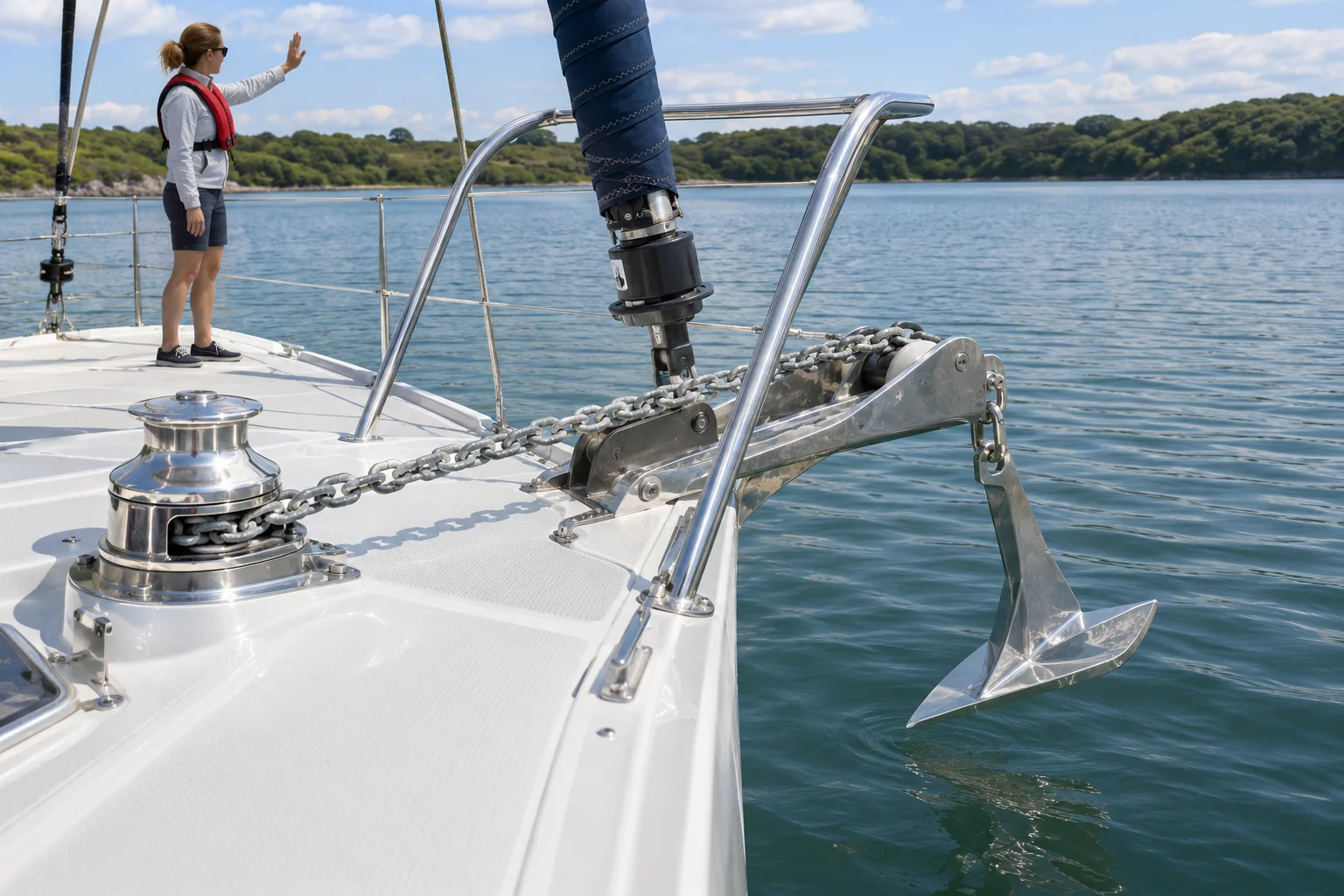
Approach slowly head to wind or current, let go as the boat stops, pay out chain as she drops back, then set the anchor gently astern.
Prepare
Before you arrive, free the anchor, check that the inboard end of the chain (the bitter end) is made fast on board, check the chain is marked so you know how much is out, and agree hand signals between the helm and the bow. The crew at the bow wears shoes and keeps feet and hands clear of the running chain.
Approach
Look at boats already anchored: they lie head to wind or current. Come in the same way, slowly, to the spot where you want the anchor. Stop the boat there with a touch astern.
Let go and pay out
As the boat starts to drift back, lower the anchor to the bottom under control, do not throw it. Pay out the chain as she falls back, so it lies along the bottom instead of piling on the anchor. Let out at least the length you worked out: a common rule of thumb in shelter is 4 times the depth plus bow height for all-chain, 7 times with chain and rope.
Set it
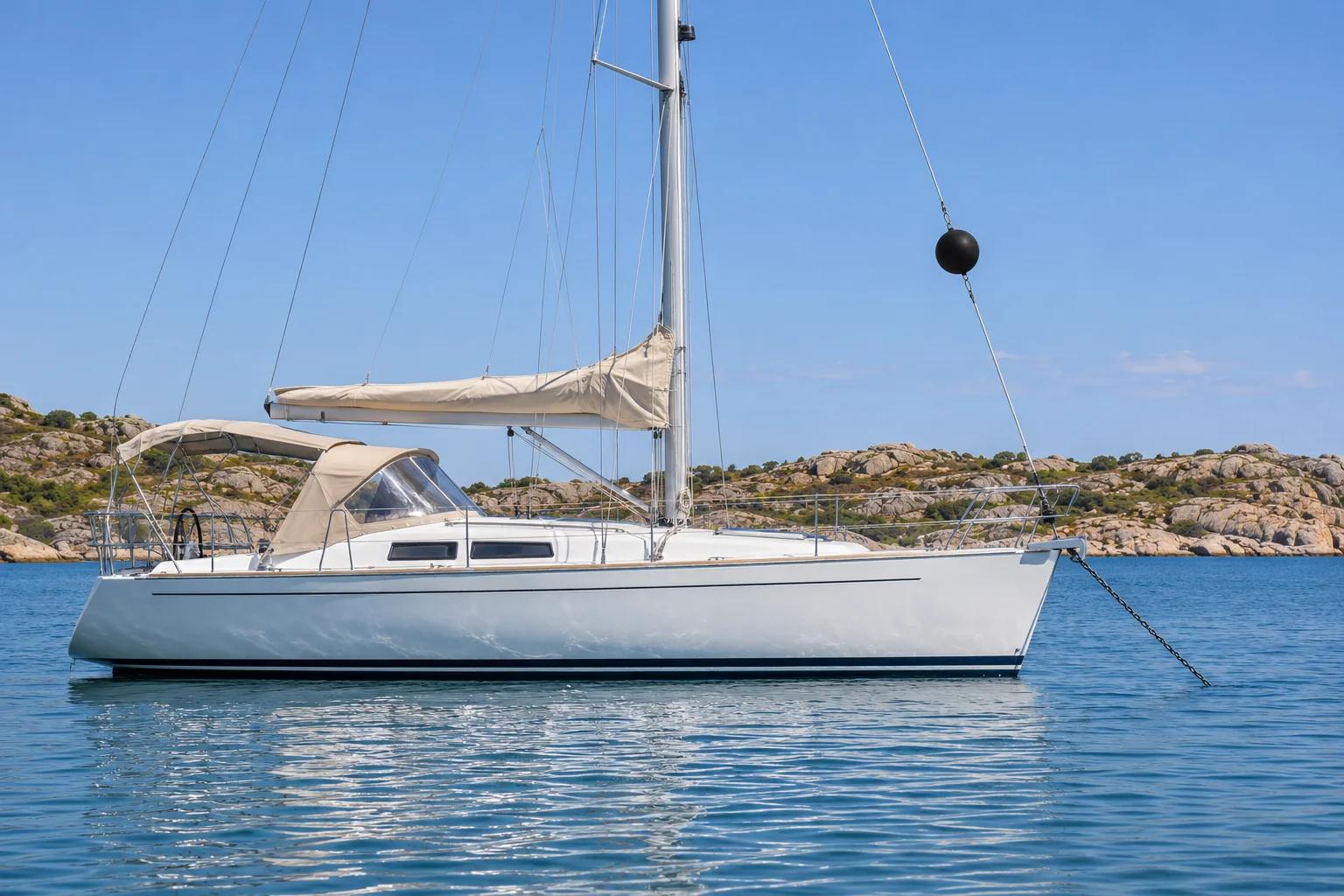
With all the chain out, make it fast and go gently astern. The chain straightens and the anchor digs in. Watch a transit, two fixed objects in line on the shore: if they stay in line, the anchor holds. By day show the black ball forward (COLREG Rule 30).
Key figures
- Approach
- Slowly, head to wind or current, like boats already anchored
- Let go
- As the boat stops and starts to drift back
- Scope (shelter)
- About 4:1 all-chain, 7:1 chain and rope
- Set
- Gently astern; check a transit on shore
- Day signal
- Black ball forward (COLREG Rule 30)
Remember
- Prepare the anchor, secure the bitter end, mark the chain, agree hand signals.
- Approach slowly, head to wind or current, and stop on the spot.
- Lower the anchor; pay out chain as the boat drops back.
- Set it astern and confirm with a transit; show the black ball by day.
Common mistakes
Wrong: Throw the anchor while the boat is still moving ahead.
Right: Stop first. Lower the anchor as the boat starts to drift back, or the chain piles on top of it.
Wrong: Let out chain equal to the depth.
Right: Let out several times the depth plus bow height: about 4:1 for chain in shelter, more in wind.
Wrong: Once the anchor is down, it holds.
Right: Set it gently astern and check a transit before you relax.
Worked case
You arrive in a sheltered bay with 4 m of water at the expected high water and a bow roller 1 m above the water. Your boat has all-chain. Other boats lie heading north. How do you approach, how much chain do you let out, and how do you know the anchor holds?
Show the answer
Approach slowly heading north, as the anchored boats show the wind or current from there. Stop on your spot and lower the anchor as you drift back. Let out at least (4 + 1) × 4 = 20 m of chain, paying out as you go. Then go gently astern and pick a transit ashore: if the two marks stay in line, the anchor holds. Show the black ball forward.
Practice question
How should you approach the spot where you want to anchor?
- Downwind at cruising speed
- Slowly, head to wind or current
- Across the wind to save time
- Astern, so the anchor goes out first
Show the answer
Answer: B. Come in slowly heading the same way as the boats already anchored, which lie head to wind or current.
3 · Anchor watch
The anchor watch, dragging and weighing anchor
At anchor, keep checking your transits and the weather. If the anchor drags, act at once: let out more chain, re-anchor or leave.
Keep watching
Note your transits and your GPS position once the anchor is set. Many GPS units have an anchor alarm that sounds if you leave a circle. Check again after every change of wind or tide, and keep an eye on the forecast.
Signs of dragging
The transits drift out of line, the GPS track moves away, you feel the chain judder, or other boats suddenly seem closer. Do not wait to see if it settles.
When it drags
Start the engine. If there is room and time, let out more chain. If not, weigh anchor and anchor again in a better spot. If the wind now blows onto the shore or the swell is building, the anchorage is no longer safe: leave.
Weighing anchor
Motor slowly towards the anchor while the crew brings in the chain; do not use the windlass to drag the boat. When the chain is vertical, the anchor is a pique (up and down) and should break out. Bring it aboard, wash off mud and weed, and secure it before you speed up.
Key figures
- Check
- Transits, GPS anchor alarm, forecast
- Dragging signs
- Transits out of line, track moving, chain judders
- If it drags
- More chain, re-anchor, or leave
- A pique
- Chain vertical: the anchor is about to break out
Remember
- Set an anchor alarm and recheck transits after each wind or tide change.
- Act at the first sign of dragging.
- If the wind turns onshore or swell builds, leave the anchorage.
- Motor up to the anchor; never drag the boat with the windlass.
Common mistakes
Wrong: Once the anchor has held for an hour, there is no need to check it again.
Right: Wind and tide changes turn the boat and can break the anchor out. Check after every change.
Wrong: Pull the boat up to the anchor with the windlass.
Right: Motor slowly towards it while the crew takes in the chain. The windlass is not built to drag the boat.
Worked case
You are anchored for lunch. The wind backs and freshens, and now blows towards the rocks astern of you. The GPS anchor alarm sounds and your transit is out of line. What do you do?
Show the answer
The anchor is dragging towards danger: act at once. Start the engine, put a crew member at the bow and weigh anchor, motoring towards the anchor so the chain comes up without strain. With the wind onto the rocks the bay is no longer a safe anchorage, so do not anchor again there. Move to shelter from the new wind direction.
Practice question
Which sign shows that the anchor is dragging?
- The boat turns to face the new wind direction
- Your shore transit drifts out of line
- The chain is lying slack on the bottom
- The tide starts to rise on the depth sounder
Show the answer
Answer: B. If two fixed marks no longer line up, the boat is moving over the ground.