
Manoeuvring and ship handling · Level R2 · 5 parts · about 16 min
Propeller walk, rudder, wind and current
5 short parts: Propeller walk · Rudder · Prop and rudder · Twin engines · Wind and current. Each part explains the idea, then gives the points to remember, the common mistakes, a worked case and a practice question; the Academy unit adds all 35 check questions.
1 · Propeller walk
Propeller walk (transverse thrust)
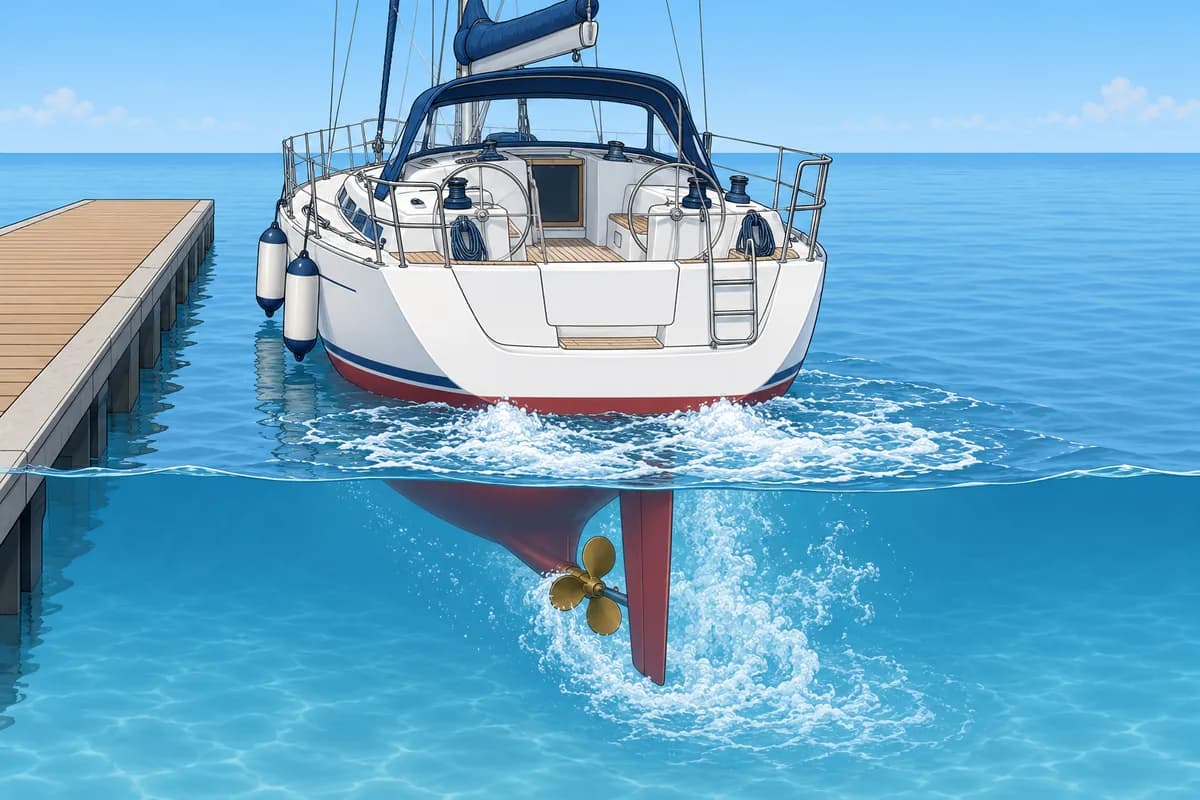
Propeller walk pushes the stern sideways. Astern, a right-handed fixed-pitch propeller usually pushes it to port.
A sideways force
Propeller walk, or transverse thrust, is the sideways force a turning propeller puts on the stern, the back of your boat. With an inclined shaft, blades meet the water at different angles as they turn. Astern, the propeller wash, the stream thrown by the propeller, also strikes the hull unevenly. Together these effects can swing the stern before you move backwards.
Which way?
Seen from astern, a right-handed propeller turns clockwise when driving ahead. With a fixed-pitch propeller, whose blade angle stays fixed, rotation reverses for astern: the stern initially walks to port, your left when facing forward. The bow, the front, swings to starboard, your right. A left-handed propeller does the opposite. Ahead, a right-handed propeller nudges the stern to starboard; the effect is usually smaller.
Why strongest astern?
With a conventional shaft drive, a straight shaft turns the propeller and the rudder sits behind it. Ahead, wash flows over it and helps you oppose the walk. Astern, wash goes forward against the hull instead. From rest rudder force is nil initially, so walk is more noticeable. Expect it during a burst astern to stop forward motion too.
Let it help you
Port side to means your port side faces the quay, the edge where you tie up. With a right-handed propeller, an astern stopping burst draws the stern towards that quay. Starboard side to, it draws the stern away. For a tight turn, favour starboard: the astern walk takes the stern to port and helps the bow turn to starboard. Reverse these choices for a left-handed propeller.
Know the limits
Walk varies with hull shape, shaft angle and drive type. Some boats barely walk. A controllable-pitch propeller changes blade angle for astern without reversing shaft rotation, so the fixed-pitch direction rule does not apply. Test your own boat before relying on the effect.
Key figures
- Right-handed, fixed-pitch, astern
- Stern to port; bow to starboard
- Left-handed, fixed-pitch, astern
- Stern to starboard; bow to port
- Right-handed: useful choices
- Port side to; tight turn to starboard
Test your boat in open water
- Choose calm water with plenty of room and no nearby traffic. — Wind and current can hide the sideways movement.
- Stop through the water, select neutral and centre the rudder. — You want to observe walk before steering flow builds up.
- Select a short burst astern, then neutral. Watch the stern. — Note both the direction and the strength of the walk on your boat.
Remember
- Propeller walk is a sideways force on the stern.
- A right-handed fixed-pitch propeller usually walks the stern to port astern.
- Walk is most noticeable astern, before the rudder has useful water flow.
- Use right-handed walk for port side to and turns to starboard.
- Test your own boat: its drive and hull affect the result.
Common mistakes
Wrong: Turning the wheel stops walk as soon as you select astern.
Right: From rest, a conventional rudder has little flow to work with. Expect the stern to walk before sternway, or backward movement through the water, builds up.
Wrong: Every right-handed propeller walks equally strongly.
Right: The usual direction rule is for fixed-pitch propellers. Hull and drive design change the strength; controllable-pitch systems need their own test.
Worked case
Your boat has a right-handed fixed-pitch propeller. In calm open-water tests, short astern bursts barely move the stern sideways. Both sides of a quay are available. Should you count on walk to bring the stern alongside?
Show the answer
No. The usual rule suggests port side to, but your tests show little useful walk. Choose the side that suits the conditions and clearance. Do not count on an astern burst to bring the stern towards the quay.
Practice question
What is propeller walk?
- The forward force produced at the rudder
- The sideways force produced by the wind
- The sideways force produced at the stern
- The downward force produced at the keel
Show the answer
Answer: C. Propeller walk is transverse thrust: the propeller produces a sideways force on the stern.
2 · Rudder
Rudder, propeller wash and pivot point
Your rudder needs water flow. A short kick ahead can turn you at low speed. Watch the stern swing, and hold the helm firmly astern.
Flow makes it work
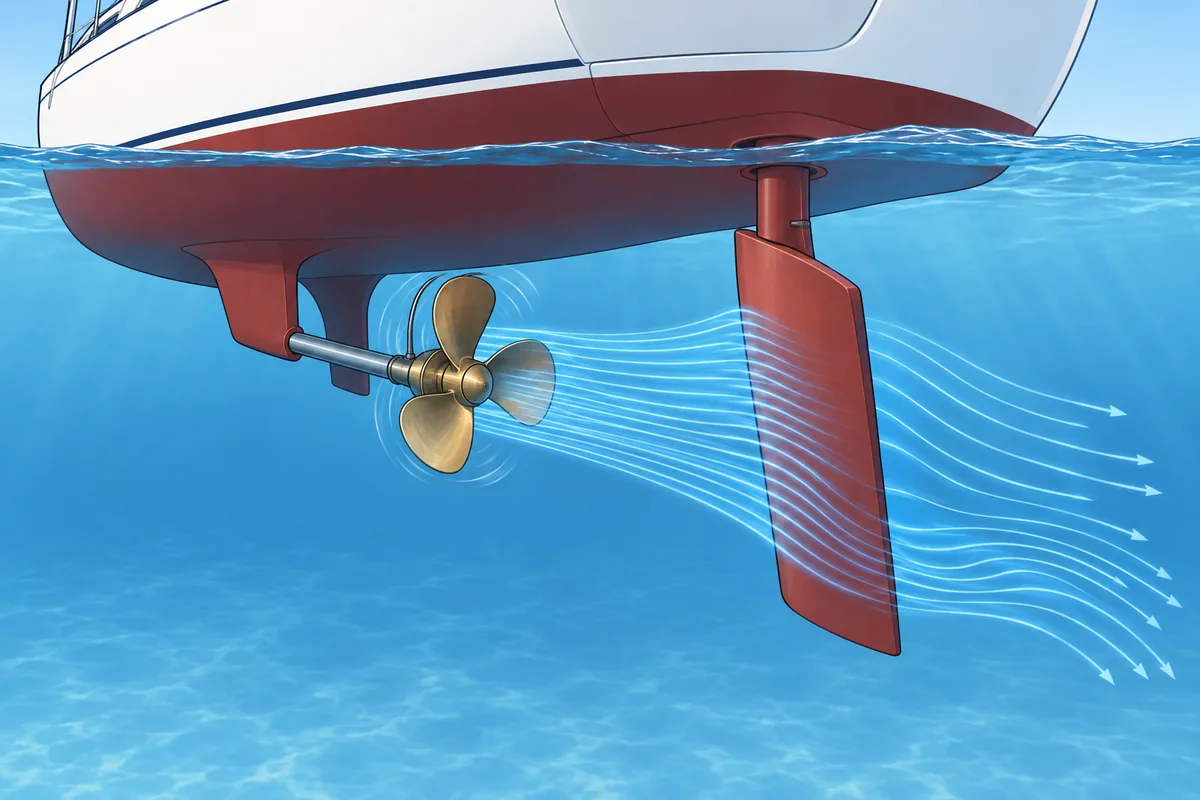
A rudder is an underwater steering blade. Turn it and flowing water pushes your stern sideways. Flow comes from movement through the water or propeller wash, the stream thrown by a propeller. Here we mean a conventional shaft drive, with the rudder behind the propeller. Ahead wash reaches the rudder; astern wash goes forward instead. Stopped through the water in neutral, you have no useful rudder flow. Swivelling drives steer by directing thrust, so they can steer astern before moving.
The kick ahead
A kick ahead is a short burst ahead with the rudder over. Wash pushes the stern sideways before you gain much forward speed. Rudder to starboard pushes the stern to port and turns the bow to starboard. Reverse the directions for rudder to port. Helm means your wheel or tiller, a lever attached to the rudder. A tiller moves opposite to the rudder. Use a brief burst and check the space around both ends.
Steering astern
Sternway means moving backwards through the water. A conventional rudder needs this flow to steer astern. On some yachts it begins to steer effectively at about 1 to 2 knots, but do not treat that as a fixed threshold. Once it works, the stern follows the wheel. A tiller moves opposite to the desired stern movement. Hold either firmly: reverse flow can force the rudder hard over. Keep sternway slow and use small angles.
Pivot point and swing
The pivot point is the point around which your boat appears to turn. With headway, it is roughly one third of the length back from the bow; the stern swings widely opposite the bow. As sternway builds, it moves aft, towards the stern, and the bow swings more widely. Its position varies with motion and forces. Check clearance at both ends: turning the bow away from a quay can swing the stern into it.
Rudder angle
Maximum efficiency is near 35°; a practical stop is about 32° (Marí Sagarra). Excess angle can separate the flow, causing stall, less steering and more drag. The exact response depends on rudder and flow. Use small angles with sternway and hold the helm firmly.
Key figures
- Rudder flow
- Movement through water or ahead propeller wash
- Ahead pivot point
- Roughly one third of the length back from the bow
- Astern pivot point
- Moves aft; allow for wider bow swing
- Rudder angle guide
- Peak near 35°; practical stop about 32°; response varies
Try a kick ahead in clear water
- Stop through the water with room around bow and stern. — Both ends will move when you turn.
- Put the rudder to starboard and give a brief burst ahead. — Wash pushes the stern to port and turns the bow to starboard.
- Return to neutral and watch your remaining movement. — A short kick limits forward speed; it does not stop existing motion.
Remember
- No flow, no rudder steering; ahead wash can supply flow at rest.
- A kick ahead swings the stern before much forward speed builds.
- With sternway, the stern follows the wheel; a tiller moves the opposite way.
- Hold the helm firmly astern, and check clearance for both ends.
- Beyond about 35°, stall may reduce steering; the exact angle varies.
Common mistakes
Wrong: A stopped boat turns when you move its rudder in neutral.
Right: A conventional rudder needs flow. A short kick ahead supplies wash; the wheel alone does not.
Wrong: The stern follows the wheel both ahead and astern.
Right: Ahead, wheel to starboard turns the bow to starboard and swings the stern to port. With sternway, wheel to starboard takes the stern to starboard. Hold the helm firmly.
Wrong: More rudder always makes the turn tighter.
Right: Excess angle can separate the flow and stall the rudder. Ease the angle at speed; a low-speed kick ahead is a different use of the wash.
Worked case
You move slowly ahead beside a quay on your port side. You turn the bow to starboard, away from it. Which end needs clearance, and why?
Show the answer
Watch the stern. The ahead pivot point is roughly one third of the length back from the bow, so the stern swings to port as the bow turns to starboard. Turning away too early can swing the stern into the quay. Allow room at both ends before turning.
Practice question
Your shaft-drive boat is stopped through the water in neutral. Why does turning the wheel have little effect?
- The rudder needs constant shaft rotation to work at all
- The rudder lacks water flow to create a steering force
- The rudder needs forward motion over the ground to steer
- The rudder needs astern wash before it can steer at rest
Show the answer
Answer: B. The rudder needs water flow. At rest in neutral, neither movement through the water nor propeller wash supplies it.
3 · Prop and rudder
Propeller and rudder together: the evolutive effects
What the boat does depends on three things at once: engine ahead or astern, the boat's way, and the helm.
Three questions
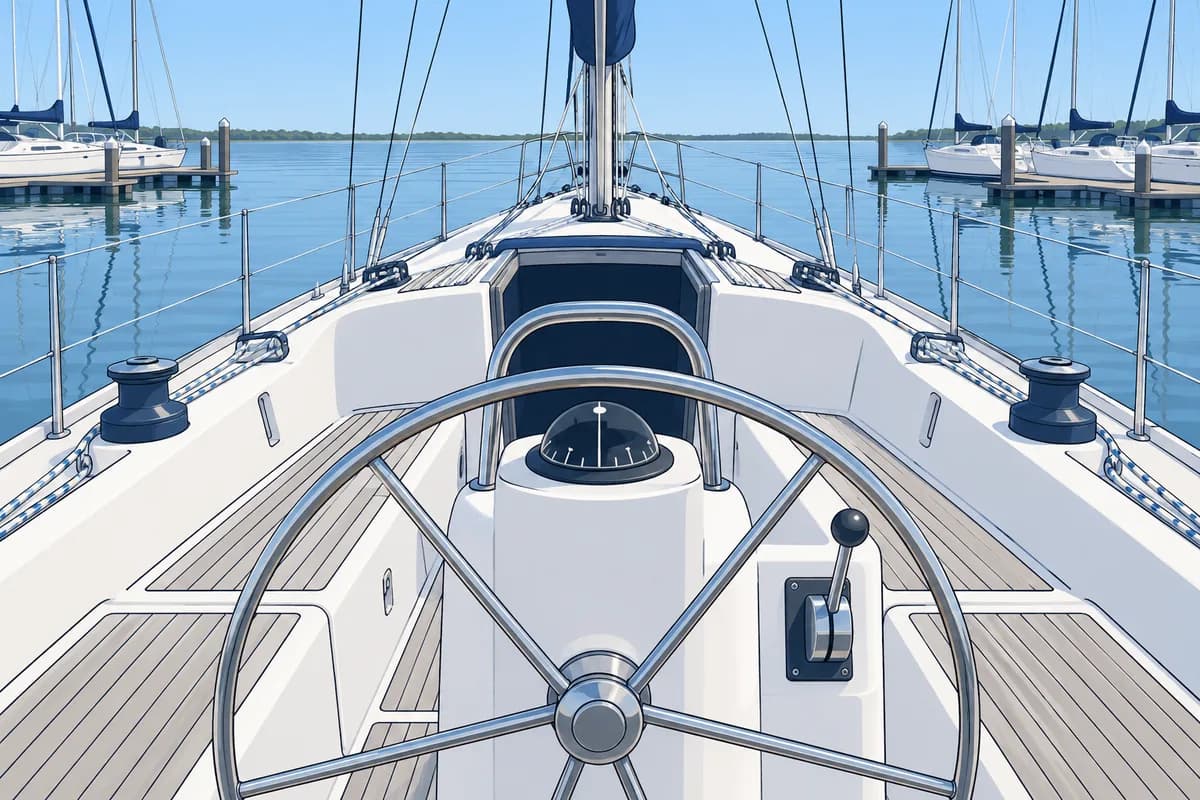
Before any manoeuvre in a single-screw boat, ask: is the engine going ahead or astern? Is the boat at rest, making headway (moving forward) or sternway (moving backwards)? Where is the helm: amidships, to port or to starboard? The answers tell you where the bow and the stern will go. This lesson assumes a right-handed propeller.
Engine ahead
The propeller washes water over the rudder, so the rudder works well, best with headway. With the helm amidships at rest, walk pushes the stern a little to starboard and the bow falls slightly to port. Helm to port swings the bow strongly to port, because rudder and walk work together. Helm to starboard swings the bow to starboard, but less from rest, because walk works against it.
Engine astern
The wash goes forward, under the stern, so from rest the rudder does almost nothing at first and walk pushes the stern to port. While you still have headway, the rudder keeps working as going ahead; below about 2 knots the walk takes over. Once sternway builds, water from astern and the propeller's suction reach the rudder: helm to port adds to the walk, so the stern goes decidedly to port; helm to starboard opposes it, and the result is weak and unclear.
Pivot point
While she has headway, the turning point is usually forward and the stern swings wide. As she gathers sternway, it moves aft and the bow swings wide. Motion and forces determine it, not the engine order. Check clearance at both ends.
Use the table
It shows typical tendencies for a small single-screw yacht in calm water a few seconds after the order. Astern rows are initially walk-dominated; the rudder acts as sternway builds. Pivot marks describe established motion. Strengths are teaching estimates: predict, act, then check the boat.
Key figures
- Rudder effect, engine ahead
- Good at rest, best with headway
- Rudder effect, engine astern
- Nil from rest; weakened steering as sternway builds
- Initially astern from rest (RH)
- Walk dominates: stern to port, bow to starboard
- Ahead at rest, helm amidships
- Stern slightly to starboard
- Pivot point
- Usually forward with headway, aft with sternway
Remember
- Three inputs decide the result: engine, way and helm.
- Engine ahead: the rudder leads, strongest with headway.
- Engine astern from rest: walk initially leads, stern to port (RH).
- With sternway, port helm adds to walk; starboard helm opposes and may overcome it.
- Predict, act, then check what the boat really does.
Common mistakes
Wrong: Astern, putting the helm to starboard will swing the stern to starboard straight away.
Right: From rest, rudder force is nil and walk leads. As sternway builds, starboard helm opposes walk and may eventually overcome it.
Wrong: With the engine ahead and the helm amidships, the boat always starts dead straight.
Right: From rest, walk nudges the stern to starboard. With headway she runs nearly straight; a little compensating helm may be needed.
Wrong: The rudder works the same ahead and astern.
Right: Ahead wash helps it work. Astern from rest, force is nil; with sternway it works, weakened. Retained headway can still provide flow.
Worked case
Your yacht has a right-handed propeller. You are at rest and need the stern to go to port to reach a berth astern.
Show the answer
Select astern: walk initially pushes the stern to port. Port helm adds only as sternway develops. Use short bursts and watch both ends; the bow swings to starboard. Do not expect immediate rudder force from rest.
Practice question
Right-handed propeller, boat at rest, engine astern, helm amidships. Where does the stern go?
- To port
- To starboard
- Straight astern
- It depends only on the wind
Show the answer
Answer: A. Propeller walk astern pushes the stern of a right-handed boat to port.
4 · Twin engines
Twin engines and turning on the spot
On a twin-screw boat, one engine ahead and one astern turns you almost on the spot. At low speed, steer with small gear and power changes.
Two propellers
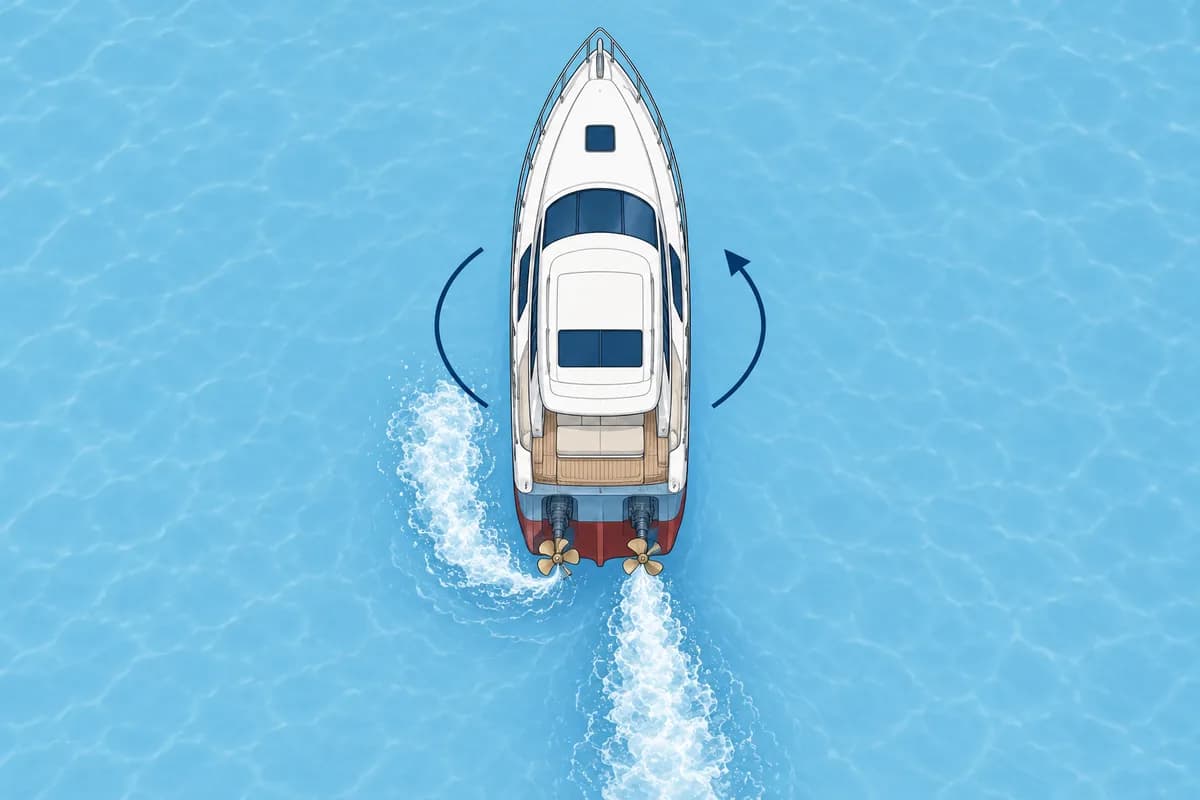
A twin-screw boat has two propellers. In the usual outward-turning layout, the top of each propeller moves away from the centreline, the line down the middle of the boat, when going ahead. Seen from astern, the starboard one is right-handed and the port one left-handed. With matched thrust in the same direction, their opposing walk largely cancels. Unequal power, wind or current can still turn you.
Turn on the spot
The engines push on opposite sides of the centreline. For a turn to port, use starboard ahead and port astern. For starboard, reverse the gears. The opposing thrusts turn you with little forward or backward travel. With outward-turning propellers, walk also helps this turn. Equal lever settings may not give equal thrust: adjust gently if you creep ahead or astern.
Steer with the levers
At very low speed, leave the rudders centred, or straight ahead, and steer with the gear levers. Start at idle, in gear with no added throttle. An engine ahead turns the bow away from its own side: port ahead turns the bow to starboard. An engine astern turns the bow towards its own side: port astern turns the bow to port and the stern to starboard. Use short inputs and watch the result.
Sideways moves
Some twin-shaft boats can walk sideways with opposed engines and carefully set rudders; capability depends on hull and installation. Suitable thrusters working with the engines, coordinated pods, or steerable stern drives make sideways moves more dependable. A bow thruster alone mainly turns the bow and may swing the stern too. Practise before relying on a sideways slide.
Key figures
- Outward-turning layout
- Starboard right-handed; port left-handed
- Turn to port
- Starboard ahead; port astern
- Turn to starboard
- Port ahead; starboard astern
- Straight sideways
- Some twins can; thrusters or vectored drives make it dependable
Remember
- Outward-turning propellers largely cancel walk with matched thrust in the same direction.
- One ahead, one astern turns you with little forward or backward movement.
- To turn to port: starboard ahead, port astern. Reverse for starboard.
- At low speed, steer with gear levers, rudders centred, and adjust any creep.
- A bow thruster alone turns the bow; fixed twin shafts do not guarantee a sideways slide.
Common mistakes
Wrong: Port engine ahead turns the bow to port.
Right: Ahead thrust turns the bow away from that engine. Port ahead turns the bow to starboard; port astern turns it to port.
Wrong: Equal lever settings always hold you in one place during a turn.
Right: Ahead and astern thrust may differ. If you creep astern, add a little ahead thrust or ease the astern engine.
Wrong: Two fixed shafts let any boat move straight sideways.
Right: Some twin-shaft boats can walk sideways with opposed engines and rudders. Hull and installation matter; thrusters or vectored drives make it more dependable.
Worked case
You turn to starboard at idle: port engine ahead, starboard engine astern, rudders centred. The boat starts creeping astern. What small adjustment will help?
Show the answer
Add a little power on the port ahead engine. Alternatively, briefly put the starboard engine in neutral, since it is already at idle. Balance the thrust rather than matching lever positions. Keep watching your clearance as the turn continues.
Practice question
With usual outward-turning propellers and matched ahead thrust, what happens to propeller walk?
- The opposing sideways forces stop all forward motion
- Both stern forces add to turn the bow towards port
- Both stern forces add to turn the bow to starboard
- The opposing sideways forces largely cancel
Show the answer
Answer: D. The starboard and port propellers have opposite hands, so their walk largely cancels at matched same-direction thrust.
5 · Wind and current
Wind and current
Current carries you over the ground; wind pushes on exposed surfaces. Approach into whichever affects your boat more, and check similar moored boats.
Current and the ground
A current is moving water. It carries you over the ground, relative to the seabed and shore. Steering depends on movement through the water, which flows past the rudder. Heading directly into a 2-knot current at 2 knots through the water holds your ground position while keeping rudder flow. A freely drifting boat in uniform current is carried along without being turned by that current alone. Uneven flow or restraint can make it swing.
Wind and windage
Windage is the exposed area the wind pushes on: hull sides, cabin and mast. A high-sided boat usually feels more wind force than a low one. With other conditions unchanged, twice the wind speed gives about four times the force. A stopped boat with a high bow often has its bow blown off, or pushed downwind. A tall cabin aft can change this behaviour. Observe your own boat rather than assuming every bow falls away.
Opposite naming rules
Wind is named for where it comes from: a northerly wind blows from north to south. Current is named for where it goes: a northerly current sets towards north. Set means the direction the current flows. To head into that northerly current, point south. To head into a northerly wind, point north.
Approach into the stronger effect
For a slow approach, head into whichever affects your boat more. This is not a comparison of wind and current speeds in knots: their effects depend on the boat. Into current, you can keep water flowing past the rudder while making little progress over the ground. Into wind, the wind helps slow your approach. Check how both forces act before choosing a direction.
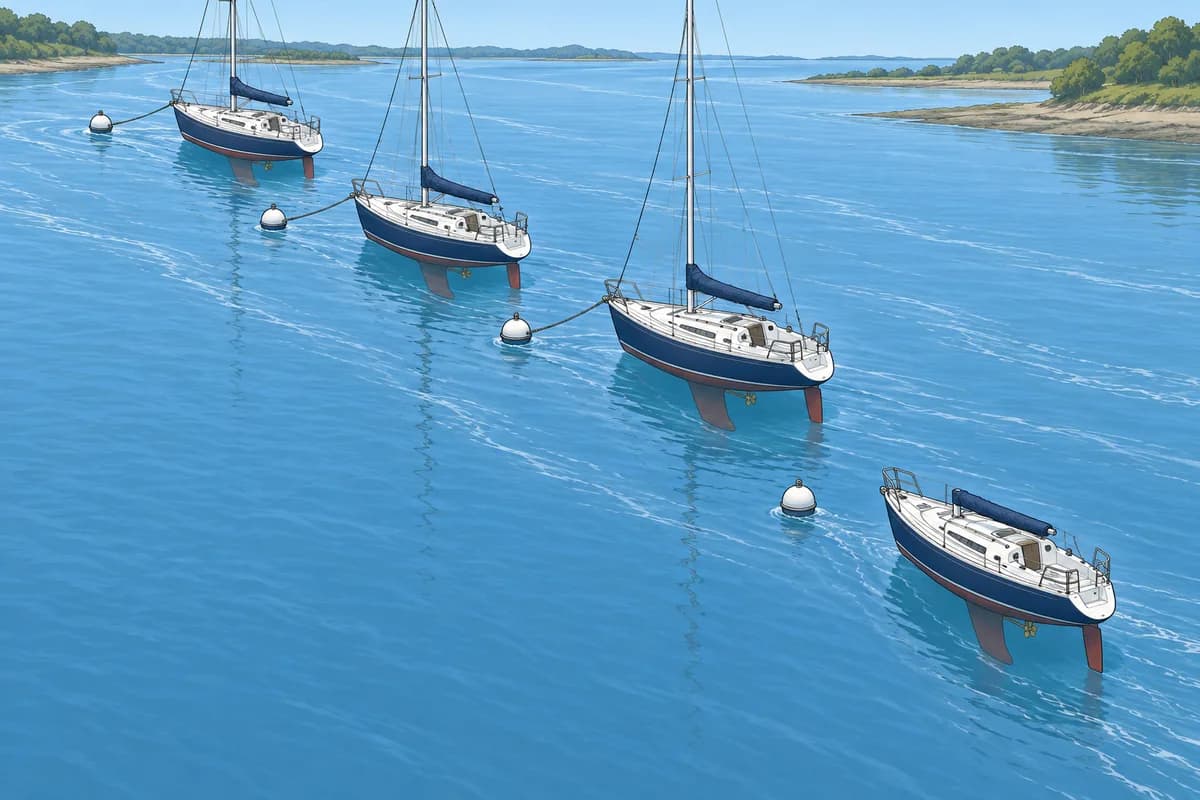
Read moored boats
Look at boats free to swing around a single mooring, especially ones like yours. Their bows usually point towards the dominant force. Boats pointing upstream suggest current dominates; boats pointing into wind suggest wind dominates. Different underwater shapes and exposed areas can make neighbouring boats point differently. Boats tied alongside cannot swing freely, so their headings are poor evidence. Confirm with wind indicators and water moving around fixed posts.
Key figures
- Wind naming
- From where it comes: northerly = from north
- Current naming
- Where it goes: northerly = towards north
- Into a 2-knot current at 2 knots through water
- 0 knots over ground, with water flowing past the rudder
- Stopped high-bowed boat
- Bow often blows downwind; layout can change this
Remember
- Current carries you over the ground; rudder flow depends on speed through the water.
- Wind acts on windage; a stopped high bow often blows downwind.
- Wind is named from; current is named towards.
- Approach into whichever has the stronger effect on your boat.
- Read similar boats free to swing on moorings; confirm with other clues.
Common mistakes
Wrong: A northerly wind and a northerly current move you the same way.
Right: The wind comes from north and pushes south. The current flows towards north.
Wrong: No movement over the ground means no steering flow.
Right: You can hold position while heading into current. At 2 knots through the water into a 2-knot current, you remain stationary over the ground. Water still flows past the hull; ahead propeller wash can add flow over the rudder.
Wrong: Every moored boat shows which force will dominate on mine.
Right: Compare similar boats that can swing freely. Hull shape, underwater area and windage change the balance; boats tied alongside cannot show it by heading.
Worked case
A river flows downstream at 1.5 knots. A light wind blows upstream. Similar boats free to swing on moorings point upstream. Which way should you approach slowly?
Show the answer
Head upstream, into the current: the similar boats suggest it has the stronger effect. At 2 knots through the water against 1.5 knots of current, you make about 0.5 knot over the ground. Matching the current at 1.5 knots through the water holds your ground position while preserving rudder flow.
Practice question
You head directly into a 3-knot current at 4 knots through the water. What is your speed over the ground?
- About 1 knot backwards
- About 4 knots forwards
- About 1 knot forwards
- About 7 knots forwards
Show the answer
Answer: C. On this straight opposing course, subtract current speed: 4 − 3 = 1 knot forwards over the ground. Water passes the hull at 4 knots; ahead propeller wash can add flow at the rudder.