

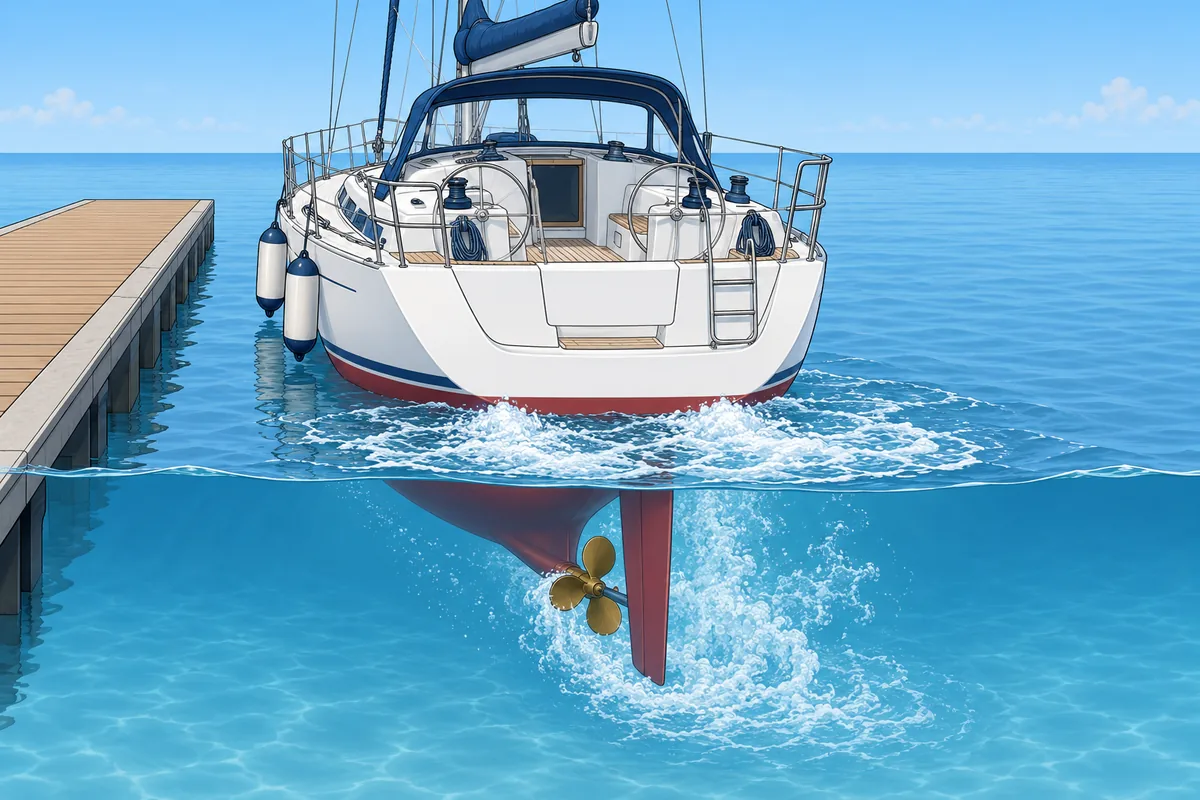
Propeller walk (transverse thrust)
See it in 3D
Try a short engine burst, then watch the stern, bow and pivot point. Forces are simplified for this 11 m teaching yacht; practise on your own boat in safe open water.
1The lesson in plain words
Propeller walk pushes the stern sideways. Astern, a right-handed fixed-pitch propeller usually pushes it to port.
A sideways force
Propeller walk, or transverse thrust, is the sideways force a turning propeller puts on the stern, the back of your boat. With an inclined shaft, blades meet the water at different angles as they turn. Astern, the propeller wash, the stream thrown by the propeller, also strikes the hull unevenly. Together these effects can swing the stern before you move backwards.
Which way?
Seen from astern, a right-handed propeller turns clockwise when driving ahead. With a fixed-pitch propeller, whose blade angle stays fixed, rotation reverses for astern: the stern initially walks to port, your left when facing forward. The bow, the front, swings to starboard, your right. A left-handed propeller does the opposite. Ahead, a right-handed propeller nudges the stern to starboard; the effect is usually smaller.
Why strongest astern?
With a conventional shaft drive, a straight shaft turns the propeller and the rudder sits behind it. Ahead, wash flows over it and helps you oppose the walk. Astern, wash goes forward against the hull instead. From rest rudder force is nil initially, so walk is more noticeable. Expect it during a burst astern to stop forward motion too.
Let it help you
Port side to means your port side faces the quay, the edge where you tie up. With a right-handed propeller, an astern stopping burst draws the stern towards that quay. Starboard side to, it draws the stern away. For a tight turn, favour starboard: the astern walk takes the stern to port and helps the bow turn to starboard. Reverse these choices for a left-handed propeller.
Know the limits
Walk varies with hull shape, shaft angle and drive type. Some boats barely walk. A controllable-pitch propeller changes blade angle for astern without reversing shaft rotation, so the fixed-pitch direction rule does not apply. Test your own boat before relying on the effect.
2Step by step
Test your boat in open water
- 1
Choose calm water with plenty of room and no nearby traffic.
Wind and current can hide the sideways movement.
- 2
Stop through the water, select neutral and centre the rudder.
You want to observe walk before steering flow builds up.
- 3
Select a short burst astern, then neutral. Watch the stern.
Note both the direction and the strength of the walk on your boat.
3Key data
- Right-handed, fixed-pitch, astern
- Stern to port; bow to starboard
- Left-handed, fixed-pitch, astern
- Stern to starboard; bow to port
- Right-handed: useful choices
- Port side to; tight turn to starboard
4Key points
- 1
Propeller walk is a sideways force on the stern.
- 2
A right-handed fixed-pitch propeller usually walks the stern to port astern.
- 3
Walk is most noticeable astern, before the rudder has useful water flow.
- 4
Use right-handed walk for port side to and turns to starboard.
- 5
Test your own boat: its drive and hull affect the result.
5Frequent mistakes
Wrong: Turning the wheel stops walk as soon as you select astern.
Right: From rest, a conventional rudder has little flow to work with. Expect the stern to walk before sternway, or backward movement through the water, builds up.
Wrong: Every right-handed propeller walks equally strongly.
Right: The usual direction rule is for fixed-pitch propellers. Hull and drive design change the strength; controllable-pitch systems need their own test.
6Practice case & exam keys
Your boat has a right-handed fixed-pitch propeller. In calm open-water tests, short astern bursts barely move the stern sideways. Both sides of a quay are available. Should you count on walk to bring the stern alongside?
Show the answer
No. The usual rule suggests port side to, but your tests show little useful walk. Choose the side that suits the conditions and clearance. Do not count on an astern burst to bring the stern towards the quay.
Exam keys
- Transverse thrust means propeller walk: a sideways force on the stern.
- Right-handed means clockwise ahead, seen from astern; fixed-pitch astern usually walks the stern to port.
- Walk is strongest astern; use it for port-side berthing and starboard turns with a right-handed propeller.
- Test your boat; controllable-pitch propellers do not follow the fixed-pitch reversal rule.
Finish this unit
When you've read it, answer three questions. Get all three right to finish the unit; opening the page alone doesn't count.
My notes for this unit
No notes