

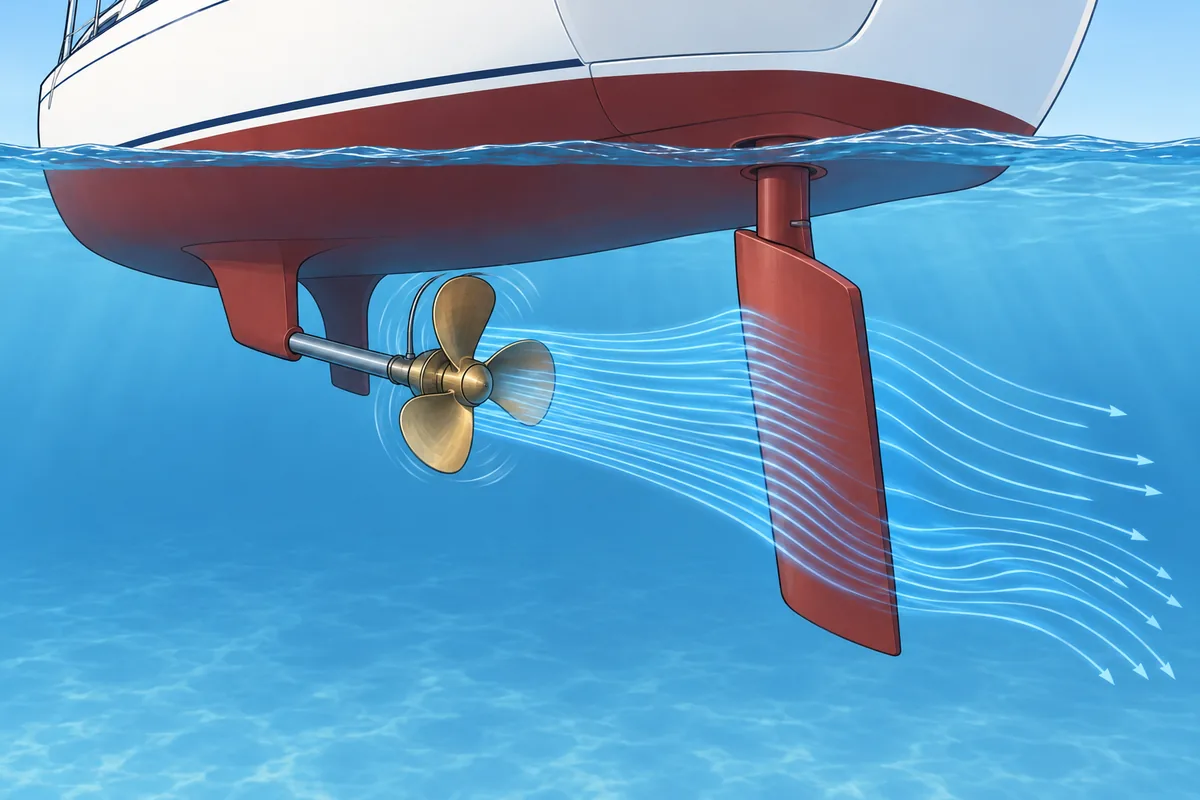
Rudder, propeller wash and pivot point
See it in 3D
Try a short engine burst, then watch the stern, bow and pivot point. Forces are simplified for this 11 m teaching yacht; practise on your own boat in safe open water.
1The lesson in plain words
Your rudder needs water flow. A short kick ahead can turn you at low speed. Watch the stern swing, and hold the helm firmly astern.
Flow makes it work
A rudder is an underwater steering blade. Turn it and flowing water pushes your stern sideways. Flow comes from movement through the water or propeller wash, the stream thrown by a propeller. Here we mean a conventional shaft drive, with the rudder behind the propeller. Ahead wash reaches the rudder; astern wash goes forward instead. Stopped through the water in neutral, you have no useful rudder flow. Swivelling drives steer by directing thrust, so they can steer astern before moving.
The kick ahead
A kick ahead is a short burst ahead with the rudder over. Wash pushes the stern sideways before you gain much forward speed. Rudder to starboard pushes the stern to port and turns the bow to starboard. Reverse the directions for rudder to port. Helm means your wheel or tiller, a lever attached to the rudder. A tiller moves opposite to the rudder. Use a brief burst and check the space around both ends.
Steering astern
Sternway means moving backwards through the water. A conventional rudder needs this flow to steer astern. On some yachts it begins to steer effectively at about 1 to 2 knots, but do not treat that as a fixed threshold. Once it works, the stern follows the wheel. A tiller moves opposite to the desired stern movement. Hold either firmly: reverse flow can force the rudder hard over. Keep sternway slow and use small angles.
Pivot point and swing
The pivot point is the point around which your boat appears to turn. With headway, it is roughly one third of the length back from the bow; the stern swings widely opposite the bow. As sternway builds, it moves aft, towards the stern, and the bow swings more widely. Its position varies with motion and forces. Check clearance at both ends: turning the bow away from a quay can swing the stern into it.
Rudder angle
Maximum efficiency is near 35°; a practical stop is about 32° (Marí Sagarra). Excess angle can separate the flow, causing stall, less steering and more drag. The exact response depends on rudder and flow. Use small angles with sternway and hold the helm firmly.
2Step by step
Try a kick ahead in clear water
- 1
Stop through the water with room around bow and stern.
Both ends will move when you turn.
- 2
Put the rudder to starboard and give a brief burst ahead.
Wash pushes the stern to port and turns the bow to starboard.
- 3
Return to neutral and watch your remaining movement.
A short kick limits forward speed; it does not stop existing motion.
3Key data
- Rudder flow
- Movement through water or ahead propeller wash
- Ahead pivot point
- Roughly one third of the length back from the bow
- Astern pivot point
- Moves aft; allow for wider bow swing
- Rudder angle guide
- Peak near 35°; practical stop about 32°; response varies
4Key points
- 1
No flow, no rudder steering; ahead wash can supply flow at rest.
- 2
A kick ahead swings the stern before much forward speed builds.
- 3
With sternway, the stern follows the wheel; a tiller moves the opposite way.
- 4
Hold the helm firmly astern, and check clearance for both ends.
- 5
Beyond about 35°, stall may reduce steering; the exact angle varies.
5Frequent mistakes
Wrong: A stopped boat turns when you move its rudder in neutral.
Right: A conventional rudder needs flow. A short kick ahead supplies wash; the wheel alone does not.
Wrong: The stern follows the wheel both ahead and astern.
Right: Ahead, wheel to starboard turns the bow to starboard and swings the stern to port. With sternway, wheel to starboard takes the stern to starboard. Hold the helm firmly.
Wrong: More rudder always makes the turn tighter.
Right: Excess angle can separate the flow and stall the rudder. Ease the angle at speed; a low-speed kick ahead is a different use of the wash.
6Practice case & exam keys
You move slowly ahead beside a quay on your port side. You turn the bow to starboard, away from it. Which end needs clearance, and why?
Show the answer
Watch the stern. The ahead pivot point is roughly one third of the length back from the bow, so the stern swings to port as the bow turns to starboard. Turning away too early can swing the stern into the quay. Allow room at both ends before turning.
Exam keys
- Rudder steering needs flow through the water or ahead propeller wash.
- Kick ahead: short burst ahead with rudder over; rudder to starboard swings stern to port.
- Astern with sternway, stern follows wheel; tiller moves opposite. Hold the helm firmly.
- Pivot usually forward with headway, aft with sternway. Peak rudder efficiency near 35°; practical stop about 32°.
Finish this unit
When you've read it, answer three questions. Get all three right to finish the unit; opening the page alone doesn't count.
My notes for this unit
No notes