

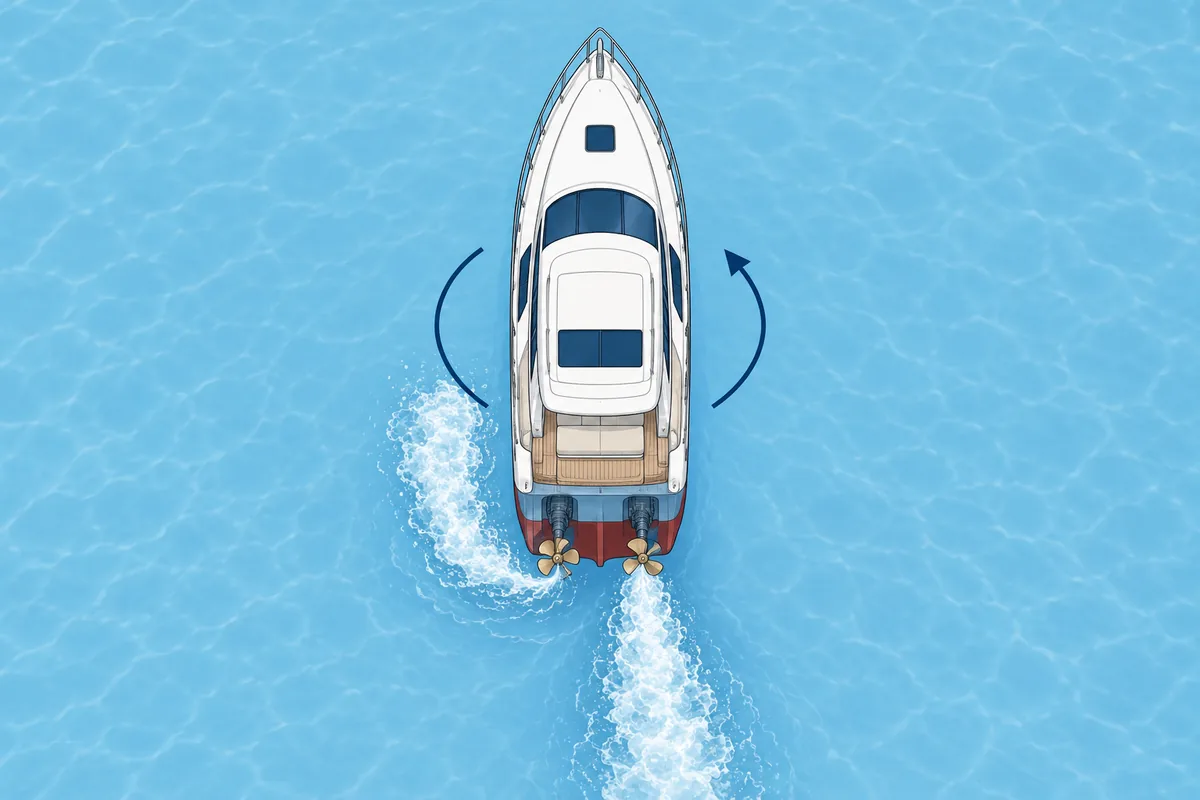
Twin engines and turning on the spot
1The lesson in plain words
On a twin-screw boat, one engine ahead and one astern turns you almost on the spot. At low speed, steer with small gear and power changes.
Two propellers
A twin-screw boat has two propellers. In the usual outward-turning layout, the top of each propeller moves away from the centreline, the line down the middle of the boat, when going ahead. Seen from astern, the starboard one is right-handed and the port one left-handed. With matched thrust in the same direction, their opposing walk largely cancels. Unequal power, wind or current can still turn you.
Turn on the spot
The engines push on opposite sides of the centreline. For a turn to port, use starboard ahead and port astern. For starboard, reverse the gears. The opposing thrusts turn you with little forward or backward travel. With outward-turning propellers, walk also helps this turn. Equal lever settings may not give equal thrust: adjust gently if you creep ahead or astern.
Steer with the levers
At very low speed, leave the rudders centred, or straight ahead, and steer with the gear levers. Start at idle, in gear with no added throttle. An engine ahead turns the bow away from its own side: port ahead turns the bow to starboard. An engine astern turns the bow towards its own side: port astern turns the bow to port and the stern to starboard. Use short inputs and watch the result.
Sideways moves
Some twin-shaft boats can walk sideways with opposed engines and carefully set rudders; capability depends on hull and installation. Suitable thrusters working with the engines, coordinated pods, or steerable stern drives make sideways moves more dependable. A bow thruster alone mainly turns the bow and may swing the stern too. Practise before relying on a sideways slide.
2Key data
- Outward-turning layout
- Starboard right-handed; port left-handed
- Turn to port
- Starboard ahead; port astern
- Turn to starboard
- Port ahead; starboard astern
- Straight sideways
- Some twins can; thrusters or vectored drives make it dependable
3Key points
- 1
Outward-turning propellers largely cancel walk with matched thrust in the same direction.
- 2
One ahead, one astern turns you with little forward or backward movement.
- 3
To turn to port: starboard ahead, port astern. Reverse for starboard.
- 4
At low speed, steer with gear levers, rudders centred, and adjust any creep.
- 5
A bow thruster alone turns the bow; fixed twin shafts do not guarantee a sideways slide.
4Frequent mistakes
Wrong: Port engine ahead turns the bow to port.
Right: Ahead thrust turns the bow away from that engine. Port ahead turns the bow to starboard; port astern turns it to port.
Wrong: Equal lever settings always hold you in one place during a turn.
Right: Ahead and astern thrust may differ. If you creep astern, add a little ahead thrust or ease the astern engine.
Wrong: Two fixed shafts let any boat move straight sideways.
Right: Some twin-shaft boats can walk sideways with opposed engines and rudders. Hull and installation matter; thrusters or vectored drives make it more dependable.
5Practice case & exam keys
You turn to starboard at idle: port engine ahead, starboard engine astern, rudders centred. The boat starts creeping astern. What small adjustment will help?
Show the answer
Add a little power on the port ahead engine. Alternatively, briefly put the starboard engine in neutral, since it is already at idle. Balance the thrust rather than matching lever positions. Keep watching your clearance as the turn continues.
Exam keys
- Usual outward-turning layout: starboard right-handed, port left-handed; matched same-direction thrust largely cancels walk.
- Starboard ahead plus port astern turns to port; port ahead plus starboard astern turns to starboard.
- At low speed use gear levers with centred rudders; adjust thrust to limit creep.
- Fixed twin shafts do not guarantee sideways travel; a bow thruster alone cannot independently control the stern.
Finish this unit
When you've read it, answer three questions. Get all three right to finish the unit; opening the page alone doesn't count.
My notes for this unit
No notes