

Wind and current
See it in 3D
Try a short engine burst, then watch the stern, bow and pivot point. Forces are simplified for this 11 m teaching yacht; practise on your own boat in safe open water.
1The lesson in plain words
Current carries you over the ground; wind pushes on exposed surfaces. Approach into whichever affects your boat more, and check similar moored boats.
Current and the ground
A current is moving water. It carries you over the ground, relative to the seabed and shore. Steering depends on movement through the water, which flows past the rudder. Heading directly into a 2-knot current at 2 knots through the water holds your ground position while keeping rudder flow. A freely drifting boat in uniform current is carried along without being turned by that current alone. Uneven flow or restraint can make it swing.
Wind and windage
Windage is the exposed area the wind pushes on: hull sides, cabin and mast. A high-sided boat usually feels more wind force than a low one. With other conditions unchanged, twice the wind speed gives about four times the force. A stopped boat with a high bow often has its bow blown off, or pushed downwind. A tall cabin aft can change this behaviour. Observe your own boat rather than assuming every bow falls away.
Opposite naming rules
Wind is named for where it comes from: a northerly wind blows from north to south. Current is named for where it goes: a northerly current sets towards north. Set means the direction the current flows. To head into that northerly current, point south. To head into a northerly wind, point north.
Approach into the stronger effect
For a slow approach, head into whichever affects your boat more. This is not a comparison of wind and current speeds in knots: their effects depend on the boat. Into current, you can keep water flowing past the rudder while making little progress over the ground. Into wind, the wind helps slow your approach. Check how both forces act before choosing a direction.
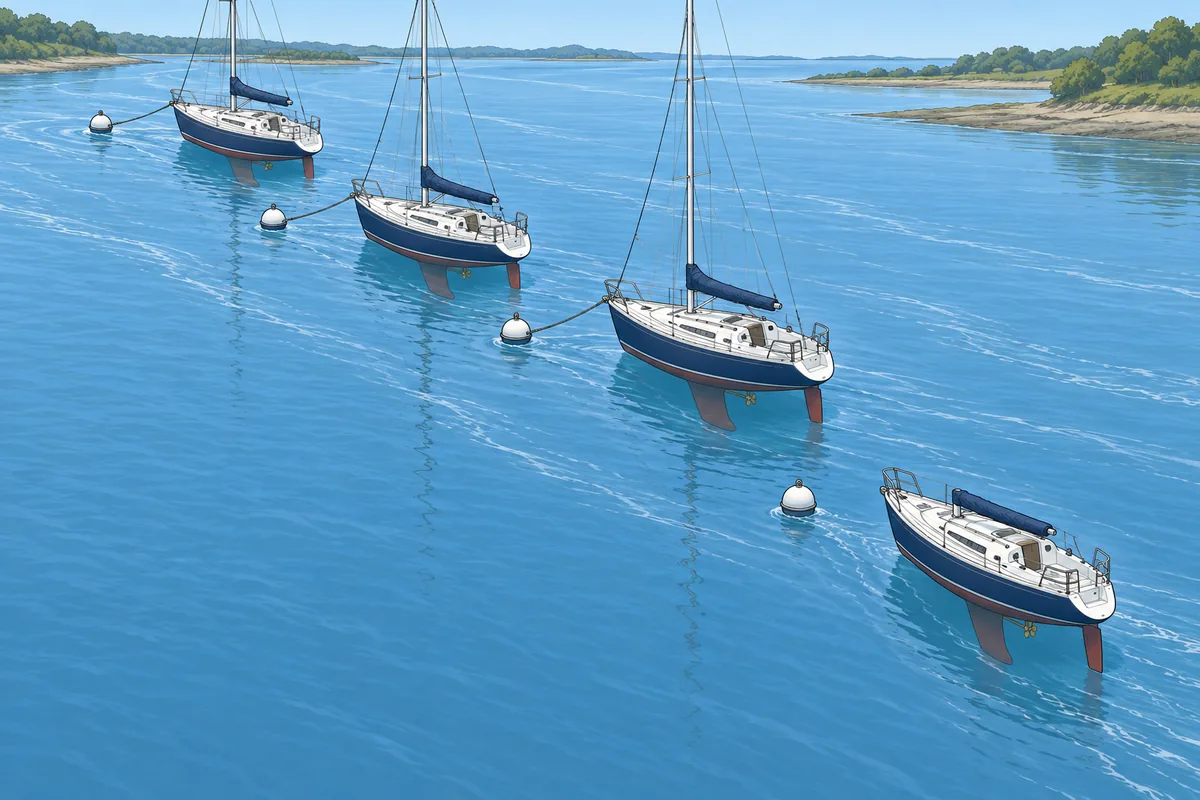
Read moored boats
Look at boats free to swing around a single mooring, especially ones like yours. Their bows usually point towards the dominant force. Boats pointing upstream suggest current dominates; boats pointing into wind suggest wind dominates. Different underwater shapes and exposed areas can make neighbouring boats point differently. Boats tied alongside cannot swing freely, so their headings are poor evidence. Confirm with wind indicators and water moving around fixed posts.
2Key data
- Wind naming
- From where it comes: northerly = from north
- Current naming
- Where it goes: northerly = towards north
- Into a 2-knot current at 2 knots through water
- 0 knots over ground, with water flowing past the rudder
- Stopped high-bowed boat
- Bow often blows downwind; layout can change this
3Key points
- 1
Current carries you over the ground; rudder flow depends on speed through the water.
- 2
Wind acts on windage; a stopped high bow often blows downwind.
- 3
Wind is named from; current is named towards.
- 4
Approach into whichever has the stronger effect on your boat.
- 5
Read similar boats free to swing on moorings; confirm with other clues.
4Frequent mistakes
Wrong: A northerly wind and a northerly current move you the same way.
Right: The wind comes from north and pushes south. The current flows towards north.
Wrong: No movement over the ground means no steering flow.
Right: You can hold position while heading into current. At 2 knots through the water into a 2-knot current, you remain stationary over the ground. Water still flows past the hull; ahead propeller wash can add flow over the rudder.
Wrong: Every moored boat shows which force will dominate on mine.
Right: Compare similar boats that can swing freely. Hull shape, underwater area and windage change the balance; boats tied alongside cannot show it by heading.
5Practice case & exam keys
A river flows downstream at 1.5 knots. A light wind blows upstream. Similar boats free to swing on moorings point upstream. Which way should you approach slowly?
Show the answer
Head upstream, into the current: the similar boats suggest it has the stronger effect. At 2 knots through the water against 1.5 knots of current, you make about 0.5 knot over the ground. Matching the current at 1.5 knots through the water holds your ground position while preserving rudder flow.
Exam keys
- Current changes movement over ground; steering depends on flow through the water.
- Wind acts on windage; a stopped high bow often blows off, with exceptions for boat layout.
- Wind direction names its origin; current direction names its destination.
- Approach into the dominant effect; use comparable boats free to swing on moorings as evidence.
Finish this unit
When you've read it, answer three questions. Get all three right to finish the unit; opening the page alone doesn't count.
My notes for this unit
No notes