
Ship parts explorer
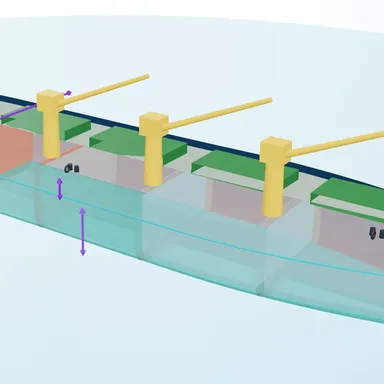
Four vessels in 3D, from an open dinghy to a 120 m cargo ship. Turn them, switch layers, pull them apart and look inside, then drag the names onto the parts to test yourself.
How to use it
1
Pick a vessel and a level
Start with the dinghy at Basic level, then climb to the yacht, the trawler and the cargo ship, and to Skipper and Professional detail.
2
Explore the layers
Switch the hull, structure, rigging, lights or tanks on and off, pull the parts apart or cut the hull open. Tap any part to read what it does.
3
Test yourself
Choose Test yourself, then drag each name onto its numbered marker, or tap a name and then the marker. You see which parts to review at the end.
Every part, vessel by vessel
Jump to:Common to every vesselOpen dinghySailing yachtFishing trawlerCargo ship
Common to every vessel · 17
Hull
- Bow
- The front end of the vessel, shaped to cut through the waves.
- Stern
- The back end of the vessel.
- Keel
- The backbone along the bottom centreline. A yacht's deep fin keel carries ballast and stops the boat drifting sideways.
- Bilge
- The lowest part of the hull, where the bottom turns up into the sides; inside, the space where water collects and is pumped out.
Structure
- Stem
- The upright timber or steel bar at the very front of the hull, where the two sides meet at the bow.
Deck and fittings
- Anchor
- Holds the vessel to the seabed; its chain or rope (the rode) leads out over the bow, through a fairlead, bow roller or hawse pipe.
Machinery and steering
- Propeller
- Turned by the engine, its blades push water aft and drive the vessel ahead.
Tanks and compartments
- Fuel tanks
- Tanks that carry the fuel for the engines.
Dimensions and directions
- Length overall (LOA)
- The length from the foremost to the aftermost point of the vessel, including the bulb or any fittings. Marinas charge by it.
- Beam
- The greatest width of the vessel.
- Draught
- The depth from the waterline down to the lowest point of the hull or keel: the water depth the vessel needs.
- Freeboard
- The height from the waterline up to the deck edge (or gunwale). More freeboard keeps waves out.
- Waterline
- The line where the water surface meets the hull when the vessel floats. Draught is measured below it, freeboard above it.
- Port side
- The left-hand side of the vessel when you face the bow. Its sidelight is red.
- Starboard side
- The right-hand side of the vessel when you face the bow. Its sidelight is green.
- Centreline
- The imaginary line from bow to stern down the middle of the vessel, dividing port from starboard.
- Amidships
- The middle of the vessel, halfway between bow and stern. 'Helm amidships' means the rudder is straight.
Open dinghy · 22
Hull
- Transom
- The flat surface across the stern; on small boats the outboard engine hangs on it.
- Topsides
- The sides of the hull between the waterline and the deck.
Structure
- Keelson
- A strong timber fixed on top of the keel, inside the boat, that stiffens the backbone and holds the frames.
- Frames
- The ribs of the hull: curved members running from the keel up to the deck that hold the shell in shape.
- Breasthook
- The triangular knee inside the bow that joins the stem to the two gunwales.
Deck and fittings
- Gunwale
- The strengthened upper edge of the side of a boat.
- Thwart
- A seat that runs across a small boat and also stiffens the hull.
- Rowlocks
- U-shaped fittings on the gunwale that hold the oars when rowing.
- Oars
- Wooden or metal poles with a flat blade used to row the boat; always carry them in case the engine fails.
- Cleats
- Two-horned fittings for making a rope fast quickly.
- Bow eye
- A strong ring low on the stem, used to tow the boat, to winch it on to a trailer or to make the painter fast.
- Painter
- The rope at the bow of a small boat, used to tie it up or tow it.
- Fenders
- Cushions hung over the side to protect the hull when lying alongside a quay or another vessel.
- Bailer
- A scoop for throwing out water that comes into an open boat.
- Drain plug (bung)
- The plug low in the transom that lets water drain out ashore. Check it is in before you launch.
Lights, shapes and sound signals
- All-round white light
- A boat under 7 m whose top speed is 7 knots or less may show this one light instead of the full set; a rowing boat may show a torch instead.
Machinery and steering
- Outboard engine
- A self-contained engine clamped on the transom; it steers by turning the whole unit.
- Transom clamps
- The screw clamps that hold the outboard engine on the transom; check them and the safety line before you start.
- Kill cord
- A lanyard clipped from the helmsman's leg or lifejacket to the engine stop switch: if they go overboard, the engine stops.
- Fuel line and primer bulb
- The hose from the fuel tank to the outboard; squeeze the bulb to fill the engine with fuel before starting.
- Tiller
- The lever used to steer; on an outboard it turns the engine.
Tanks and compartments
- Buoyancy tanks
- Sealed air compartments that keep the boat afloat even when it is full of water.
Sailing yacht · 73
Hull
- Transom
- The flat surface across the stern; on small boats the outboard engine hangs on it.
- Topsides
- The sides of the hull between the waterline and the deck.
Structure
- Floors
- Deep plates across the bottom at each frame that tie the two sides to the keel. They are not what you stand on.
- Keel bolts
- The heavy bolts that hold the ballast keel on to the hull; they are checked after any grounding.
- Deck beams
- Beams across the hull under the deck that support it and hold the two sides together. They curve slightly (camber) so water runs off.
- Watertight bulkheads
- Walls across the hull that divide it into compartments, so one flooded space does not sink the vessel.
Deck and fittings
- Deck
- The horizontal surface that closes the top of the hull and that the crew walks on.
- Cockpit
- The open, lowered area aft where the crew steer and handle the sheets.
- Sprayhood
- The folding canvas shelter over the front of the cockpit that keeps spray and wind off the crew.
- Toe rail
- A low rail along the deck edge that stops feet and gear sliding overboard; blocks can be clipped to it.
- Stanchions
- The upright posts along the deck edge that hold up the guardrails.
- Guardrails
- The wires (lifelines) stretched between the pulpit, the stanchions and the pushpit that keep the crew on board.
- Pulpit
- The strong metal rail around the bow, where the guardrails start and the sidelights are often fitted.
- Pushpit
- The rail around the stern; it often carries the lifebuoy and the sternlight.
- Winches
- Drums turned by a handle that give extra pulling power on sheets and halyards.
- Mainsheet traveller
- A track across the boat on which the lower mainsheet block slides, to move the boom in or out.
- Cleats
- Two-horned fittings for making a rope fast quickly.
- Fenders
- Cushions hung over the side to protect the hull when lying alongside a quay or another vessel.
- Mooring lines
- The ropes that hold the vessel alongside: bow line, stern line and springs.
- Hatch
- An opening in the deck with a watertight cover, for access, light or loading.
- Companionway
- The entrance and steps from the cockpit down into the cabin.
- Anchor locker
- The locker in the foredeck, under a lid, where the anchor chain or rode is stowed.
- Bow roller
- A roller at the stem head over which the anchor chain or warp runs out and is hauled back.
Superstructure
- Coachroof
- The raised cabin top that gives standing headroom below.
Mast and rigging
- Mast
- A vertical spar or post: on a sailing boat it carries the sails; on a power vessel it carries the navigation lights, antennas and radar.
- Boom
- The horizontal spar along the foot of the mainsail.
- Gooseneck
- The hinged fitting that joins the boom to the mast and lets it swing and tilt.
- Forestay
- The wire from the masthead to the bow that holds the mast forward and carries the jib.
- Headsail furler
- The drum at the foot of the forestay that rolls the jib round the stay to reef or stow it.
- Backstay
- The wire from the masthead to the stern that holds the mast aft.
- Shrouds
- The wires on each side that hold the mast upright.
- Spreaders
- Short struts on the mast that spread the shrouds out for a better angle.
- Chainplates
- Strong metal plates bolted to the hull that the shrouds are attached to.
- Halyards
- The ropes used to hoist (raise) the sails up the mast and lower them.
- Topping lift
- The line from the masthead to the boom end that holds the boom up when the sail is lowered.
- Mainsheet
- The rope and blocks that control the angle of the boom and mainsail to the wind.
- Jib sheets
- The two ropes from the jib's clew to the winches; the one on the leeward side trims the jib.
- Outhaul
- The line that pulls the mainsail's clew out along the boom to flatten the sail.
- Kicking strap (vang)
- The tackle or strut from the foot of the mast to the boom that stops the boom lifting.
Sails
- Mainsail
- The sail set behind the mast, on the boom.
- Jib
- The headsail set in front of the mast, on the forestay.
- Head
- The top corner of a sail, where the halyard is attached.
- Tack
- The lower front corner of a sail, fixed at the gooseneck or the bow.
- Clew
- The lower back corner of a sail, where the sheet or outhaul pulls.
- Luff
- The front edge of a sail, along the mast or the forestay.
- Leech
- The back edge of a sail, from the head down to the clew.
- Foot
- The bottom edge of a sail, from the tack to the clew.
- Battens
- Thin flexible strips in pockets in the sail that support the leech and hold the sail's shape.
- Reef points
- Rows of short lines or eyes across the mainsail, used to tie in a reef and make the sail smaller in strong wind.
Lights, shapes and sound signals
- Masthead light
- A white light on the centreline shining forward over 225°, shown by a power-driven vessel underway, including a sailing yacht under engine. Ships of 50 m or more show two, the after one higher. While trawling, a trawler of 50 m or more also shows one abaft and higher than the green.
- Sidelights
- Red on the port side and green on the starboard side, each shining from right ahead to 22.5° abaft the beam.
- Sternlight
- A white light at the stern shining aft over 135°.
- Tricolour light
- Red, green and white sectors in one lantern at the masthead. A sailing vessel under 20 m may show it instead of sidelights and sternlight, but never when motoring.
- Anchor light
- An all-round white light shown where it can best be seen while lying at anchor. A vessel of 50 m or more shows two: one forward and a lower one aft.
- Anchor ball
- A black ball hoisted in the forepart by day to show that the vessel is at anchor. Any vessel of 7 m or more must show it.
- Motor-sailing cone
- A black cone, point down, shown forward by day when a yacht has its sails up and its engine running: she is then a power-driven vessel.
- Whistle
- The sound-signalling appliance. In sight of one another, one short blast means altering course to starboard, two to port, three operating astern propulsion.
Navigation and safety equipment
- Steering compass
- The magnetic compass in front of the helm, used to steer and take bearings; keep magnets and electronics away from it.
- Antennas
- The aerials for the VHF radio, GPS and AIS: VHF range depends on how high the antenna is.
- Wind indicator
- The vane at the masthead that shows the apparent wind direction to the helmsman.
- Radar reflector
- A metal shape hoisted high so that a small boat shows up clearly on other vessels' radar.
- Jackstays
- Strong straps running fore and aft along the deck that crew clip their safety harness lines to.
- Liferaft
- An inflatable survival craft packed in a canister; it inflates when thrown overboard or freed by its hydrostatic release.
- Lifebuoy
- A buoyant ring kept ready to throw to a person in the water.
Machinery and steering
- Main engine
- The diesel engine that turns the propeller shaft.
- Propeller shaft
- Carries the turning force from the engine through the stern tube to the propeller.
- Rudder
- The blade at the stern that turns the vessel by deflecting the water flow.
- Steering wheel
- Turns the rudder through cables or hydraulics.
- Seacocks
- Valves on the openings through the hull for engine cooling water, toilet and sinks; close them if a hose fails.
- Bilge pump
- The pump that removes water from the bilge; a yacht has an electric pump and a manual one worked from the cockpit.
Tanks and compartments
- Fresh water tank
- Carries drinking and washing water for the crew.
Dimensions and directions
- Length on the waterline (LWL)
- The length of the hull where it floats in the water; it sets a displacement hull's top speed.
- Air draught
- The height from the waterline to the highest point of the vessel: check it before passing under a bridge or a power line.
Fishing trawler · 51
Hull
- Bilge keel
- A long fin fixed along the turn of the bilge on each side to reduce rolling.
- Side shell
- The steel plating that forms the ship's sides from the bilge up to the deck.
- Draught marks
- Numbers painted at the bow and stern, on both sides, to read how deep the ship is floating.
Structure
- Sternpost
- The upright member at the aft end of the keel that carries the stern frame, the propeller boss and often the rudder.
- Frames
- The ribs of the hull: curved members running from the keel up to the deck that hold the shell in shape.
- Floors
- Deep plates across the bottom at each frame that tie the two sides to the keel. They are not what you stand on.
- Centre girder
- The tall plate running fore and aft along the centreline of the bottom: the steel ship's inner backbone.
- Deck beams
- Beams across the hull under the deck that support it and hold the two sides together. They curve slightly (camber) so water runs off.
- Deck stringer
- The strip of thicker deck plating along each deck edge, joined to the sheer strake; it takes the heaviest bending stress at deck level.
- Brackets (beam knees)
- Triangular plates in each corner that join a deck beam to its frame so that the two work together as one ring.
- Pillars
- Vertical columns (stanchions) that carry deck loads down to the bottom structure where the beams need extra support, as at the hatch ends.
Deck and fittings
- Deck
- The horizontal surface that closes the top of the hull and that the crew walks on.
- Bulwark
- The solid wall above the deck edge that protects the crew and stops things washing overboard.
- Hatch
- An opening in the deck with a watertight cover, for access, light or loading.
- Bollards
- Strong pairs of posts on deck to make mooring lines fast.
- Fairleads
- Guides at the deck edge that lead mooring lines over the side without chafing.
- Fenders
- Cushions hung over the side to protect the hull when lying alongside a quay or another vessel.
- Hawse pipe
- The steel tube that leads the anchor chain from the windlass on deck out through the ship's side to the anchor.
- Trawl winch
- The powerful winch that hauls in the warps and the fishing net.
- Trawl warps
- The steel wires that tow the trawl, led from the winch over the gantry blocks to the trawl doors.
- Net drum
- The large reel at the stern on which the trawl net is wound in and stored.
- Trawl net
- The cone-shaped net towed along the seabed or in midwater; the catch collects in its closed end, the cod-end.
- Stern gantry
- The A-frame at the stern that carries the blocks for shooting and hauling the trawl.
- Trawl doors
- Heavy boards (otter boards) on the towing warps that spread the mouth of the net open as it is towed.
Superstructure
- Wheelhouse
- The enclosed space from which the vessel is steered and navigated.
- Mast
- A vertical spar or post: on a sailing boat it carries the sails; on a power vessel it carries the navigation lights, antennas and radar.
- Funnel
- Carries the engine exhaust up and away from the decks.
Lights, shapes and sound signals
- Masthead light
- A white light on the centreline shining forward over 225°, shown by a power-driven vessel underway, including a sailing yacht under engine. Ships of 50 m or more show two, the after one higher. While trawling, a trawler of 50 m or more also shows one abaft and higher than the green.
- Sidelights
- Red on the port side and green on the starboard side, each shining from right ahead to 22.5° abaft the beam.
- Sternlight
- A white light at the stern shining aft over 135°.
- Trawling lights
- All-round green over all-round white: the lights of a vessel engaged in trawling (remember: green over white, trawling tonight).
- Day shapes
- Black shapes hoisted by day to show the vessel's status: two cones with their points together mean engaged in trawling or fishing.
- Whistle
- The sound-signalling appliance. In sight of one another, one short blast means altering course to starboard, two to port, three operating astern propulsion.
- Bell
- Rung rapidly for about 5 seconds every minute at anchor in restricted visibility. Vessels of 20 m or more carry a bell, in addition to the whistle every vessel of 12 m or more must have.
Navigation and safety equipment
- Radar scanner
- The rotating antenna that detects other vessels and the coast in any visibility.
- Antennas
- The aerials for the VHF radio, GPS and AIS: VHF range depends on how high the antenna is.
- Searchlight
- A powerful steerable lamp used to find buoys, moorings or a person in the water at night.
- EPIRB
- An emergency position-indicating radio beacon: it floats free and sends a distress alert with the vessel's position by satellite.
- Liferaft
- An inflatable survival craft packed in a canister; it inflates when thrown overboard or freed by its hydrostatic release.
- Lifebuoy
- A buoyant ring kept ready to throw to a person in the water.
Machinery and steering
- Main engine
- The diesel engine that turns the propeller shaft.
- Propeller shaft
- Carries the turning force from the engine through the stern tube to the propeller.
- Rudder
- The blade at the stern that turns the vessel by deflecting the water flow.
- Steering gear
- The machinery in the steering compartment that moves the rudder stock on the bridge's orders.
Tanks and compartments
- Fish hold
- The insulated compartment below deck where the catch is stored on ice.
- Engine room
- The compartment that houses the main engine and its auxiliary machinery.
- Watertight bulkheads
- Walls across the hull that divide it into compartments, so one flooded space does not sink the vessel.
- Collision bulkhead
- The first watertight bulkhead behind the bow, built extra strong to stop water after a head-on collision.
Dimensions and directions
- Length on the waterline (LWL)
- The length of the hull where it floats in the water; it sets a displacement hull's top speed.
- Moulded depth
- The height from the keel (baseline) to the deck at the side, amidships. It is roughly the draught plus the freeboard.
- Air draught
- The height from the waterline to the highest point of the vessel: check it before passing under a bridge or a power line.
Cargo ship · 76
Hull
- Bulbous bow
- A rounded bulb below the waterline at the bow that reduces wave resistance and saves fuel.
- Bilge keel
- A long fin fixed along the turn of the bilge on each side to reduce rolling.
- Side shell
- The steel plating that forms the ship's sides from the bilge up to the deck.
- Sheer strake
- The top row of side plating, along the deck edge; it is made thicker because it takes the most stress when the hull bends.
- Draught marks
- Numbers painted at the bow and stern, on both sides, to read how deep the ship is floating.
- Load line mark
- The Plimsoll mark amidships: the ship must never be loaded so deep that the applicable line goes under water.
- Name and port of registry
- The ship's name painted on each bow and, with its port of registry, across the stern.
Structure
- Sternpost
- The upright member at the aft end of the keel that carries the stern frame, the propeller boss and often the rudder.
- Frames
- The ribs of the hull: curved members running from the keel up to the deck that hold the shell in shape.
- Web frames
- Extra-deep frames fitted every few ordinary frames; they carry the side stringers and give the hull great transverse strength.
- Floors
- Deep plates across the bottom at each frame that tie the two sides to the keel. They are not what you stand on.
- Centre girder
- The tall plate running fore and aft along the centreline of the bottom: the steel ship's inner backbone.
- Side girders
- Fore-and-aft plates in the double bottom on each side of the centre girder, crossing the floors to form a strong bottom grid.
- Stringers
- Long stiffeners running fore and aft inside the side shell that keep the plating from buckling.
- Deck stringer
- The strip of thicker deck plating along each deck edge, joined to the sheer strake; it takes the heaviest bending stress at deck level.
- Deck beams
- Beams across the hull under the deck that support it and hold the two sides together. They curve slightly (camber) so water runs off.
- Brackets (beam knees)
- Triangular plates in each corner that join a deck beam to its frame so that the two work together as one ring.
- Pillars
- Vertical columns (stanchions) that carry deck loads down to the bottom structure where the beams need extra support, as at the hatch ends.
Deck and fittings
- Deck
- The horizontal surface that closes the top of the hull and that the crew walks on.
- Forecastle
- The raised deck at the bow (fo'c'sle) that protects the anchoring and mooring gear from heavy seas.
- Hatch covers
- Large steel covers that close the cargo holds and keep them watertight at sea.
- Hatch coamings
- The raised steel walls around each hatch opening that carry the hatch covers and keep water out of the hold.
- Cargo cranes
- Deck cranes that load and discharge cargo without help from the port.
- Bulwark
- The solid wall above the deck edge that protects the crew and stops things washing overboard.
- Bollards
- Strong pairs of posts on deck to make mooring lines fast.
- Fairleads
- Guides at the deck edge that lead mooring lines over the side without chafing.
- Mooring lines
- The ropes that hold the vessel alongside: bow line, stern line and springs.
- Mooring winches
- Winches that heave in and hold the mooring lines when berthing.
- Windlass
- The machine at the bow that heaves up and lets go the anchor chain.
- Hawse pipe
- The steel tube that leads the anchor chain from the windlass on deck out through the ship's side to the anchor.
- Accommodation ladder
- The sloping stairway lowered down the ship's side for people to come on board from the quay or a launch.
- Pilot ladder
- The rope ladder with wooden steps rigged over the side for the pilot to climb on board from the pilot boat.
Superstructure
- Accommodation
- The decks of cabins, mess rooms and offices where the crew live.
- Bridge
- The ship's navigation centre, with the helm, radars and charts, high up for a clear view.
- Bridge wings
- Open platforms on each side of the bridge, used to watch the ship's side when berthing.
- Monkey island
- The open deck on top of the bridge, with the standard magnetic compass, the masts and the antennas.
- Funnel
- Carries the engine exhaust up and away from the decks.
- Mast
- A vertical spar or post: on a sailing boat it carries the sails; on a power vessel it carries the navigation lights, antennas and radar.
Lights, shapes and sound signals
- Masthead light
- A white light on the centreline shining forward over 225°, shown by a power-driven vessel underway, including a sailing yacht under engine. Ships of 50 m or more show two, the after one higher. While trawling, a trawler of 50 m or more also shows one abaft and higher than the green.
- Sidelights
- Red on the port side and green on the starboard side, each shining from right ahead to 22.5° abaft the beam.
- Sternlight
- A white light at the stern shining aft over 135°.
- Anchor light
- An all-round white light shown where it can best be seen while lying at anchor. A vessel of 50 m or more shows two: one forward and a lower one aft.
- Anchor ball
- A black ball hoisted in the forepart by day to show that the vessel is at anchor. Any vessel of 7 m or more must show it.
- Deck working lights
- Floodlights that light up the decks. A vessel of 100 m or more must also use them at anchor, besides her anchor lights.
- Not-under-command lights
- Two all-round red lights in a vertical line: the vessel cannot manoeuvre as the rules require, for example after an engine or steering failure. She adds sidelights and a sternlight only when making way. By day, two black balls.
- Whistle
- The sound-signalling appliance. In sight of one another, one short blast means altering course to starboard, two to port, three operating astern propulsion.
- Bell
- Rung rapidly for about 5 seconds every minute at anchor in restricted visibility. Vessels of 20 m or more carry a bell, in addition to the whistle every vessel of 12 m or more must have.
- Gong
- Vessels of 100 m or more also carry a gong. At anchor in fog it is sounded in the after part, just after the bell rung forward.
Navigation and safety equipment
- Steering compass
- The magnetic compass in front of the helm, used to steer and take bearings; keep magnets and electronics away from it.
- Radar scanner
- The rotating antenna that detects other vessels and the coast in any visibility.
- Antennas
- The aerials for the VHF radio, GPS and AIS: VHF range depends on how high the antenna is.
- EPIRB
- An emergency position-indicating radio beacon: it floats free and sends a distress alert with the vessel's position by satellite.
- SART
- A search and rescue transponder: switched on in a survival craft, it shows on rescuers' radar as a line of 12 dots leading to its position.
- Liferaft
- An inflatable survival craft packed in a canister; it inflates when thrown overboard or freed by its hydrostatic release.
- Lifebuoy
- A buoyant ring kept ready to throw to a person in the water.
- Lifeboat
- An enclosed survival craft for the whole crew; this free-fall type slides off its ramp at the stern.
- Rescue boat
- A fast boat on its own davit, launched to recover a person overboard or help another craft.
Machinery and steering
- Main engine
- The diesel engine that turns the propeller shaft.
- Propeller shaft
- Carries the turning force from the engine through the stern tube to the propeller.
- Stern tube
- The tube through the stern in which the propeller shaft turns, sealed so the sea cannot get into the ship.
- Rudder
- The blade at the stern that turns the vessel by deflecting the water flow.
- Steering gear
- The machinery in the steering compartment that moves the rudder stock on the bridge's orders.
- Bow thruster
- A propeller in a tunnel across the bow that pushes the bow sideways when berthing.
Tanks and compartments
- Cargo holds
- The large spaces below deck where the cargo is carried.
- Tank top
- The inner bottom plating: the floor of the cargo holds and the top of the double-bottom tanks.
- Double bottom
- A second watertight bottom above the outer one; the space between is used for ballast or fuel tanks and protects against grounding.
- Wing ballast tanks
- Tanks along the sides filled with sea water to keep the ship stable and trimmed when it carries little cargo.
- Watertight bulkheads
- Walls across the hull that divide it into compartments, so one flooded space does not sink the vessel.
- Collision bulkhead
- The first watertight bulkhead behind the bow, built extra strong to stop water after a head-on collision.
- Forepeak tank
- The tank right in the bow, ahead of the collision bulkhead, usually for ballast water.
- Afterpeak tank
- The tank right in the stern, around the stern tube, usually for ballast water.
- Chain locker
- The compartment under the windlass where the anchor chain is stowed.
- Engine room
- The compartment that houses the main engine and its auxiliary machinery.
Dimensions and directions
- Length on the waterline (LWL)
- The length of the hull where it floats in the water; it sets a displacement hull's top speed.
- Moulded depth
- The height from the keel (baseline) to the deck at the side, amidships. It is roughly the draught plus the freeboard.
- Air draught
- The height from the waterline to the highest point of the vessel: check it before passing under a bridge or a power line.
Questions
Is the explorer free?
Yes. It runs in your browser with no sign-in. The IALACOLREG Academy uses the same explorer inside its lessons.
Which parts should I learn for my licence?
Basic covers the names a first boating licence asks for. Skipper adds the rigging, sails, lights and gear of a yacht skipper's syllabus. Professional adds ship structure, tanks and markings for deck officers.
Are the models to scale?
Each vessel keeps realistic proportions, but they are simplified teaching models and are not to scale with each other.