
Decide
Four situations at sea. Decide first, then read why.
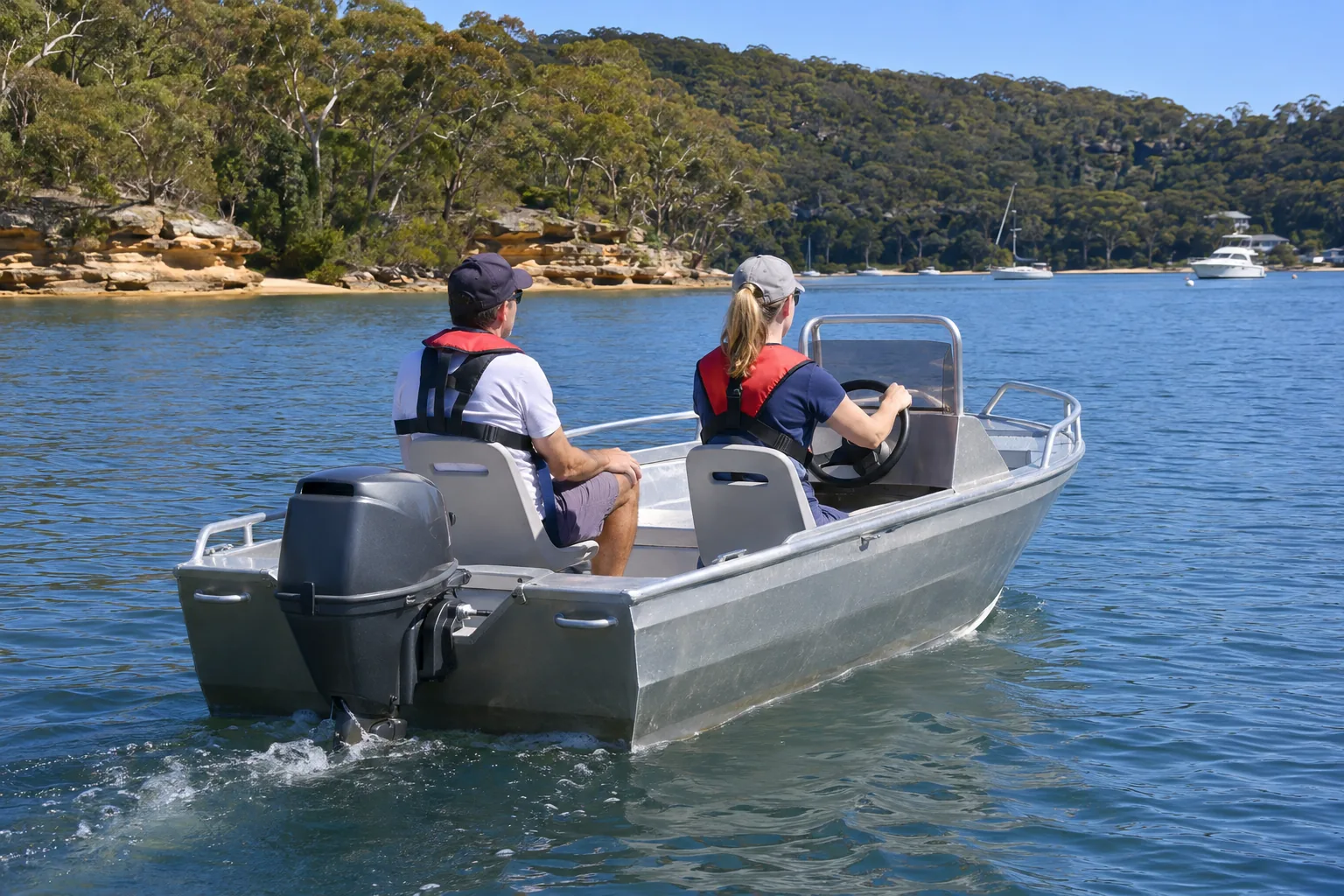
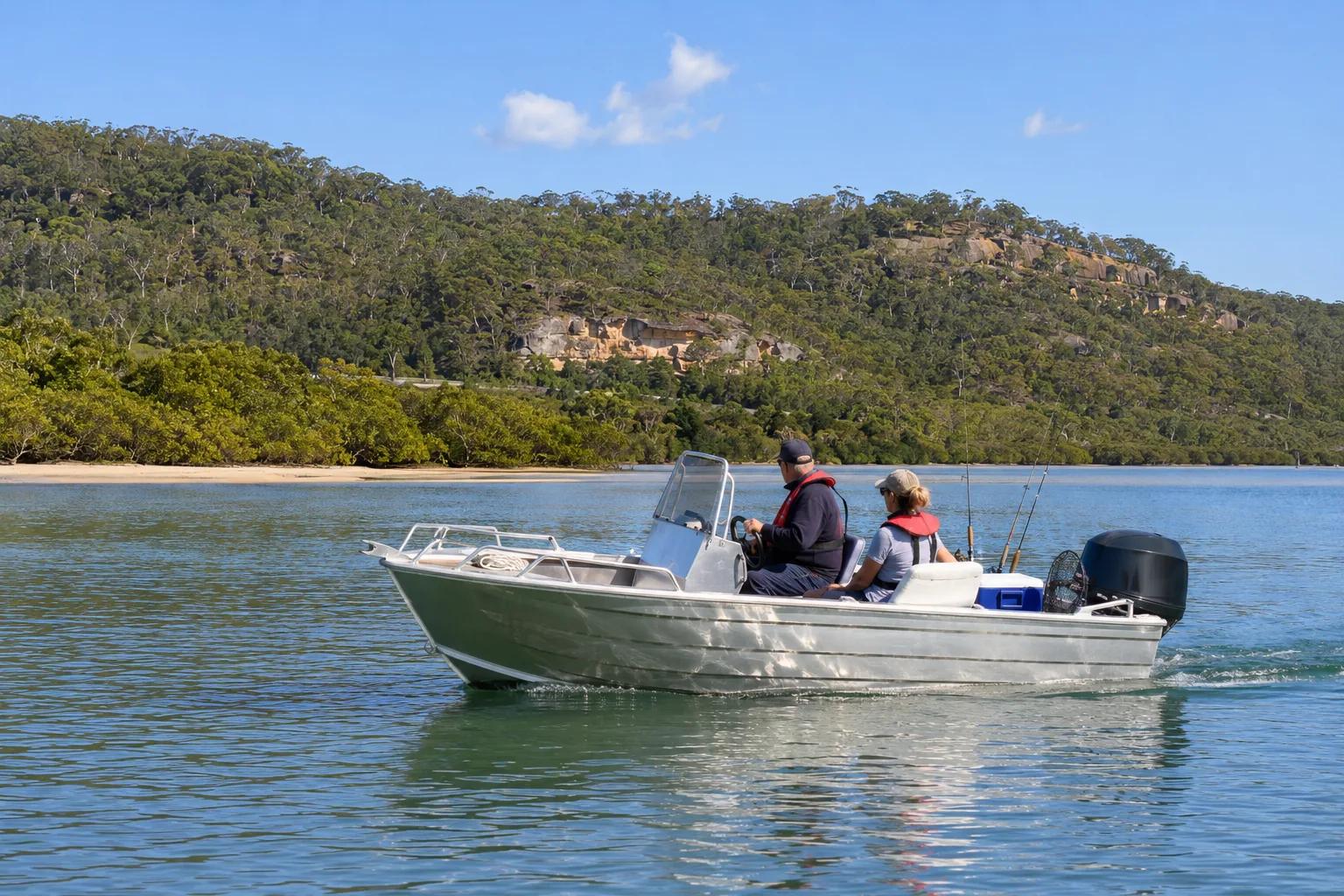
You are an adult without a boat licence. While learning in a runabout on Pittwater, you want to increase from 8 to 12 knots. Your licensed friend is beside you. What should you do?
Key points
- Know your boat and your roleThe skipper is in charge; the driver is at the controls.
- Facing the bow, port is left and starboard is right; the stern is behind you.
- A sailing boat using its engine is a powered vessel. Drifting still counts as underway.
- Transport for NSW regulates maritime safety. Learn the collision rules as well as the licensing rules.
- Ten knots is the NSW boat licence triggerFor an ordinary recreational powered boat, 10 knots or more needs a licence; PWC driving needs a PWC licence at any speed.
- You can apply from 12, with additional restrictions under 16. Identity, eyesight and health requirements apply. A current master or coxswain certificate of competency is an alternative driving authority.
- General boat test: 50 questions, at least 24/30 in A and 20/20 in B. Do not rely on the order: Handbook p. 15 and the webpage describe it differently; check the current TfNSW page.
- Practical route: at least 3 logged trips with an eligible skipper, or an ATP course including on-water training.
- Apply within 12 months of passing, with practical experience also within its 12-month window. Test success alone is not your licence.
- Under 16: extra care and extra limitsA licensed adult aboard does not remove the 20-knot maximum.
- Use the stricter supervision reading: a person aged 16 or over aboard at 10 knots or more, with a general boat or PWC licence for an ordinary boat, and a PWC licence for a PWC.
- Use the stricter night and towing reading: no driving between sunset and sunrise and no towing a person.
- The handbook and webpage conflict on these thresholds: check the current TfNSW page. Do not treat the cautious reading here as resolved legal wording.
- No races, displays, regattas or similar operations unless an authorised event exemption applies.
- Keep your licence current and handyCarry your current licence when driving at 10 knots or more, or when driving a PWC.
- Stop and show it when an authorised officer asks. Borrowing or hiring does not remove the requirement.
- Renew for 1, 3, 5 or 10 years. If not renewed within 5 years of expiry, the full licensing process applies again.
- Notify changed personal details within 14 days. Moving to NSW or using its waterways beyond 3 consecutive months requires a NSW licence.
- Registration belongs to the boatRegistration covers the boat. An ordinary powered boat's driver needs a licence at 10 knots or more; PWC have their own licence requirement.
- Register powerboats and sailing boats with engines rated at least 4.0 kW, or hull length at least 5.5 metres, plus vessels needing a mooring licence or marina berth, and all PWC.
- Transfer registration within 14 days after buying or selling. Registration lasts 12 months; renew before use after expiry. Moving an interstate-registered boat to NSW also requires NSW registration.
- Display clear registration numbers above the waterline: both hull sides, or the transom for a sailing boat. Minimum height: powerboats 150 mm; sailing boats and PWC 100 mm. Check the required safety or PWC behaviour label too.
- Commercial use brings AMSA requirements. When hiring, receive a safety briefing and follow the hire conditions as well as NSW rules.
- Cross a border? Check the local rulesThe NSW 10-knot trigger is not an Australia-wide licensing rule.
- Victoria generally requires a marine licence for powered recreational operation, with specific exemptions. Its marine test pass is 26/30; a PWC endorsement starts at 16 and needs 13/15 on the extra test.
- For driving alone, Queensland requires an RMDL above 4.5 kW, from age 16. BoatSafe includes theory and practical competency; its theory assessment is 50 questions, 45 minutes, all correct.
- Queensland's supervised-operation permission does not remove NSW's own driver-licence requirement. Queensland towing a person requires the operator's own licence.
Check what you have read
On a Hawkesbury River trip, the person in charge hands the wheel to another licensed adult. Who is the skipper?
Worked case: Your first steps towards a Pittwater picnic
You are 34 and want to take your family out on Pittwater in a registered runabout. You have never driven a boat. Your friend, aged 38, has a current NSW boat licence held for eight years and offers to help you learn. Later, you hope to drive at 18 knots where conditions and local limits allow.
Before you read the solution: what would you do?
True or false?
Decide each statement before you see the answer.
For an ordinary recreational powered boat, 10 knots or more needs a licence; PWC driving needs a PWC licence at any speed.
Any total of 44 out of 50 passes the knowledge test.
My ATP theory certificate replaces all practical experience and is my licence.
The NSW 10-knot trigger is not an Australia-wide licensing rule.
A general boat licence covers a jet ski if I go slowly.
Carry your current licence when driving at 10 knots or more, or when driving a PWC.
The hire company registered the boat, so I do not need a licence.
Ten knots is still below the licence threshold.
Registration covers the boat. An ordinary powered boat's driver needs a licence at 10 knots or more; PWC have their own licence requirement.
A licensed adult aboard does not remove the 20-knot maximum.
The skipper is in charge; the driver is at the controls.
An adult aboard removes all the restrictions on my under-16 licence.
Exercise: Build your licence plan
You are an adult preparing for a general boat licence. Work through the trip record, test result and application.
Step by step
Using the logbook route, what is the minimum number of practical trips?
Show the solution
At least 3 trips with an eligible experienced skipper, in a powered vessel operating under power, excluding PWC (Handbook p. 14).
Your result is A: 28/30 and B: 19/20. What happens?
Show the solution
Both section requirements apply. A high A score cannot make up for a wrong answer in B.
Put these milestones in a sensible order. Practical experience and the test can be completed in either order before applying.
- 1Drive at 10 knots or more only once you hold the appropriate licence
- 2Prepare with handbook study and practical learning
- 3Pass the test and collect the required practical and identity evidence
- 4Apply to Service NSW within the applicable 12-month windows
Show the solution
Study and practical learning prepare you for licensing. Passing the test alone does not authorise driving at 10 knots or more.
Now on your own
Now your adult friend wants to borrow a runabout and later try a PWC. Decide without the hints.
Your friend has no boat licence. You have one and sit beside them. May they drive the runabout at 12 knots in NSW?
They later pass with A: 24/30 and B: 20/20. Have they met both knowledge-test pass requirements?
After passing the knowledge test, within how many months must they apply for the licence?
They now hold only a general boat licence. Can they drive a PWC slowly?
Check: 10 questions
Questions from this subject, explained after each answer.
Free: lesson + 10 questions · Exam Pass: all 32 questions, unlimited practice tests, your mistakes retrained
The full explanation and the lessons for each programme item
Topic 1 of 6
Welcome aboard: the skipper, the boat and the rules
You do not need boating experience to start studying.
The Boating Handbook is your main NSW study resource. Transport for NSW is the state's maritime safety regulator. Its work includes boating education, enforcement and navigation aids. The collision rules, or COLREGs, apply through NSW law. The handbook explains the main rules; current legislation takes priority if they differ (Boating Handbook, pp. 6–8).
The skipper is the person in charge, even when someone else is driving. A vessel includes powered boats, sailing boats, paddlecraft and rowing boats. A sailing boat using its engine counts as a powered vessel. A PWC, such as a jet ski, is a waterjet-powered craft with a fully enclosed hull that you ride on rather than sit inside. A tender carries people or goods between its parent vessel and the shore or another vessel; the handbook definition requires it to be less than 7.5 metres long and operate no further than 1 nautical mile from its parent vessel (pp. 9–11).
For recreational driving in NSW, you need a general boat driving licence at 10 knots or more, including when a sailing boat uses its engine. Below 10 knots, an ordinary powered boat does not require that licence. A PWC needs a PWC licence at any speed. A current certificate of competency as a master or coxswain is an alternative authority for general boat and PWC driving. Being below the licence threshold never removes your safety responsibilities (pp. 13, 18, 22).
- Facing the bow: port is left and starboard is right. The stern is the back; the transom forms its rear surface.
- Beam is the boat's widest part. Draft is the distance from the waterline to its lowest part. Freeboard is the vertical distance from the waterline to the top of the hull.
- The hull is the boat's main body; the gunwale is the top edge of its sides. Water collects in the bilge, inside the bottom of the hull. Tie lines to a cleat, a fitting designed for ropes.
- One knot is one nautical mile per hour. A drifting boat is still underway: stopping the engine does not make it anchored.
- Planing means rising and skimming on top of the water as speed increases. The handbook's safety advice is to always wear a lifejacket, check the weather, keep a lookout and choose a safe speed; know your limits and avoid alcohol and illegal drugs (p. 6).
- Giving way means keeping out of another vessel's path, by changing speed or course as needed.
Topic 2 of 6
Getting licensed: the knowledge test and practical experience
You can apply from age 12.
You must meet eyesight standards and declare medical conditions or disabilities that could affect safe driving. Bring the accepted identity documents. For applicants aged 16 or over, the identity route is an accepted stand-alone document, or one primary plus one secondary document. Under 16, your parent or legal guardian must attend the test and application, provide identity evidence and give written consent. Check the current TfNSW identity list before attending (Boating Handbook, pp. 13–16; TfNSW proof-of-identity page).
The general boat knowledge test has 50 multiple-choice questions. The current TfNSW webpage calls the sections A and B: you need at least 24 of 30 in Section A and all 20 in Section B. Both requirements apply. Handbook p. 15 describes the 20 must-be-right questions first, whereas the webpage lists A before B. Do not rely on an assumed order; check the current TfNSW page before your test.
Book at a Service NSW Centre, or take the test through an Authorised Training Provider (ATP). The general boat test at a service centre costs AUD 44 per attempt under the fees effective 1 July 2026; the licence fee is separate. ATPs set their own course fees. The free practice quiz on the Service NSW site uses questions from the actual test pool. The questions in this course are our own study questions. After passing, you have 12 months to apply for your licence.
You also need practical experience: either at least 3 logged trips in a powered boat operating under power, excluding PWC, with an eligible experienced skipper, or an ATP course including on-water training. A theory-only ATP course still needs a practical logbook. Demonstrate the logbook skills, including trip preparation, boat handling, navigation, anchoring, safety equipment and emergency response; both you and the skipper verify the record. Apply within 12 months of the practical experience too (p. 14). For the logbook route, choose a skipper over 18 with a current NSW or interstate boat licence held for at least 3 consecutive years at some stage, or a certificate of competency. The handbook says 18 or over, while the practical-experience webpage says over 18: use the stricter reading and check the current TfNSW page if your skipper is exactly 18. Stay below 10 knots while unlicensed; the practical webpage's instruction not to exceed 10 knots does not authorise driving at exactly 10 without a licence. Carry the required safety equipment and, for night trips, the required lights.
Passing a test or finishing an ATP course is a step towards your licence. Lodge your application with Service NSW with identity, practical and test evidence, and payment. To get a PWC licence, complete the general boat qualification first or obtain both together. The additional PWC test requires at least 12 correct answers out of 15. A PWC licence also covers general boat driving. A general-to-PWC upgrade does not require another practical logbook; the PWC application needs 2 passport-acceptable colour photos (pp. 15–20; current licensing guidance).
- Example: 30/30 in A and 19/20 in B is a fail, despite a total of 49/50.
- You can sit the knowledge test before completing your practical experience; you need both for the licence application.
- A free interpreter can be arranged on 13 14 50. For special needs or learning difficulties, call 13 77 88 before booking.
- If you fail, a same-day re-sit may be available; otherwise book again. Pay for each attempt. Cheating prevents a re-sit for 6 weeks (p. 16).
Topic 3 of 6
Your licence has limits
Under-16 licence holders have extra restrictions.
Do not exceed 20 knots. For supervision, use the stricter reading: at 10 knots or more, have a person aged 16 or over aboard with a general boat or PWC licence for an ordinary boat, and a PWC licence for a PWC. For night use and towing, use the stricter reading too: do not drive between sunset and sunrise and do not tow a person. The current licensing page and Handbook p. 20 differ on these thresholds, so check the current TfNSW page before planning either activity. These are cautious study instructions while the wording conflicts, rather than a claim that the handbook prohibits all slow-speed night boating or towing.
Under-16 drivers must also stay out of races, displays, regattas, exhibitions and similar operations unless an authorised event exemption applies. NSW's under-16 restrictions apply to visiting interstate and overseas licence holders too (p. 20).
Licences can run for 1, 3, 5 or 10 years. Renew before you drive after expiry. If it has not been renewed within 5 years of expiry, you must complete the full licensing process again. Tell Transport for NSW within 14 days if your personal details change (p. 21).
Visitors with an appropriate interstate or overseas licence must follow NSW operating rules. You need a NSW licence if you move to NSW, already live here or use its waterways for longer than 3 consecutive months. An interstate general boat licence that is current or expired less than 5 years ago can transfer without another knowledge test or practical evidence. PWC transfers have separate conditions. Most overseas qualifications cannot transfer, though recognised New Zealand exceptions exist. Check your exact qualification with TfNSW rather than assuming it transfers (p. 21 and the current moving-to-NSW guidance).
- Carry your current licence when driving an ordinary powered boat at 10 knots or more, or a PWC at any speed. Stop and show it when an authorised officer asks (p. 22).
- Borrowing a boat does not change the licence requirement. A licensed passenger does not give an unlicensed adult permission to drive at 10 knots or more.
- An owner must be able to identify anyone who drives their powered vessel, even if the owner is not aboard.
Topic 4 of 6
Buying, registering and hiring a boat
Your licence is about you; registration is about the vessel.
NSW registration is required for powerboats and sailing boats with an engine rated at 4.0 kW or more; powerboats and sailing boats 5.5 metres or longer, with or without an engine; vessels needing a mooring licence or marina berth; and all PWC. You must be at least 16 to register a vessel (Boating Handbook, p. 23).
Registration involves proof of purchase and identity, the application and fee, and the required Hull Identification Number (HIN) and Australian Builders Plate (ABP) documentation. The HIN identifies the hull; its plate must be permanently attached and clearly displayed. The ABP gives safety information such as maximum people, load and engine rating; most powerboats built after 1 July 2006 must have one. Display it permanently where the driver can see it. Modifying a boat may invalidate its ABP. Registration lasts 12 months; do not drive after it expires until renewed (pp. 23–26).
Display registration numbers on both sides of the hull, well above the normal waterline, in clear, solid numerals and upper-case letters contrasting with the hull. Sailing boats may instead use the transom. Minimum character height is 150 mm for powerboats and 100 mm for sailing boats and PWC. Powered vessels other than sailing boats with an engine and PWC must display a safety label showing capacity and load where everyone aboard can see it. PWC must display a behaviour label clearly visible to the driver (pp. 25–26).
When buying or selling a registered vessel, transfer registration within 14 days to avoid a late fee. The buyer pays the transfer fee and, if registration has expired, the renewal fee. The seller remains responsible until the transfer is complete. An interstate or overseas registered vessel must be registered in NSW if you move here or use NSW waterways for longer than 3 consecutive months (p. 27).
Do not assume recreational registration and a recreational licence cover commercial use. AMSA regulates domestic commercial vessels under a national system. A certificate of survey addresses vessel standards; a certificate of operation covers operation; a certificate of competency qualifies the person for their role. Specific exemptions may apply. Hire-and-drive vessels must meet commercial safety standards, even though the customer's trip is recreational (pp. 28–31).
When you hire, the company must give you safety instructions before departure. Ask about controls, safety equipment, lifejackets, capacity, navigation and emergencies. You still need a boat licence to drive a hired powered boat at 10 knots or more. To hire and drive a PWC, you must ordinarily have a PWC licence and be at least 16; specific hire-tour exemptions exist. Hire companies may set extra conditions. Hiring does not remove the NSW rules (p. 31).
- A low-speed boat can still need registration: engine power and length are separate registration triggers. Third-party insurance is recommended for damage to someone else's property (p. 23).
- Know the distinction: HIN identifies the boat; ABP describes its capability and capacity; your driving licence qualifies the driver.
Topic 5 of 6
In Victoria and Queensland
These are other states' rules.
In Victoria, a marine licence is generally needed to operate a powered recreational vessel regardless of speed. A narrow exemption covers qualifying electric kayaks and canoes with no more than 40 lb thrust (750 W), operated at no more than 5 knots, tapered at both ends and with no fixed or removable transom. The general marine licence starts at 16. A restricted licence for ages 12–15 permits daylight operation below 10 knots, with no towing of a person, vessel or object; it becomes a general marine licence at 16.
Victoria's marine test requires 26 correct answers out of 30, through an accredited provider or VicRoads. A PWC endorsement requires a marine licence, a minimum age of 16 and at least 13 correct answers in an additional 15-question test. Restricted licence holders cannot obtain the PWC endorsement.
In Queensland, a recreational marine driver licence (RMDL) is required for a recreational boat with engine power greater than 4.5 kW. Minimum age is 16 and the licence does not expire. The BoatSafe route includes theory training, a 50-question multiple-choice assessment with 45 minutes allowed and all answers correct, and practical competency. The statement of competency is valid for 6 months; take it with the application, identity and fee to the licensing service. Recognised interstate qualifications provide another route.
Queensland PWC drivers need both a recreational marine licence and a personal watercraft licence, with BoatSafe PWC theory and practical assessment. An unlicensed person may operate under a validly licensed supervisor aboard who can take immediate control, but towing a person requires the operator's own licence. Do not import that supervised-driving permission, the 4.5 kW trigger or the 45-minute test limit into NSW.
- NSW's ordinary recreational boat driving trigger is speed: 10 knots or more. Victoria generally uses powered operation; Queensland uses engine power greater than 4.5 kW.
- Check the destination state's current requirements before travelling. Follow its operating rules as well as any conditions on your licence.
Topic 6 of 6
Practise and go further
The best places to practise this subject. When you finish, one tap brings you back to the course.
- Get to know the parts of a boatLesson
- How the collision rules applyLesson
- Recreational boating rulesLesson
- Safety equipment for your practical learningLesson
- Know the boat before departureLesson
All lessons by programme item
- H1 Staying safe on NSW waterways: marine safety rules, Transport for NSW, types and parts of vessels, maritime terms (Handbook ch. 1)
- H2a Getting a general boat licence and a PWC licence: the knowledge test, practical experience, age and identity (Handbook pp. 13–19)
- H2b Licence restrictions under 16, renewing, interstate and overseas licences, driving without a licence (Handbook pp. 20–22)
- H2c Registering, transferring, commercial use and hiring a vessel (Handbook pp. 23–31)
- VQ1 Victoria and Queensland: when you need a licence and how the test differs
Sources
- TfNSW: licence and test fees effective 1 July 2026 · checked
- TfNSW: practical boating experience and logbook requirements · checked
- TfNSW: proof of identity for maritime transactions · checked
- Service NSW: book a knowledge test; practical evidence and the 12-month application window · checked
- Service NSW: official boating practice quiz; questions from the actual test pool · checked
- TfNSW: moving an interstate or overseas boat or PWC licence to NSW · checked
- TfNSW Boating Handbook 2026 (05/26), staying safe and licences and registration, pp. 6–31 · checked
- TfNSW: get a boat or PWC licence; compare under-16 restrictions with Handbook p. 20 · checked
- TfNSW: knowledge and practice tests; compare the test description with Handbook pp. 15–16 · checked
- Safe Transport Victoria: marine licensing and registration, including restricted licences and PWC endorsements · checked
- Queensland Government: recreational marine licences, BoatSafe and supervised operation · checked
- Safe Transport Victoria Boating Safety Handbook 2024, p. 136: marine and PWC test pass marks · checked
- VicRoads: marine licence eligibility, including the minimum age of 12 · checked
- Maritime Safety Queensland: BoatSafe theory and practical assessment · checked
Checked against the official sources on .