Decide
Four situations at sea. Decide first, then read why.
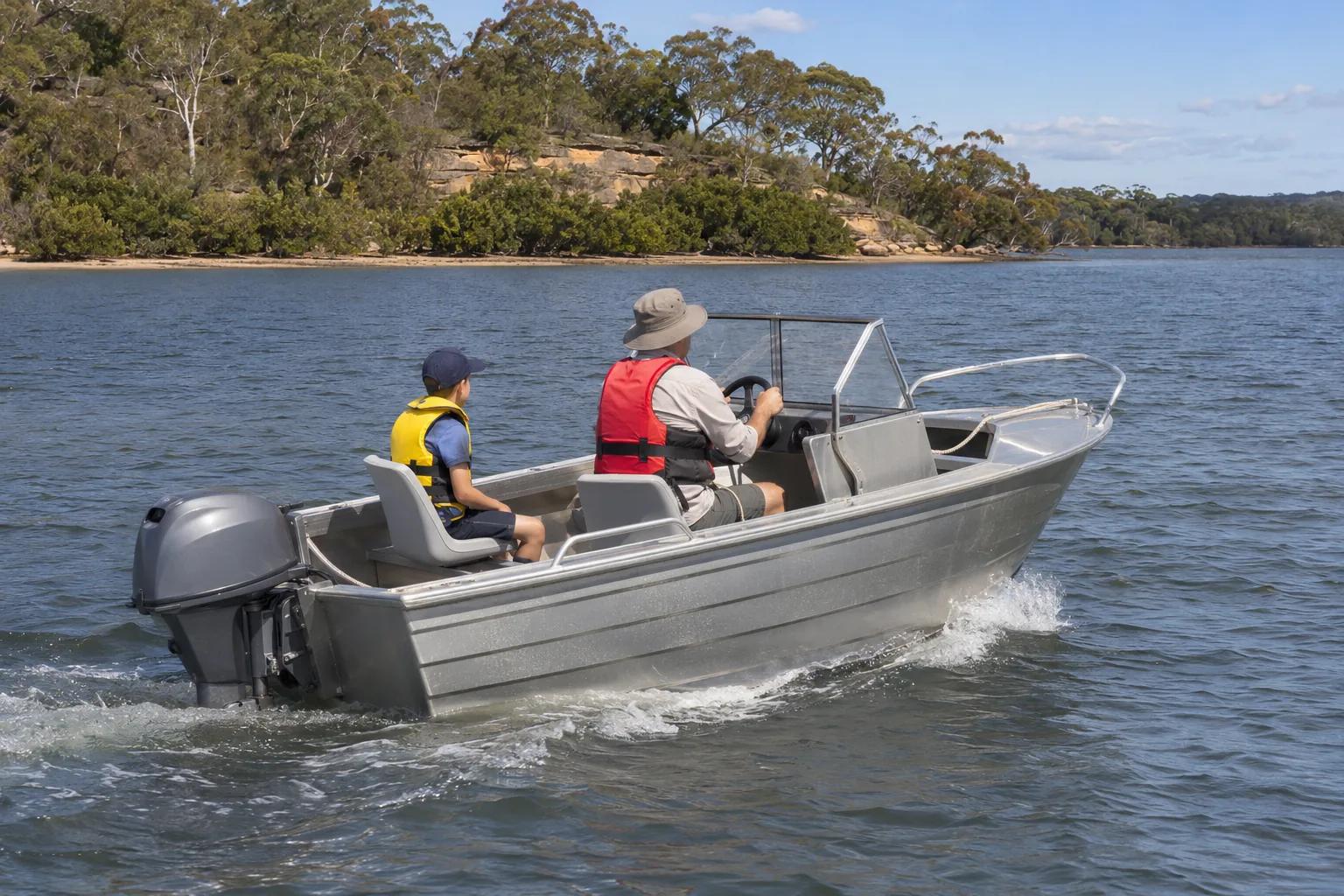
You are the only adult in a 4.3 m runabout on enclosed waters inside Lake Macquarie. Your nine-year-old is aboard. It is daylight. What must you wear?
Key points
- Powerboats and sailing boats under 4.8 mEnclosed waters: wear when alone or at night; alpine and open waters: wear at all times.
- Enclosed and alpine minimum: Level 50S or above. Ordinary powerboats on open waters: Level 100 or above.
- Alone includes one adult with only children under 12. Night is sunset to sunrise.
- At exactly 4.8 m, follow the stricter small-boat wear triggers and check the current TfNSW page: its wording differs from the handbook.
- Bars, towing and the skipper's callPut the right jacket on before you reach the risk.
- Powerboats 4.8 m or longer: everyone wears Level 100 or above crossing a coastal bar.
- Everyone on a PWC and anyone being towed: Level 50S or above at all times; inflatables are not recommended.
- Wear when the skipper directs you, whatever other wear rules apply.
- One suitable jacket for each personCarry the right size and level, in good condition and within easy reach.
- Level 50 and 50S support you but do not automatically turn you face up.
- Level 100 helps turn you face up; it is not intended for rough conditions. Level 150 is intended for offshore and rough weather.
- Old Type 1/2/3 correspond to Level 100+/50/50S; the handbook permits well-maintained old types.
- Mark hidden storage with a red-on-white 'Lifejackets' sign.
- An inflatable needs checks and servicingCheck before wearing and service on schedule.
- Check wear, cylinder condition and tightness, any automatic cartridge's expiry and tightness, and the free pull cord.
- Service annually or in accordance with the manufacturer's instructions; record the date inside and keep evidence.
- Follow the model's instructions for permitted self-servicing. A failed check means do not use it; use an accredited service agent.
- After use, remove an automatic cartridge before rinsing, dry and reconnect before storage. Store out of sun and away from fuel; never use a jacket as a cushion.
- Under 12: wear early and fit properlyUnder 4.8 m: wear at all times; 4.8 m to less than 8 m: wear in open areas underway.
- Children's minimum: Level 50S or above on enclosed waters, Level 100 or above on open waters.
- Use an approved jacket that cannot slip off. A crotch strap is recommended; inflatables are not recommended for under-12s.
- Use the stricter reading at exactly 4.8 m: under-12s wear at all times; at exactly 8 m: in open areas underway. Check the current TfNSW page.
- Other wear rules still apply. From age 12, follow adult rules, with wearing at all times still strongly recommended.
- Babies and petsA baby's jacket must fit now; a dog's jacket needs its own fit too.
- Babies need an approved jacket suited to their weight, snugly fitted and with a crotch strap.
- If no jacket fits, follow the stricter handbook restriction: do not carry the baby under 4.8 m, or in open areas from 4.8 m to less than 8 m underway. Apply the boundary precautions above and check the current TfNSW page; its infant advice differs.
- NSW has no pet wear requirement. Consider a well-fitting dog jacket with a grab handle.
- Victoria uses different rulesCheck the destination state's wear rules and waterway categories.
- Victoria: wear in open areas underway on powered boats up to and including 4.8 m; boats over 4.8 m and under 12 m also require wear at heightened risk. At exactly 12 m, wear at heightened risk and check the current Safe Transport Victoria page because its boundary differs from the handbook.
- Victorian ordinary powerboats: Level 100 or above on enclosed and coastal waters; Level 50S or above inland.
- Victorian under-12s wear in open areas underway; coastal and enclosed minimum is Level 100 or above.
- For Queensland, check current Maritime Safety Queensland guidance before boating there.
Check what you have read
You take a 4.2 m runabout out alone on enclosed waters at midday. What must you do about a lifejacket?
Worked case: One adult and a child on Lake Macquarie
You are taking your nine-year-old out in a 4.3 m open runabout on enclosed waters inside Lake Macquarie. It is a calm afternoon. You have a fitted foam Level 100 jacket for the child and an approved Level 150 inflatable for yourself. Your inflatable's service record is current.
Before you read the solution: what would you do?
True or false?
Decide each statement before you see the answer.
The boat is exactly 4.8 m, so the website and handbook must give the same answer.
The service date is current, so I can skip checking my inflatable.
Put the right jacket on before you reach the risk.
Check before wearing and service on schedule.
It is not completely dark yet, so the night rule has not started.
Carry the right size and level, in good condition and within easy reach.
A baby's jacket must fit now; a dog's jacket needs its own fit too.
Check the destination state's wear rules and waterway categories.
A Level 50S will turn an unconscious person face up.
Enclosed waters: wear when alone or at night; alpine and open waters: wear at all times.
My child is aboard, so I am not boating alone.
The child can grow into an adult jacket, or use a swim vest.
Exercise: Make a lifejacket plan before you leave
You have a 4.4 m powerboat, two adults and a ten-year-old. You will stay on enclosed waters in Pittwater and return after sunset. Choose your preparations.
Step by step
How many approved, correctly sized lifejackets must this boat carry for these people?
Show the solution
One for each person: three. A jacket being worn counts towards that person's equipment (Handbook, p. 39).
Who must wear a lifejacket on this boat before sunset, assuming no other trigger or skipper's direction?
Show the solution
The under-12 child must wear one at all times on a boat under 4.8 m. With two adults aboard, the alone trigger does not apply (pp. 34, 42).
You are still on enclosed waters at sunset. What is now required?
Show the solution
For a powerboat under 4.8 m, night is sunset to sunrise. Everyone must wear Level 50S or above on enclosed waters (p. 34).
An adult's inflatable has a pierced CO2 cylinder. What do you do before departure?
Show the solution
An unpierced, firmly fitted cylinder is part of the pre-wear check. A faulty jacket cannot be relied on as that person's ready-to-use lifejacket (pp. 39, 45–47).
Now on your own
Now plan a separate trip: a 6 m powerboat with two adults and a seven-year-old will cross the Ballina coastal bar in daylight. The child will sit in the open cockpit.
What must the adults wear for the bar crossing?
What does the child's open-cockpit position mean while underway?
Which jacket is the recommended choice for the child?
Before reaching the bar, the skipper tells everyone to put their jackets on. When do you comply?
Check: 10 questions
Questions from this subject, explained after each answer.
Free: lesson + 10 questions · Exam Pass: all 28 questions, unlimited practice tests, your mistakes retrained
The full explanation and the lessons for each programme item
Topic 1 of 6
Start with your boat, your waters and your crew
Wearing a lifejacket at all times is recommended.
To work out when it is compulsory, check the vessel type and length, the waters, the time of day and who is aboard. You must also wear one whenever the skipper directs you to. Breakdown, cold water, severe weather, non-swimmers or a risk of swamping are reasons for the skipper to act early (Boating Handbook, p. 33).
Enclosed waters include rivers, lakes and enclosed coastal bays and harbours, such as Lake Macquarie and Pittwater. Open waters include coastal and ocean waters outside enclosed waters. Alpine waters are a particular enclosed-water category, with stricter wear rules: check the handbook list rather than judging by the weather or the name of a lake (pp. 129, 137–138).
On powerboats and sailing boats under 4.8 m, everyone must wear Level 50S or above on enclosed waters when alone or at night, between sunset and sunrise. An adult with only children aged under 12 counts as alone. On alpine waters, everyone on these small boats must wear Level 50S or above at all times. On open waters and when crossing coastal bars, everyone must wear Level 100 or above at all times; off-the-beach sailing boats have a Level 50S exception (p. 34).
On powerboats and sailing boats 4.8 m or longer, everyone must wear Level 100 or above when crossing a coastal bar. Child rules and the skipper's direction still apply. Do not treat boat length as a reason to ignore those requirements.
Boundary note: the May 2026 handbook says 'under 4.8 m' and, for children, '4.8 m to less than 8 m'. TfNSW webpages use 'up to' wording at these boundaries. Use the stricter reading while you check the current TfNSW page: at exactly 4.8 m, follow the small-boat wear triggers and have under-12s wear at all times; at exactly 8 m, have under-12s wear in open areas while underway. Use the required level for the waters and activity.
- PWC: everyone aboard, including the observer, and anyone being towed must wear Level 50S or above at all times. People towed by any vessel, including wakesurfers, must also wear Level 50S or above (p. 34).
- Canoes and kayaks, including outrigger canoes: Level 50S or above when alone or at night on enclosed waters, and at all times on alpine or open waters and coastal bars (p. 36). The webpage also lists an enclosed-water outrigger exception. Follow the stricter handbook rule and check the current TfNSW page before relying on that exception.
- Sailboards and kiteboards more than 400 metres from shore: Level 50S or above when alone or at night on enclosed waters, and at all times on alpine or open waters and coastal bars (p. 35).
- Surf skis: wearing at all times is recommended. Under 4.8 m, follow the small-powerboat rules; the handbook exempts surf club members involved in lifesaving, training or competition unless the organiser requires wear. At exactly 4.8 m, follow the stricter webpage reading of the small-boat rules and check the current TfNSW page. Lifejackets are recommended for stand-up paddleboard (SUP) users; if wearing one is not possible, a leg rope is recommended (p. 37).
- Ordinary rowing boats: Level 50S or above when alone or at night on enclosed waters, always on alpine waters, and Level 100 or above on open waters and coastal bars. People in rowing racing shells do not have to wear on enclosed waters under their specific rule; Level 50S or above is recommended outside organised events and activities. Other applicable wear rules still apply (p. 38).
Topic 2 of 6
Carry the right level and make it easy to reach
A recreational boat must carry an approved lifejacket for each person, even when wearing one is not compulsory.
Each must be the right size and level, in good condition and easy to find. Store them for quick access. If the storage place is not easy to see, mark it 'Lifejackets' in red lettering on a white background (Boating Handbook, p. 39).
The former Type 1 corresponds to Level 100 and above, Type 2 to Level 50, and Type 3 to Level 50S. The handbook still permits old types in good condition and well maintained, but recommends upgrading to newer jackets. All jackets must meet the approved standards (pp. 39–40).
Level 50 supports you but does not automatically turn you face up. It is intended for swimmers with the bank, shore or help close by, and has high-visibility colours. Level 50S gives similar support but comes in a wider range of colours and styles. Neither should be treated as a face-up turning jacket (p. 40).
Level 100 helps turn you face up. It is intended for use with the shore in sight, rather than rough conditions. Level 150 is intended for offshore and rough weather and helps turn an unconscious wearer face up. Choose for the actual conditions as well as the legal minimum. Levels 100 and above can use foam or an inflatable bladder. Level 275 is intended for offshore and rough weather when clothing could trap air and prevent turning, or heavy items demand extra buoyancy; it helps turn and keep the wearer face up with mouth and nose above water (pp. 40–41).
- A higher level does not fix a poor fit: fasten the jacket properly and check that it cannot slip off.
- Manual inflatables need someone able to find and pull the tab; they are not recommended for non-swimmers.
- Inflatables are not recommended for under-12s, PWC drivers or passengers, or anyone being towed. Show passengers how their jackets work (p. 41).
Topic 3 of 6
Look after it before you need it
Check for damage, rinse off salt after use and store lifejackets dry, ventilated and out of sunlight.
Keep them away from oil and fuel. Do not use them as cushions or fenders, and remove new jackets from their plastic wrapping before storage (Boating Handbook, p. 44).
Service an inflatable once a year, or in accordance with the manufacturer's instructions. Record the service date inside the jacket and keep receipts or certificates. You must show the service record if a TfNSW authorised officer or police asks. Self-servicing is only an option where the manufacturer's instructions allow it; follow the instructions for that model (pp. 44–47).
Before wearing an inflatable, inspect for wear. Check that the CO2 cylinder is unpierced and hand tight, any automatic cartridge is hand tight and in date, and the pull cord is free. A quick check does not replace the scheduled service. If the bladder loses pressure during the prescribed overnight check, or another part fails inspection, do not use it: take it to an accredited service agent (pp. 45–47).
- Know whether your jacket inflates manually by pulling a tab or automatically on contact with water; spray can activate an automatic jacket. After use, remove the automatic cartridge before rinsing with fresh water, dry the jacket and reconnect the cartridge before storing (p. 45).
- For permitted self-servicing, check fabric, seams, buckles, fastenings and straps; inflate the bladder through its oral tube and leave it overnight to check for leaks. Deflate with the inverted tube cap, never by inserting another object into the valve (p. 46).
- Remove and inspect the CO2 cylinder for rust, corrosion or piercing. Weigh it: the handbook says its weight should match the marked minimum gross weight or be within 2 grams. Check the pull cord and firing pin, and that automatic components are armed and in date. Follow the model instructions for replacements and hand-tight refitting; take failed inspections to an accredited service agent (pp. 46–47).
- Repack exactly as the manufacturer directs, with the pull cord accessible.
- Foam jackets do not need inflatable servicing, but still need inspection and care (p. 41).
Topic 4 of 6
Children need their own fit; dogs need a separate plan
Children under 12 must wear a lifejacket at all times on vessels under 4.8 m. On vessels 4.8 m to less than 8 m, they must wear one in open areas while underway.
Open areas include open decks and cockpits; a rigid cabin or securely enclosed space is treated differently. The whole of a canoe or kayak is an open area. Other wear rules still apply, including coastal bars and the skipper's direction (Boating Handbook, pp. 42–43). At exactly 4.8 m, use the stricter reading and have the child wear at all times; at exactly 8 m, have the child wear in open areas underway. Check the current TfNSW page because its boundary wording differs.
For children, the minimum is Level 50S or above on enclosed waters and Level 100 or above on open waters. Choose an approved jacket that fits securely so the child cannot slip out; a crotch strap is recommended. Inflatable jackets are not recommended for under-12s. A learn-to-swim vest is not a substitute for an approved lifejacket. From age 12, the adult wear rules apply, though children are strongly advised to wear one at all times.
A baby's approved jacket must suit their weight, fit snugly and include a crotch strap. If no approved jacket fits, do not carry the baby on a vessel under 4.8 m, or in the open area of a vessel 4.8 m to less than 8 m while underway. The children-and-lifejackets webpage instead discusses an adult holding an infant too small for a jacket. Follow the stricter handbook restriction, including the boundary precautions above, and check the current TfNSW page; holding a baby is not a substitute in those situations (p. 43).
- NSW has no rule requiring a dog or other pet to wear a lifejacket.
- A well-fitting dog lifejacket is worth considering. A grab handle can help you lift the dog from the water (p. 43).
Topic 5 of 6
In Victoria and Queensland
These are other states, with their own rules.
In Victoria, people in open areas of powered boats up to and including 4.8 m must wear lifejackets while underway. On powered boats over 4.8 m and under 12 m, people in open areas must also wear lifejackets while underway at heightened risk. Examples include boating alone, an ocean bar, restricted visibility, breakdown and specified weather warnings. At exactly 12 m, the live page includes the boat but the linked handbook uses a less-than-12 m limit: wear at heightened risk and check the current Safe Transport Victoria page. Check its full rules before a trip.
Victoria's ordinary powerboat minimum is Level 100 or above on coastal and enclosed waters, and Level 50S or above on inland waters. Under-12s must wear in open areas while underway; their coastal and enclosed-water minimum is Level 100 or above. Victoria's enclosed waters therefore have a different minimum from NSW enclosed waters. Use each state's waterway categories.
For Queensland, check Maritime Safety Queensland's current lifejacket guidance before boating there. This block does not set out Queensland lifejacket thresholds; do not assume either the NSW or Victorian rules apply there.
- NSW comparison: the small-powerboat table uses under 4.8 m and Level 50S or above on enclosed waters when alone or at night; child and skipper-direction rules are additional.
Topic 6 of 6
Practise and go further
The best places to practise this subject. When you finish, one tap brings you back to the course.
Sources
- TfNSW Boating Handbook 2026: wear rules, types, children and care, pp. 33–47; waterway definitions, pp. 129, 137–138 · checked
- NSW Government: when to wear a lifejacket — compare Handbook pp. 33–38 and the 4.8 m boundary · checked
- NSW Government: children and lifejackets — compare Handbook pp. 42–43 and length boundaries · checked
- Safe Transport Victoria: licensing and registration — open-area wear rules · checked
- Safe Transport Victoria: wear a lifejacket — Victorian wear rules and levels · checked
Checked against the official sources on .