
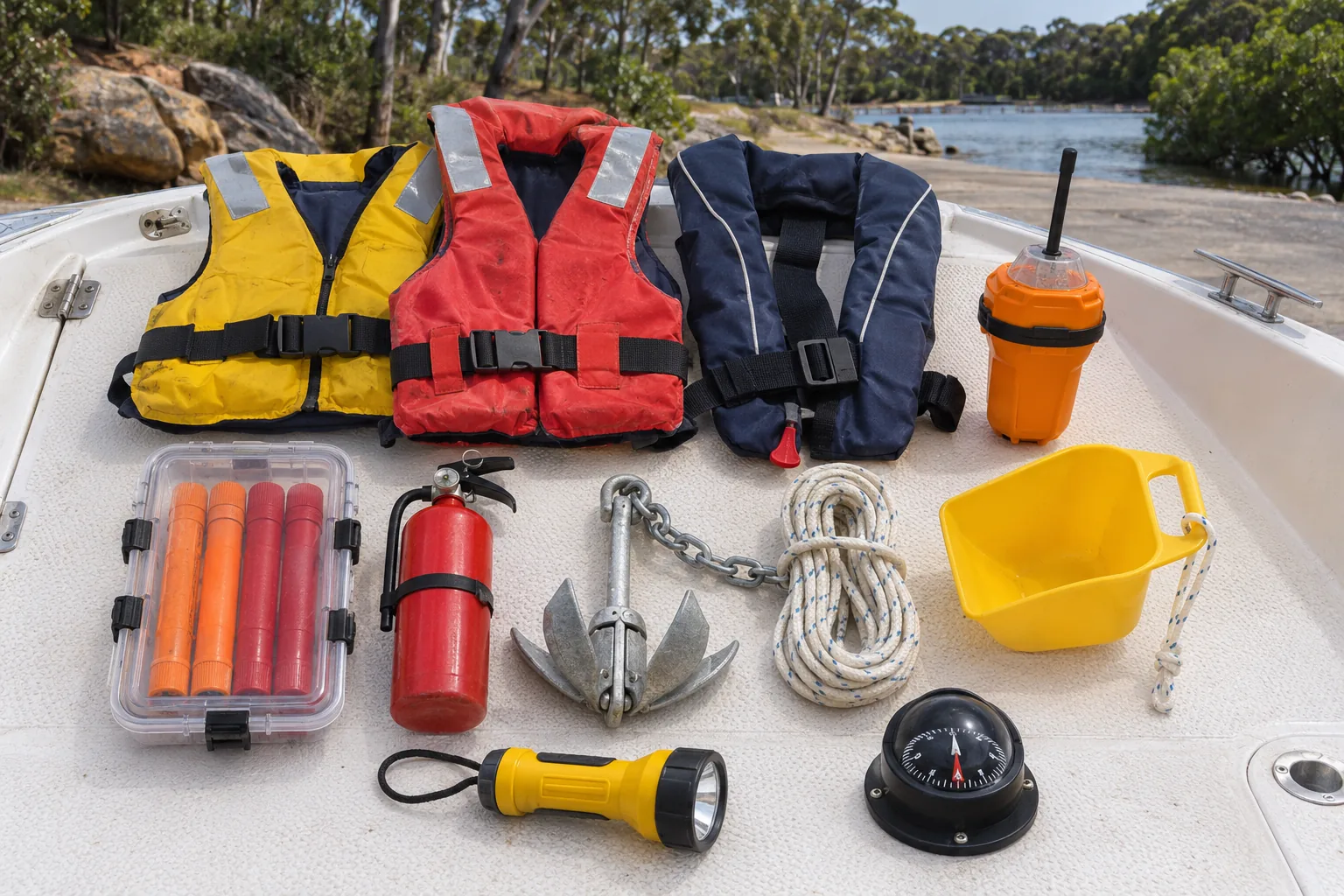
Decide
Four situations at sea. Decide first, then read why.
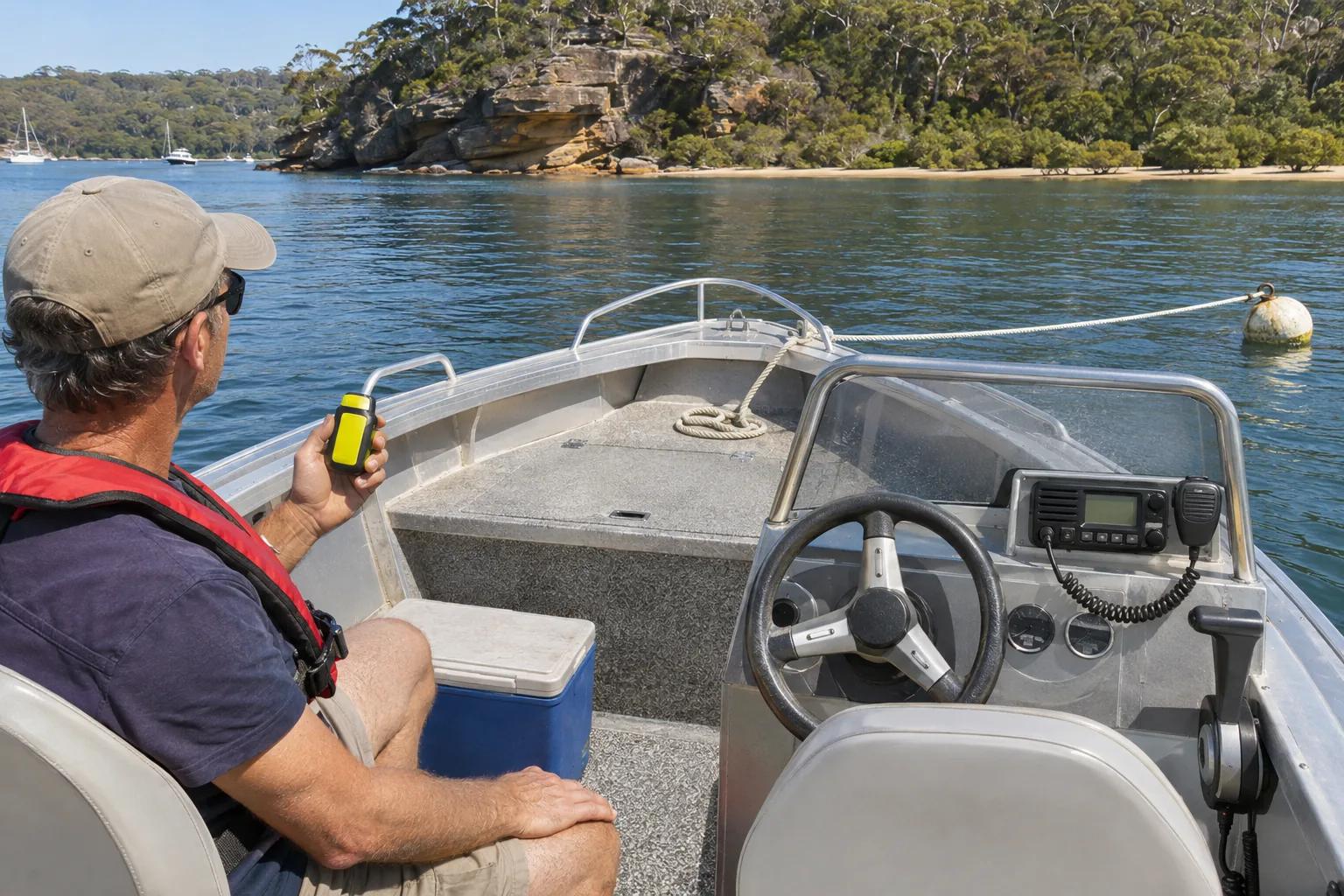
You are preparing to take a runabout 3 nautical miles offshore from Pittwater. It has a marine radio and you brought a PLB. Can the PLB replace the required EPIRB?
Key points
- The core kit on both watersThe main checklist applies to ordinary powerboats and sailing boats, with stated exceptions.
- One approved lifejacket per person; anchor and chain/line except on sailing boats up to 6 metres.
- Required extinguisher, sound signal and a working, floating waterproof torch; display the ordinary powerboat safety label where everyone can see it.
- Up to 6 metres: paddles or oars with rowlocks unless you have a second means of propulsion.
- Keep equipment serviceable, within expiry where applicable and easy to reach. Check the detailed list for your vessel.
- Remove water before it overwhelms youA bailer works by hand; pumps drain covered bilges and relevant underfloor compartments.
- A bailer or bucket needs a lanyard. Required pumps must drain each compartment and have strainers.
- The main checklist excludes airtight void spaces from its underfloor pump provision.
- Bailer exemptions differ between handbook and web checklist for some powerboats. Carry both a bailer or bucket with a lanyard and the required pump; check the current TfNSW page.
- Open waters add navigation and waterA short coastal trip still needs the open-water additions.
- Carry a chart for the area, printed or digital, and a fluid-filled magnetic compass.
- Download digital charts before departure. Satellite navigation does not replace the compass.
- Carry at least 2 litres of fresh drinking water per person.
- Enclosed waters include rivers, lakes and enclosed bays and harbours; calm weather does not turn coastal ocean waters into enclosed waters.
- Make a distress signal visibleOn open waters, carry two orange smoke flares, two red hand flares and a V sheet.
- Orange smoke: day. Red hand flares: day or night. All required flares must be within expiry.
- Keep flares accessible and dry, and make sure everyone knows how to use them.
- The orange-red V sheet has a black V and is at least 1.8 metres by 1.2 metres.
- Prepare for 2 nautical miles or moreUse the stricter open-water checklist threshold for both EPIRB and marine radio.
- At 2 nautical miles or more from shore: registered, in-date 406 MHz EPIRB plus marine radio.
- Descriptive official text says 'more than 2nm', while the checklist includes exactly 2. Carry both at exactly 2 and check the current TfNSW page.
- A PLB does not replace the EPIRB; a mobile phone does not replace the radio.
- Both are recommended closer to shore too. VHF is recommended over 27 MHz.
- Check the craft, not just its sizePWC, tenders and paddlecraft have specific equipment provisions.
- PWC: behaviour label visible from the steering position; wear a lifejacket at all times.
- A tender up to 3 metres needs the main equipment list anywhere on open waters or more than 200 metres from shore on enclosed waters.
- Tenders over 3 metres use the main list. A vessel more than 1 nautical mile from its parent is no longer classed as a tender.
- A canoe or kayak with an engine uses the main checklist on open waters. For rowing boats used as tenders, sources differ: use the main list and check the current TfNSW page. See pp. 59–62 for special craft.
- Add useful backupsRecommended extras help you deal with injury, breakdown and separation from the boat.
- A complete first-aid kit for the maximum number of people your vessel is designed to carry.
- A basic toolkit with suitable tools and spares for your boat.
- If possible, two means of communication, such as marine radio plus mobile phone in a waterproof cover.
- On a boat with a lanyard-operated kill switch, strongly recommended: connect it to yourself and wear it with the engine on and in gear.
Check what you have read
Your engine stops in Pittwater and the wind is pushing you towards rocks. What is the safety purpose of your anchor?
Worked case: From Pittwater to a fishing spot off Barrenjoey
You have a 5.5-metre runabout with one electric-start outboard and four people aboard. It is not a tender. You plan to leave Pittwater for an open-water fishing spot 2.5 nautical miles from shore. The boat has covered bilges, a working pump and a PLB, but no EPIRB. Your phone has reception at the ramp.
Before you read the solution: what would you do?
True or false?
Decide each statement before you see the answer.
At exactly 2 nautical miles I can leave the EPIRB and radio ashore.
With covered bilges I can automatically leave the bucket at home.
My PLB and phone replace the EPIRB and radio.
Recommended extras help you deal with injury, breakdown and separation from the boat.
Expired flares count as long as I have four of them.
PWC, tenders and paddlecraft have specific equipment provisions.
The main checklist applies to ordinary powerboats and sailing boats, with stated exceptions.
Use the stricter open-water checklist threshold for both EPIRB and marine radio.
A bailer works by hand; pumps drain covered bilges and relevant underfloor compartments.
The sea is flat, so the enclosed-water kit will do offshore.
A first-aid kit is enough extra preparation; I can leave the lanyard loose.
On open waters, carry two orange smoke flares, two red hand flares and a V sheet.
Exercise: Pack for the whole trip
Use the main checklist for a 5-metre runabout with one outboard. It will carry three people from Sydney Harbour onto open waters, staying 1 nautical mile from shore.
Step by step
Which checklist covers the planned trip?
Show the solution
Choose for the vessel and the whole route. Leaving the harbour for open waters adds the open-water requirements.
What is the minimum fresh drinking water for three people on open waters?
Show the solution
3 people × 2 litres each = at least 6 litres. Boating Handbook, pp. 53 and 57.
Which flare pack meets the open-water checklist?
Show the solution
Carry two of each kind, even when staying within 2 nautical miles. Orange smoke is for day; red hand flares are for day or night.
Which recommended addition gives you two means of communication?
Show the solution
The handbook recommends two means, such as radio plus phone. At this 1-nautical-mile distance, EPIRB and radio carriage are recommended. For 2 nautical miles or more, use the stricter checklist reading and carry both; the descriptive text differs, so check the current TfNSW page.
Now on your own
Now prepare a 5.8-metre single-engine runabout for five people on open waters, 3 nautical miles from shore.
How many litres of fresh drinking water are required at minimum?
You have a PLB and mobile phone. What else is required for the offshore distance?
Do you need paddles or oars with rowlocks on this boat?
How should you use the fitted kill switch lanyard?
Check: 10 questions
Questions from this subject, explained after each answer.
Free: lesson + 10 questions · Exam Pass: all 32 questions, unlimited practice tests, your mistakes retrained
The full explanation and the lessons for each programme item
Topic 1 of 6
Start with your boat and your waters
The minimum kit depends on the type of vessel and where you take it. The main checklist is for powerboats and sailing boats of any size, except tenders and off-the-beach sailing boats.
Those craft have separate rules. On boats covered by the main checklist, carry enough approved lifejackets for everyone, even when they do not have to be worn. Special craft and exempt activities are covered below. Boating Handbook, pp. 48 and 56.
Enclosed waters include inland and coastal rivers and lakes, creeks, lagoons, enclosed coastal bays, ports, harbours, estuaries, dams and alpine waters. The handbook names Sydney Harbour, Pittwater, Lake Macquarie and Jervis Bay as examples. Open waters include coastal and ocean waters outside enclosed waters. Calm seas do not change the category. Use TfNSW boating maps and information to plan your route; do not invent a boundary from the weather or your distance offshore. Boating Handbook, pp. 129 and 133.
Safety equipment must meet the appropriate standards, be in good condition, be maintained or serviced to the manufacturer's instructions, and be replaced before its expiry date, where applicable. Keep it easy to find and reach. Show your passengers where it is and how to use it before departure. Boating Handbook, pp. 48 and 53.
- Check the whole route, including any open-water part of the trip.
- A checklist is a minimum. Conditions may call for more equipment or a different plan.
Topic 2 of 6
The equipment you use on both kinds of water
An anchor can stop a broken-down boat drifting onto rocks or breaking waves.
Carry the right type and size for your boat and the seabed. Sand (Danforth) anchors suit sand or mud; reef anchors (grapnels) suit rocky areas; plough anchors suit larger, heavier boats in sand or mud but may catch on rocks. Include chain and allow about three times the water depth in anchor line, plus extra for bad weather or emergencies. The checklist exempts sailing boats up to 6 metres from carrying an anchor. Boating Handbook, pp. 48 and 56.
A bailer or bucket removes water by hand; it must have a lanyard. Covered bilges or closed underfloor compartments, other than airtight void spaces, need a manual or electric bilge pump able to drain each compartment. Pumps need strainers to prevent choking. There is a source conflict: handbook p. 56 lists a bailer exemption for some powerboats with these compartments, while the web checklist does not. Carry a sturdy bailer or bucket with a lanyard as well as the required pump, and check the current TfNSW page before relying on an exemption. Both checklists exempt sailing boats with permanently enclosed, self-draining hulls.
A fire extinguisher is required for a boat with electric start, an electric engine, a battery, gas installation or a fuel stove. It must meet AS 1841 and be securely fixed where it is easy to reach. Additional extinguishers are required if you carry flammable liquids below deck, have LPG or other flammable gas aboard, or have sleeping accommodation. Choose an extinguisher suited to the fire risks aboard: not every type is safe for every fire class. Use the suitability table on p. 52 and advice from an authorised dealer. Boating Handbook, pp. 51–52 and 57.
Protect the extinguisher from saltwater and inspect for rust, dents, corrosion or other damage. Check that the gauge is green; replace it if the gauge is red. The cylinder date should be less than five years old or within the expiry date, and servicing must follow the manufacturer's instructions through the manufacturer or an authorised agent before expiry. Give it a gentle shake before boating. Boating Handbook, p. 51.
The handbook recommends at least a 5B rating for less than 25 litres of fuel and at least 20B for more than 25 litres; it does not specify exactly 25 litres, so seek advice from an authorised dealer for that case. Boating Handbook, pp. 51 and 57.
- Lifejackets: one approved lifejacket for each person.
- Paddles or oars with rowlocks: required on boats up to 6 metres unless there is a second means of propulsion, such as a second engine.
- Safety label: it shows the maximum number of people and load, plus other safety information. Display it on an ordinary powerboat where everyone aboard can see it. Sailing boats and PWC are excluded from this powerboat label rule.
- Sound signal: carry an air horn, whistle or bell to signal to other vessels or attract attention.
- Torch: carry a working, floating waterproof torch, including on daytime trips. Use it for signalling or working on the engine. Store it with spare bulbs and batteries in an accessible, sealed waterproof container.
Topic 3 of 6
Add the open-water equipment before you leave
For a powerboat or sailing boat covered by the main checklist, open waters require extra navigation, signalling and drinking-water supplies.
These are needed even for a short trip close to shore. Charts must show navigation features such as shallows, reefs, hazards and channels. Download digital charts before departure so you can use them without reception. You must be able to show the chart to TfNSW authorised officers or police if asked. Satellite navigation does not remove the compass requirement. Boating Handbook, pp. 49 and 56–57.
Use the checklist's stricter threshold: carry a registered, in-date 406 MHz EPIRB and a marine radio at 2 nautical miles or more from shore on open waters. There is a conflict: handbook p. 57 and the web checklist say '2nm or more', but the descriptive text on pp. 50 and 53 and the essential-equipment web page say 'more than 2nm'. Include exactly 2 nautical miles in your preparation and check the current TfNSW page. Both items are recommended even closer to shore.
An EPIRB alerts search and rescue services through a distress signal, transmitted for at least 48 hours once activated. It must meet AS/NZS 4280.1 and transmit on 406 MHz. Register it with AMSA and keep it accessible without risking accidental activation. If it activates accidentally, switch it off immediately and contact AMSA. A personal locator beacon (PLB) is extra protection for a person; it does not replace a required EPIRB. Boating Handbook, pp. 49–50.
A marine radio lets you call nearby vessels or shore stations, report your trip and receive warnings. VHF and 27 MHz are line-of-sight radios. VHF is recommended because it is more reliable, has a longer range and is more widely monitored. HF suits longer-range communication beyond sight of land. VHF channel 16 is for distress, safety and calling. Using VHF or HF requires a radio operator's certificate. A mobile phone does not replace a required marine radio. Boating Handbook, pp. 49–50 and 53–54.
- Navigation: a chart of your operating area, printed or digital, and a fluid-filled magnetic compass.
- Flares: two in-date orange smoke flares for daytime use and two in-date red hand flares for day or night. Store them in an accessible, sealed waterproof container; everyone should know how to use them.
- Water: at least 2 litres of fresh drinking water for each person aboard.
- V sheet: one fluorescent orange-red sheet with a black V, at least 1.8 metres by 1.2 metres. Spread it on deck or fly it to show you are in trouble. Keep it in an accessible, sealed waterproof container.
- Use flares when there is a chance they will be seen. Replace them before expiry and use an approved disposal service for expired flares.
Topic 4 of 6
Small craft have their own checklists
Do not transfer the ordinary powerboat list to every small craft.
A PWC must display a PWC behaviour label visible from the steering position, and everyone on a PWC must wear a lifejacket at all times. Its recommended equipment includes a kill switch lanyard (strongly recommended), a working waterproof torch, first-aid kit, fire extinguisher, two means of communication, and a wetsuit and helmet for each person. Boating Handbook, p. 59.
For tow-in surfing without an observer, carry a rescue sled, spare kill switch lanyard wrapped around the handlebar, two-way communication device, dive fins, safety knife, toolkit, a quick-release floating tow rope at least 7 metres long and a bow tow-line at least 7 metres long. Boating Handbook, p. 59.
Sailboards, kiteboards and off-the-beach sailing boats must carry a lifejacket for each person. A means of communication is strongly recommended if you go alone to remote areas or open waters. Canoes and kayaks must carry lifejackets for each person, plus a waterproof torch at night (sunset to sunrise). Highly visible clothing, a high-visibility flag and a handheld marine radio or protected mobile phone are recommended. On open waters, a canoe or kayak with an engine must carry the same safety equipment as powerboats and sailing boats. Boating Handbook, pp. 59 and 61.
A tender is a boat up to 7.5 metres used to transport people or goods between its parent vessel and the shore or another vessel. Beyond 1 nautical mile from its parent vessel it is no longer classed as a tender. A tender up to 3 metres must carry paddles or oars, a bucket, bailer or bilge pump, and a waterproof torch at night. It needs the main powerboat/sailing-boat equipment if it goes more than 200 metres from shore on enclosed waters, or anywhere on open waters. Tenders over 3 metres need the main equipment list. Boating Handbook, p. 62.
- Ordinary rowing boats and small inflatables generally use the main checklist. The p. 61 equipment exemption applies only when all four conditions are met: up to 3 metres, no engine or fuel, built to float if swamped or capsized, and within 200 metres of the nearest shore.
- For rowing boats and small inflatables used as tenders, handbook p. 61 refers to the tender rules, but the web checklist's rowing section requires the main powerboat/sailing-boat list. Use that stricter list and check the current TfNSW page before relying on the lighter tender list.
- Surf skis must carry lifejackets for each person, except during council or surf club lifesaving, training or competition activities. Wearing a lifejacket on a stand-up paddleboard is strongly recommended. Boating Handbook, p. 61.
- Rowing racing shells need not carry safety equipment or lifejackets on enclosed waters. Surf rescue boats other than PWC have equipment and lifejacket-wearing exemptions only when used by a local council or recognised rescue organisation for lifesaving, surf rescue, training or competition. Organised sailing-training vessels need not carry the safety equipment if a powered rescue-capable vessel is close by, but everyone must wear a lifejacket. Dragon boats and outriggers have special equipment, storage and drill rules: check p. 62 for those activities.
Topic 5 of 6
Recommended extras that help when plans change
The handbook recommends a first-aid kit, a kill switch lanyard for small powerboats, a basic toolkit and, if possible, two means of communication.
These recommendations add to the required kit; they do not replace it. Size the first-aid kit for the maximum number of people your vessel is designed to carry. Boating Handbook, pp. 58 and 63.
If your boat has a lanyard-operated kill switch, attach one end to your arm, leg, clothing or lifejacket and the other to the engine's kill switch. If you fall overboard or lose control, the lanyard disconnects and stops the engine. Wearing it while the engine is on and in gear is strongly recommended. Boating Handbook, p. 63.
- Toolkit: include suitable spanners, pliers, screwdrivers, spare fuel line, electrical wire and insulation tape; petrol engines may also need spare spark plugs and a plug spanner.
- Two means of communication: for example, a marine radio plus a charged mobile phone in a waterproof cover. Mobile reception is not assured.
- Keep the extras accessible too. A first-aid kit buried under bags is hard to use when someone needs help.
Topic 6 of 6
Practise and go further
The best places to practise this subject. When you finish, one tap brings you back to the course.
- Safety equipment and its usesLesson
- Anchors and anchoringLesson
- Distress signalsLesson
- Charts and navigation hazardsLesson
- Using a compassLesson
- Engine checks before departureLesson
All lessons by programme item
- H3d Essential safety equipment and what each item is for (Handbook pp. 48–55)
- H3e The safety equipment checklist for enclosed and open waters (Handbook pp. 56–62)
- H3f Recommended extra equipment (Handbook p. 63)
Sources
- TfNSW Boating Handbook 2026: essential safety equipment, pp. 48–55 · checked
- TfNSW Boating Handbook 2026: equipment checklists, pp. 56–62, and recommended equipment, p. 63 · checked
- TfNSW safety equipment checklist: enclosed and open waters; compare Handbook pp. 56–58 · checked
- TfNSW essential safety equipment: uses and care; compare Handbook pp. 48–55 · checked
- TfNSW Boating Handbook 2026: open waters, p. 129, and enclosed waters, p. 133 · checked
Checked against the official sources on .