

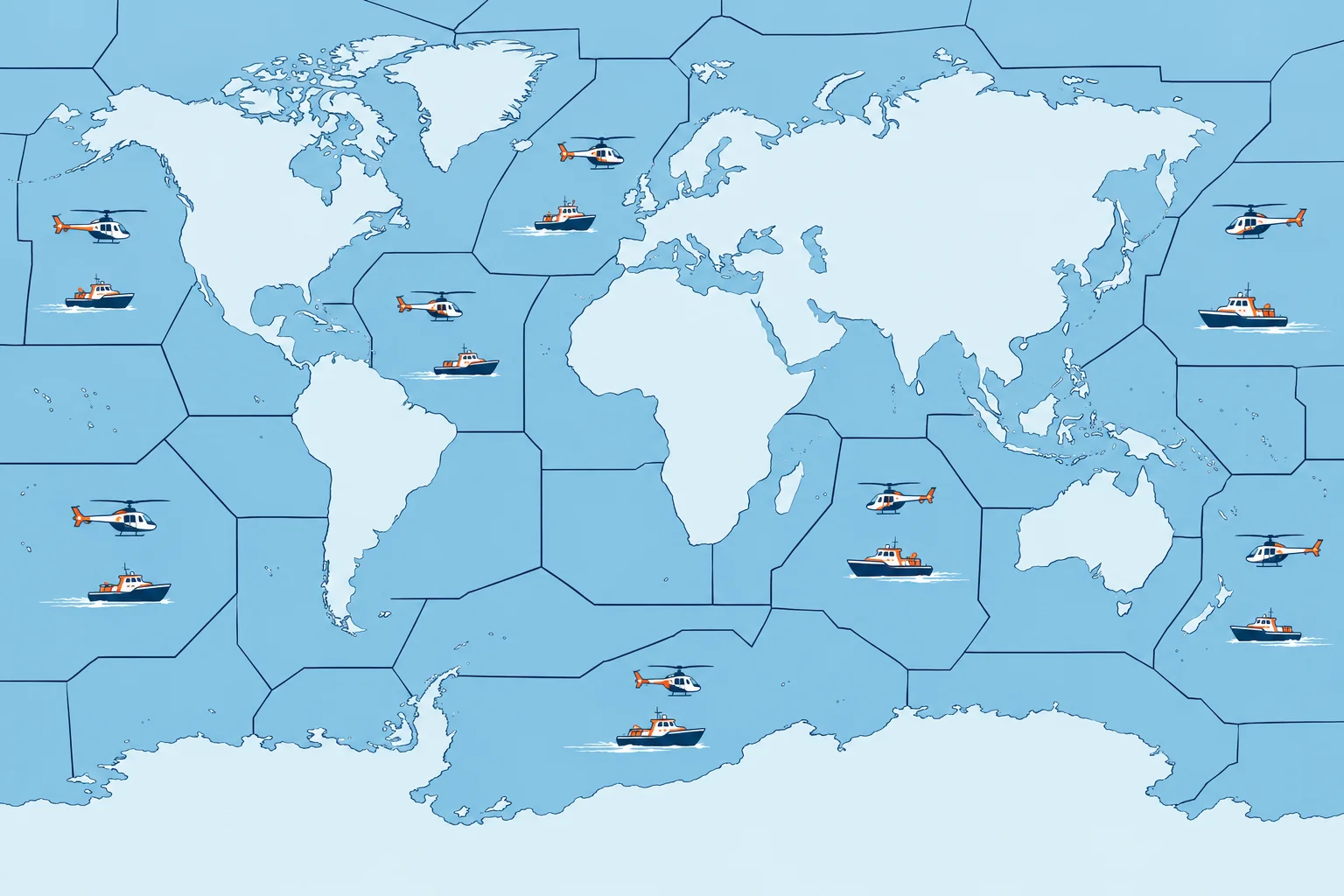
How search and rescue is organised
1The lesson in plain words
Search and rescue (SAR) centres coordinate help within sea regions. You can alert them directly or through coast stations, other vessels or satellite beacons.
Regions and centres
Under the International Maritime Organization (IMO) SAR Convention, the world’s seas are divided into search and rescue regions (SRRs). Each has a rescue coordination centre (RCC) that runs every rescue in its area. A maritime RCC (MRCC) handles sea rescues, a joint RCC (JRCC) handles both air and sea, and a sub-centre (MRSC) covers part of a region. They are linked worldwide, so an alert is passed to the right centre.
Who they are
The service has different names in each country: HM Coastguard in the UK, the CROSS centres in France, Salvamento Marítimo with its coordination centres in Spain, the Guardia Costiera in Italy and the US Coast Guard in the United States. The centre does not usually own every rescue unit. It calls on lifeboats, helicopters, aircraft, patrol vessels and any ship nearby.
The IAMSAR Manual
The IAMSAR Manual (International Aeronautical and Maritime Search and Rescue) provides shared practical guidance. Volume I covers organisation, Volume II mission coordination, and Volume III, carried on board ships, covers what a vessel or aircraft does: how to raise an alert, respond, search and act on scene. The 2025 edition applies from 1 January 2026.
Roles on a rescue
The SAR mission coordinator (SMC) at the RCC plans the rescue. An on-scene coordinator (OSC) coordinates units there. An aircraft coordinator (ACO) manages several aircraft. Report your position and capabilities to the RCC or OSC. Follow the coordinated plan and take safe immediate action while awaiting instructions. Your skipper retains command and responsibility for your boat’s safety. Report any unsafe task or change in conditions immediately.
2Key data
- RCC
- Rescue coordination centre: runs SAR in one region
- MRCC / JRCC / MRSC
- Maritime / joint air-sea / maritime sub-centre
- SMC
- SAR mission coordinator, at the RCC
- OSC
- On-scene coordinator: coordinates units at the scene
- IAMSAR Vol III
- Mobile facilities: carried aboard ships; 2025 edition
3Key points
- 1
The seas are split into SAR regions, each with an RCC.
- 2
MRCC for sea, JRCC for air and sea, MRSC for part of a region.
- 3
National names differ: Coastguard, CROSS, Salvamento Marítimo.
- 4
IAMSAR Vol III is the ship-board manual; 2025 edition.
- 5
SMC runs the rescue from the RCC; OSC coordinates on scene.
4Frequent mistakes
Wrong: You must call the rescue service of your own flag country.
Right: Call the nearest coast station or RCC. Alerts are passed to the centre for the region you are in.
Wrong: As a yacht nearby, you should organise the search yourself.
Right: Report and coordinate with the RCC or OSC. Until coordination is established, take safe action to help.
5Practice case & exam keys
A British yacht in Spain’s search and rescue region hears a Mayday from a French boat. Who will coordinate the rescue, and what should the British skipper do?
Show the answer
The Spanish RCC for that search and rescue region coordinates it, whatever the boats’ flags. The skipper reports the yacht’s position and capabilities to the RCC, offers help and coordinates with it. The skipper remains responsible for the yacht’s safety and takes safe immediate action while awaiting instructions.
Exam keys
- IMO SAR Convention: SAR regions, each with an RCC (MRCC, JRCC, MRSC).
- IAMSAR Manual Vol I organisation, Vol II coordination, Vol III mobile facilities carried aboard.
- SMC at the RCC; OSC on scene; ACO for aircraft.
- The centre for the region coordinates, regardless of flag.
Finish this unit
When you've read it, answer three questions. Get all three right to finish the unit; opening the page alone doesn't count.
My notes for this unit
No notes