

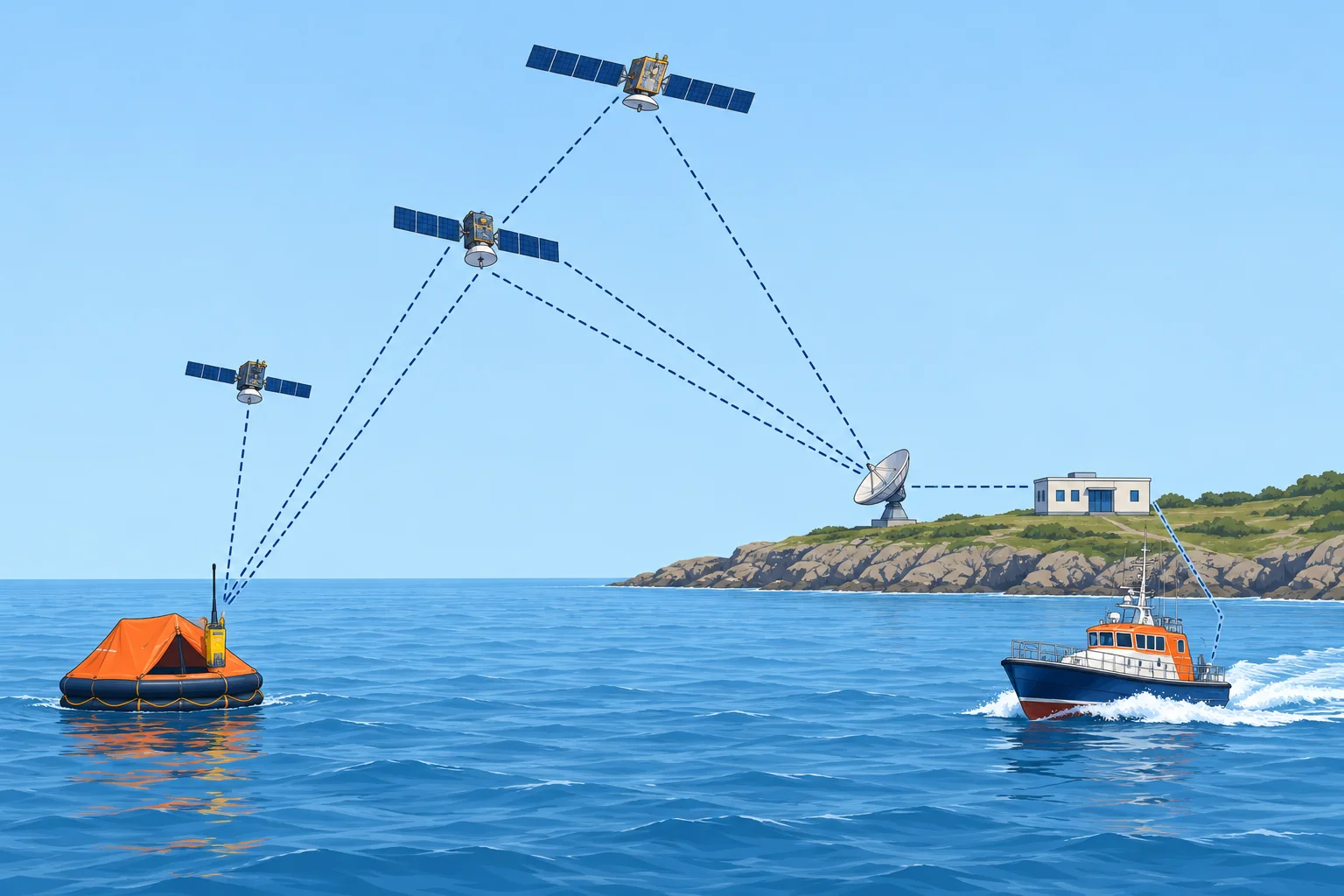
How a distress alert reaches the rescuers
1The lesson in plain words
A DSC alert reaches coast stations and ships nearby; a 406 MHz beacon reaches a rescue centre through satellites. Both end at the same RCC.
DSC and VHF
Digital selective calling (DSC) sends a coded distress alert on VHF Channel 70. Coast stations and ships within radio range can receive your MMSI (your radio’s nine-digit identity number), the nature of distress if selected, and your position and its time if available. A coast station forwards the alert to the RCC. For operating steps and voice calls, see GMDSS: distress calls.
Satellite beacons
An EPIRB (emergency position-indicating radio beacon) or PLB (personal locator beacon) sends a 406 MHz alert through Cospas-Sarsat satellites to a LUT (local user terminal), a ground station. LEOSAR and MEOSAR can provide an independent location; GEOSAR relies on a position encoded by the beacon. An MCC (mission control centre) routes the alert to the responsible RCC. Rescuers navigate towards the reported position and use the separate 121.5 MHz signal for close-range homing.
MEOSAR
Cospas-Sarsat now uses three kinds of satellites: low orbit (LEOSAR), geostationary (GEOSAR) and, increasingly, medium-orbit navigation satellites such as Galileo, GPS, GLONASS and BeiDou (MEOSAR). MEOSAR detects an alert within minutes almost anywhere. It can locate a beacon from its signal alone, even if the beacon has no GNSS (global navigation satellite system) position. A position calculated by GNSS is called a fix.
Return Link Service
Galileo’s Return Link Service (RLS) sends an acknowledgement back to beacons built for it. The indicator confirms that Cospas-Sarsat has received and located the alert. It does not confirm that rescue units have been dispatched. Keep the beacon transmitting during a real emergency.
Registration
Register your 406 MHz beacon with the appropriate national authority. Keep its details and emergency contacts current so the RCC can identify you and assess an alert. If you activate it accidentally, switch it off immediately and contact the nearest RCC or coast station at once, even if nobody has called. Give the beacon ID, your position and activation time; confirm everyone is safe. Switching it off does not cancel an alert already sent.
2Key data
- DSC distress
- VHF Channel 70; MMSI; position and time if available
- Satellite beacons
- 406 MHz to Cospas-Sarsat; 121.5 MHz homing
- Chain
- Beacon → satellite → LUT → MCC → RCC
- MEOSAR
- Navigation satellites: fast alerts, position even without GNSS
- RLS
- Alert received and located; rescue dispatch is not confirmed
3Key points
- 1
DSC: Channel 70 → coast station → RCC; ships within radio range can also receive the alert.
- 2
406 MHz beacons: satellite → LUT → MCC → RCC.
- 3
MEOSAR: fast alerts and independent location.
- 4
RLS confirms receipt and location, not rescue dispatch.
- 5
Register beacons. Accidental activation: switch off immediately and report to the RCC or coast station.
4Frequent mistakes
Wrong: A beacon alert goes straight to the nearest lifeboat.
Right: It goes via satellites, ground stations and a mission control centre to the RCC, which sends units.
Wrong: Switch a beacon off quickly if you set it off by mistake and say nothing.
Right: Switch it off immediately and report the false alert to the RCC or coast station.
5Practice case & exam keys
Your registered EPIRB activates accidentally in harbour. You switch it off. Nobody calls, and a crew member says the incident is over. Are they right? What do you do?
Show the answer
No. Switching off does not cancel an alert already sent. Contact the nearest RCC or coast station immediately. Give the beacon ID, position and activation time, explain the accidental activation and confirm everyone is safe. Registration helps the RCC identify you; it does not replace reporting the false alert.
Exam keys
- DSC: VHF Channel 70 → coast station → RCC; MMSI, nature if selected, position and time if available.
- 406 MHz → Cospas-Sarsat satellites → LUT → MCC → RCC; 121.5 MHz homing.
- LEOSAR, GEOSAR, MEOSAR; MEOSAR gives fast detection and independent location.
- RLS confirms receipt and location, not rescue dispatch. Register beacons; switch off accidental activations and report immediately.
Finish this unit
When you've read it, answer three questions. Get all three right to finish the unit; opening the page alone doesn't count.
My notes for this unit
No notes