

Assisting another vessel
1The lesson in plain words
If you can help people in distress, proceed with all speed without serious danger to your boat or those aboard. Report to the RCC and coordinate on scene.
The duty to assist
Under SOLAS (the International Convention for the Safety of Life at Sea), chapter V, regulation 33, if you are at sea and can help people in distress, you must proceed with all speed. Inform the rescue service if possible. This duty applies to pleasure craft too, regardless of the nationality or status of the people in distress. Under the law of the sea (UNCLOS), help is expected without serious danger to your boat or those aboard. If you cannot help, log why and tell the rescue service.
Listen and relay
When you hear a voice Mayday, note the position, boat’s name and problem. Allow a coast station a reasonable opportunity to acknowledge. If none does, acknowledge the casualty by voice and pass the distress to a coast station or RCC by Mayday relay. Do this even if you can also assist. Keep listening and avoid duplicate traffic. See GMDSS: distress calls for procedures.
Going to help
Tell the RCC your position, speed and what you can do. Post lookouts and keep a radio watch. Do not expose your boat or those aboard to serious danger. You may be asked to stand by, search an area or pass on messages. Coordinate with the OSC while remaining responsible for your boat’s safety. Report any task you cannot safely carry out.
On scene
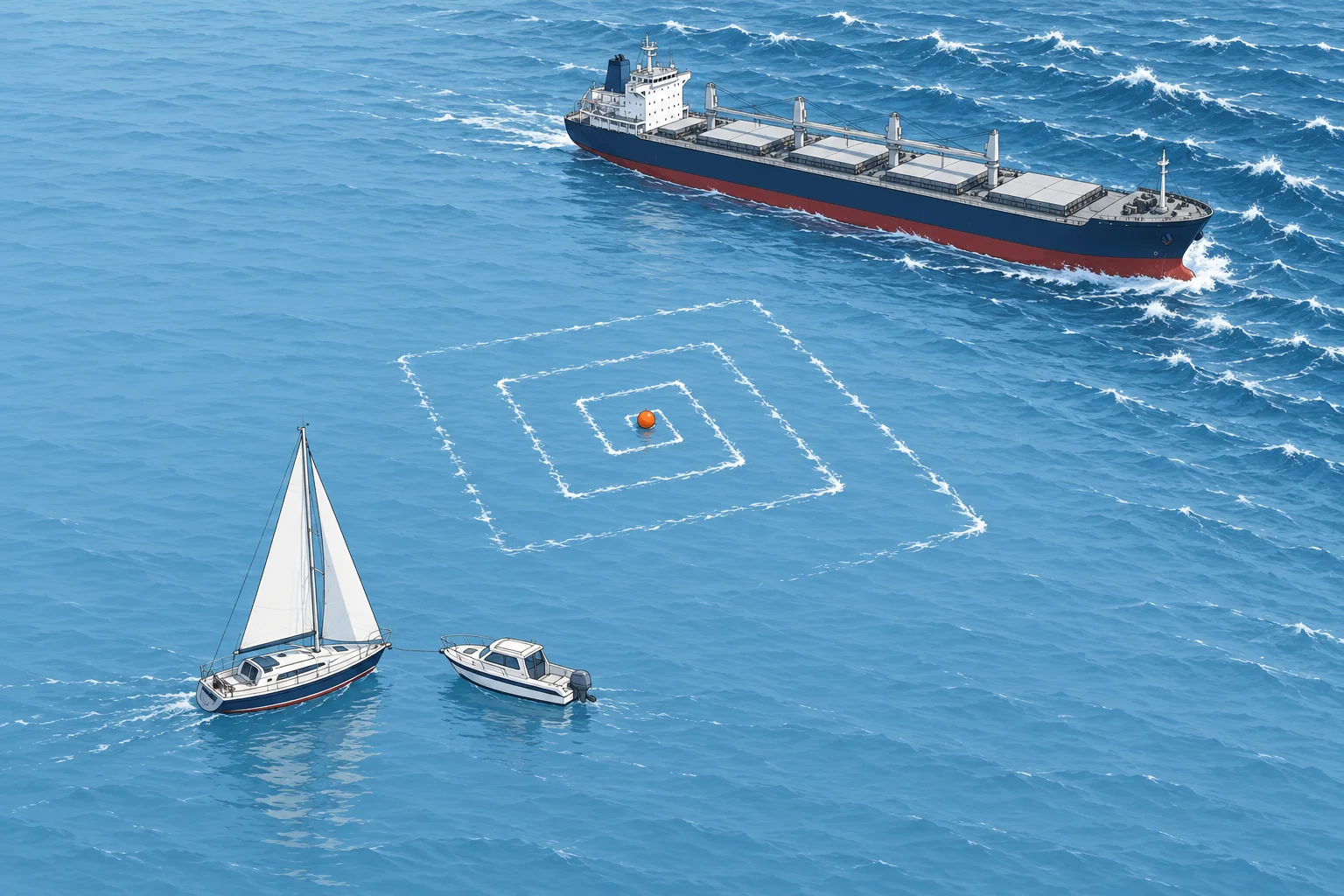
Approach a person in the water as you would a man overboard, slowly into wind or sea with the propeller stopped close by. Shout and use lights. A disabled boat may drift faster than you expect. If asked to search, follow the OSC’s pattern. An expanding square uses right-angle turns and progressively longer legs around the datum, the estimated casualty position allowing for drift. Report every sighting, including debris.
2Key points
- 1
SOLAS V/33: proceed with all speed to help, if you can.
- 2
If no coast station acknowledges, ensure the distress reaches a coast station or RCC.
- 3
Report to the RCC and coordinate with the OSC; your skipper retains command.
- 4
Help without serious danger to your boat or those aboard.
- 5
On scene: lookouts, slow approach, report all sightings.
3Frequent mistakes
Wrong: A small yacht is not bound by the duty to assist.
Right: SOLAS V/33 applies to pleasure craft too. Assist without serious danger to your boat or those aboard.
Wrong: Answer a Mayday at once even though the coast station has acknowledged it.
Right: Keep the channel clear, listen and offer help to the coordinator without interrupting distress traffic.
4Practice case & exam keys
You see a red flare to windward in breaking seas. Your 10 m yacht has a tired crew and cannot safely reach the casualty. How can you still help?
Show the answer
Report the flare to the coast station or RCC, giving your position, the bearing and time. Explain why you cannot safely approach and what you can offer. Keep lookouts and a radio watch from a safe position, relay updates, and accept only tasks within your capabilities. Record why you could not proceed.
Exam keys
- SOLAS V/33: duty to proceed with all speed to people in distress, regardless of nationality.
- If unable to assist: log the reason and inform the rescue service.
- If no coast station acknowledges, ensure the distress reaches a coast station or RCC.
- Report to the RCC and coordinate with the OSC. Help without serious danger to your boat or those aboard.
Finish this unit
When you've read it, answer three questions. Get all three right to finish the unit; opening the page alone doesn't count.
My notes for this unit
No notes