
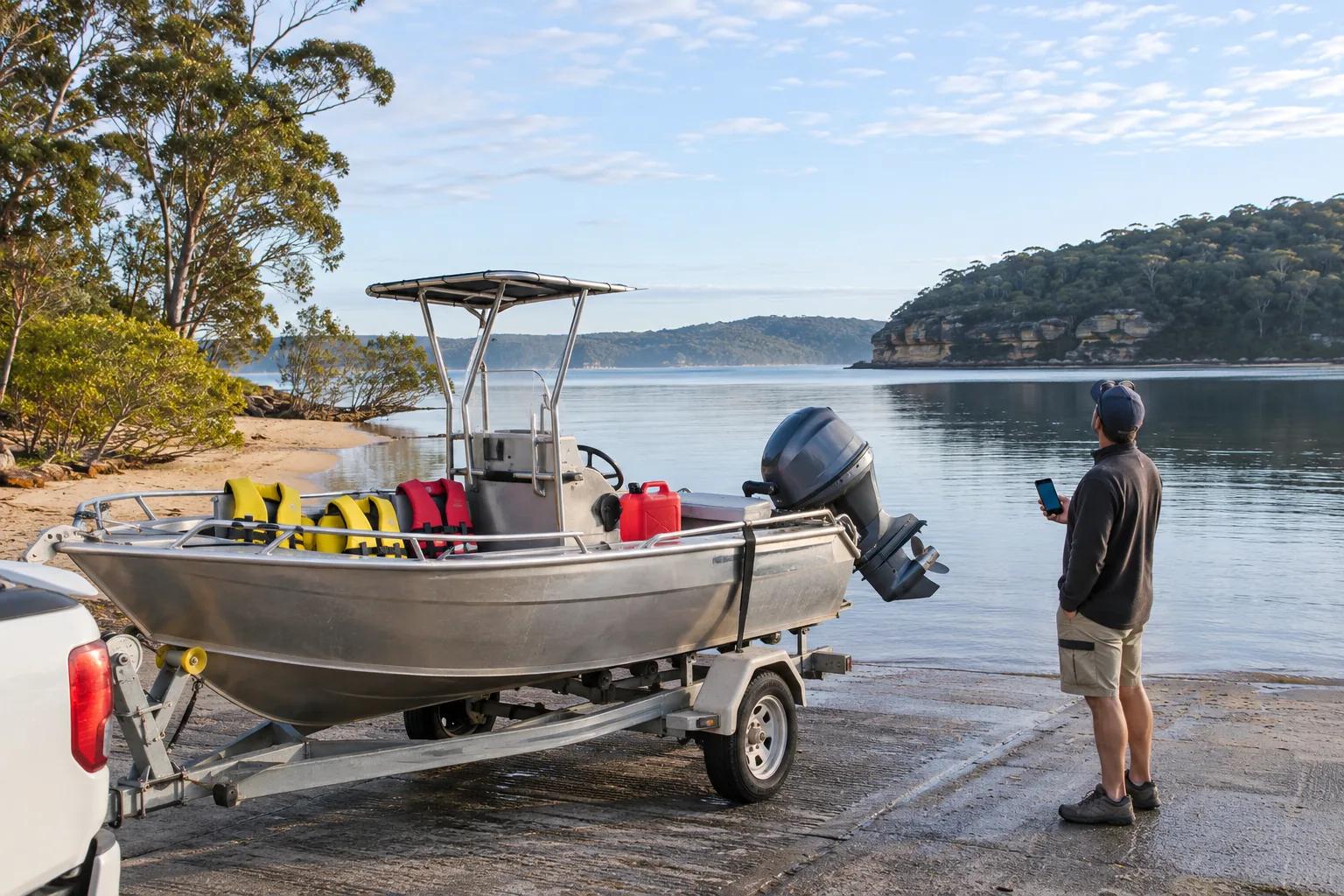
Decide
Four situations at sea. Decide first, then read why.
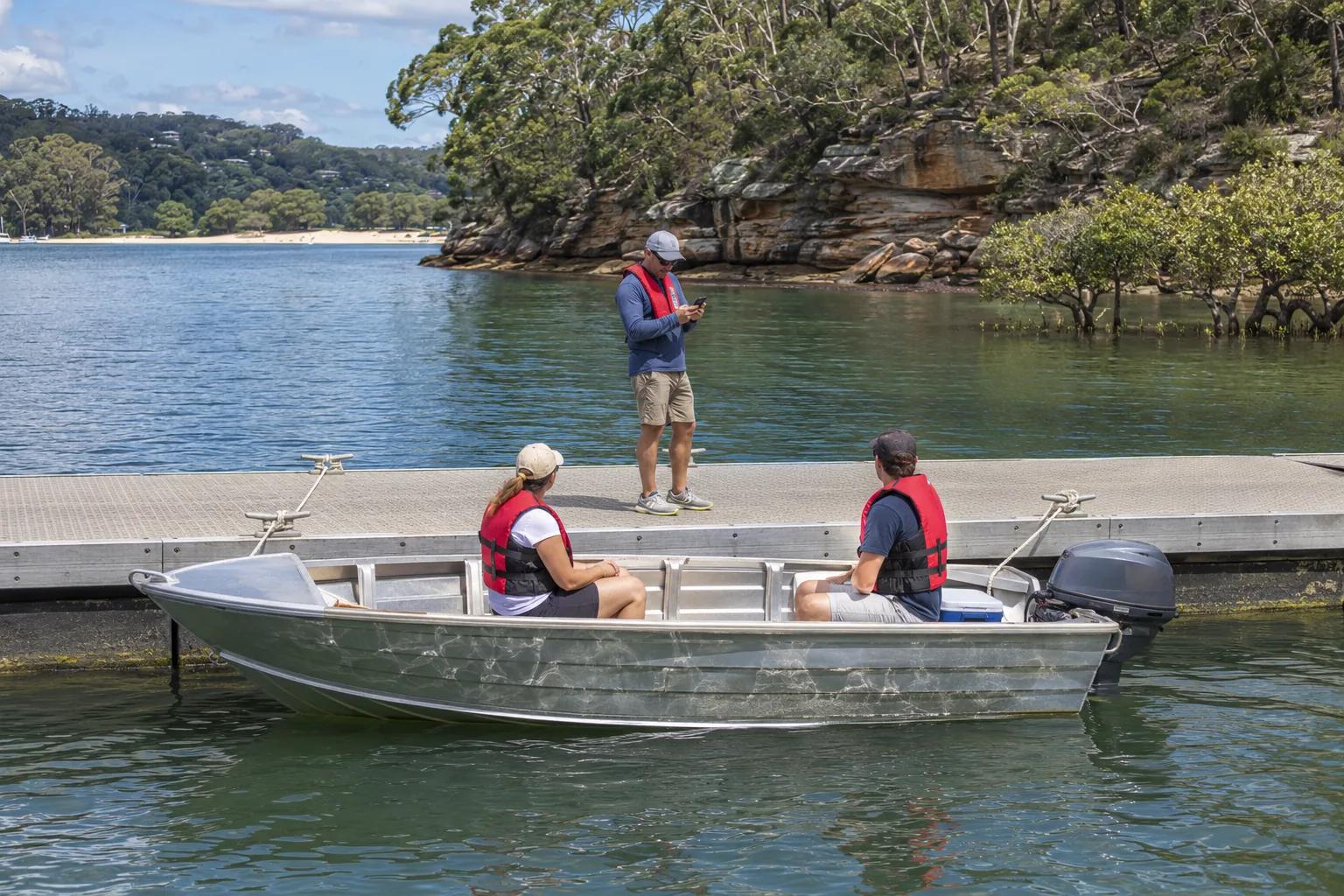
You are about to leave a Pittwater pontoon. Nobody ashore knows your route or return time. What should you do first?
Key points
- Leave a trip planSomeone ashore should know where you are going and when you expect to be back.
- Give the route, expected return, vessel details and number aboard.
- Log on and off with Marine Rescue NSW as recommended by TfNSW.
- Report a changed or extended trip; identify shelter options before leaving.
- Know the waterway rules and emergency actions; take extra care in cold water, especially alpine waters.
- Ready boat, ready crewCheck the boat and show everyone the safety equipment before departure.
- Match the boat and the driver's skills to the waterway.
- Check lifejackets and the correct equipment for the vessel and waters; keep them accessible.
- Prepare children for emergencies, lifejacket use and safe boarding; keep their bodies inside while underway.
- Check hatches open both ways and remain unlocked underway.
- Forecast, updates, eyes outsideCheck BoM before leaving and regularly while out, including the return conditions.
- Check warnings, wind changes, waves and swell, tides, visibility and local bar conditions.
- Gusts may be up to 40% stronger than the forecast average; maximum waves may be up to twice the forecast significant wave height.
- Threatening clouds or whitecaps: lifejackets on and head for shore.
- Choose a calmer trip or postpone if doubtful.
- Limits and balance both matterStay within the people and weight limits, with heavy gear low and secured.
- Follow the powerboat's ABP or safety-label limits. Recreational powered boats other than sailing boats and PWC need a safety label visible to everyone aboard.
- Spread passengers and equipment evenly to keep the boat level and balanced.
- Too much weight aft lowers the stern and increases swamping risk.
- Reduce the load in poor conditions or on open water, as the handbook recommends.
- Fuel in thirdsPlan one third out, one third home and one third in reserve.
- Check that the planned legs fit those fuel allowances.
- Keep the reserve for unexpected events; changing conditions can alter fuel needs.
- Check fuel lines and filters, and check for leaks or petrol and LPG odours before switches or engine use.
- The handbook generally advises against ethanol-blended petrol for boats; biodiesel also has fuel-system risks. Ask about the blend before filling.
- Fix it before you goA recent service does not replace today's checks.
- Check the engine, cooling water, steering, battery and lights.
- Check the bung is fitted, drains are clear and unusual bilge water is investigated.
- Carry a basic toolkit and suitable spares; use the correct charger for lithium batteries.
- Check LPG equipment, ropes and ready-to-use anchors. Professional servicing every year is recommended for powered vessels.
Check what you have read
You leave a trip message for a relative before launching at Brooklyn. Which set of details best follows the handbook?
Worked case: A Pittwater picnic with an afternoon wind change
You plan a morning picnic trip on Pittwater, returning in the afternoon. The ramp is sheltered, but the BoM forecast shows strengthening winds before your return. Your boat has 60 litres of usable fuel, and the proposed outward leg is expected to use 15 litres. Picnic gear is piled beside the stern seats.
Before you read the solution: what would you do?
True or false?
Decide each statement before you see the answer.
It is calm at the ramp, so the whole trip will be calm.
The annual service means I can skip today's checks.
A recent service does not replace today's checks.
Stay within the people and weight limits, with heavy gear low and secured.
We are under the passenger limit, so another heavy esky cannot matter.
Someone ashore should know where you are going and when you expect to be back.
The forecast wave height is the biggest wave I can meet.
I told someone the destination, so they have everything they need.
Half the fuel gets us there and half gets us home.
Check BoM before leaving and regularly while out, including the return conditions.
Plan one third out, one third home and one third in reserve.
Check the boat and show everyone the safety equipment before departure.
Exercise: Make a launch decision
These are invented planning figures, not a fuel-range prediction. Your Lake Macquarie outing starts with 72 litres of usable fuel, and stronger winds are forecast for later.
Step by step
What should your trip message to someone ashore include?
Show the solution
Give enough information to describe the trip and vessel, including your estimated return and number aboard. Report changes to the plan (p. 66).
Using the rule of thirds, how much of the 72 litres do you keep in reserve?
Show the solution
72 ÷ 3 = 24 litres in reserve. Plan another 24 litres for each leg; check the planned legs actually fit those allowances (pp. 67, 76).
The ramp is calm, but the return route may be too rough for your boat later. What is the sound decision?
Show the solution
Plan for the conditions you may meet on the return as well as the outward leg. Choose a calmer option or postpone if conditions are doubtful (p. 70).
You are within both carrying limits, but the stern sits low under a stack of heavy gear. What next?
Show the solution
Limits and weight distribution both matter. Stern-heavy loading increases the risk of swamping; heavy items belong low and secured (pp. 73–74).
Now on your own
Try a new plan for Port Hacking. You have 90 litres of usable fuel. Answer before reading the solutions.
Under the rule of thirds, what is the planned outward fuel allowance?
You decide to stay out longer than your logged return time. What should you do?
Threatening clouds and whitecaps develop while you are out. What does the handbook advise?
You are boarding a small dinghy for the trip. Which method follows the handbook?
Check: 10 questions
Questions from this subject, explained after each answer.
Free: lesson + 10 questions · Exam Pass: all 26 questions, unlimited practice tests, your mistakes retrained
The full explanation and the lessons for each programme item
Topic 1 of 6
Make a plan someone ashore can follow
As skipper, you are responsible for the boat and everyone on board.
Choose a route that suits the boat, your experience and the conditions. Work out how long the trip will take, check any special waterway restrictions, and identify places to shelter if the weather changes. Build experience on calm, quiet waterways. Take an experienced person along if you can. Boating Handbook, pp. 65–67.
Before leaving, tell a friend or relative where you are going, your estimated return time, your vessel details and how many people are aboard. NSW safety advice also recommends logging on and off with Marine Rescue NSW, using the MarineRescue app, VHF channel 16 or phone. Update your contact and Marine Rescue if you change or extend the trip, then log off on return.
Know the waterway rules before you leave: lookout, giving way, navigation marks and signals, safe speed and distance, alcohol limits and any towing rules that apply. Know your emergency actions and who to contact. If you are involved in or witness an incident, the handbook says you must stop and give as much help as possible; reporting to authorities may also be needed. Take extra care in cold water, especially alpine waters, because of cold shock and hypothermia. Boating Handbook, pp. 65–67.
- Include the return leg in your plan, with shelter options along the way.
- Take extra care to let someone know if you are going alone.
- Have a compass and an up-to-date chart or map; a chart or map is required for open waters (p. 68).
Topic 2 of 6
Check the boat and brief the people
Check the engine, lights and equipment before leaving home or launching.
If the vessel is registered, check that its registration has not expired and its registration number is clearly displayed. A boat designed for enclosed waters may be unsuitable for open waters and larger waves. Anyone driving needs the skills and experience for that boat and waterway. Boating Handbook, pp. 67, 75.
Carry the correct safety equipment for your vessel and the waters you will use. It must be in good condition and easy to reach. Show everyone where it is and how to use it. Carry enough approved lifejackets for everyone, and explain when they must be worn. Wearing one throughout the trip is the handbook's safety advice; the legal wearing rules depend on the vessel, waters and risk.
Prepare children too: make sure they have lifejackets and wear them when required. Explain what to do if someone falls overboard or the boat capsizes, show them the safety equipment, and teach them to board without upsetting the boat. Explain that emergency equipment is only for emergencies. Keep their body parts inside the vessel underway, and teach them about lookout and safe distances. Check the rules for towing people under 16 if you plan to tow. Bring suitable clothing for changing weather and consider seasickness, especially in choppy water. Boating Handbook, pp. 68–69.
- Check hatches open from inside and outside, and keep them unlocked while underway.
- Bring drinking water, sun protection, warm clothing and wet weather gear.
- Fix faults before you go; equipment on board is only useful if it works.
Topic 3 of 6
Read the marine forecast, then keep watching
Use the Bureau of Meteorology (BoM), the official weather source, before departure and regularly on the water.
Check warnings, wind strength and changes, storms, waves and swell, high and low tide times, and visibility. Allow for extreme heat or cold and check sunrise and sunset times. Check local coastal-bar conditions if a bar is on your route. A sunny ramp does not tell you what the return journey will be like. Boating Handbook, pp. 70–72, and TfNSW weather advice.
BoM's Marine & Ocean service provides marine forecasts and warnings, including hazardous surf warnings; MetEye gives detailed forecasts for your area. The handbook gives these average wind ranges: strong wind 26–33 knots, gale force 34–47 knots, storm force 48–63 knots and hurricane force 64 knots or more. Gusts may be up to 40% stronger than the forecast average. Significant wave height is not the height of the largest wave: the handbook warns that maximum waves may be up to twice the forecast height (p. 71).
Keep checking updates, listening for Marine Rescue NSW weather warnings on VHF channel 16 or 27 MHz channel 88, and looking at the sky and water. Threatening clouds or whitecaps mean you should make sure everyone is wearing a lifejacket and head for shore. Postpone the trip or choose a calmer location if the forecast or water conditions are doubtful. Take extra care on open waters and alpine waters, where weather can change quickly. Boating Handbook, pp. 70, 72.
- Check the whole route and the time you expect to return.
- A forecast average is not a ceiling on gusts or individual waves.
- If in doubt, don't go out.
Topic 4 of 6
Stay within the limits and keep the load balanced
Capacity is the maximum number of people; load is the maximum weight, including people and equipment.
On a powerboat, follow the limits on the Australian Builders Plate (ABP) or safety label. Staying under the headcount does not allow you to exceed the weight limit. The handbook recommends reducing the load in poor conditions or on open water. Boating Handbook, p. 73.
For PWC designed to carry more than two people, follow the ABP or similar plate. For other vessels, including sailing boats, paddlecraft and rowing boats, use the manufacturer's capacity and load information, available on its website or in the vessel's booklet. Boating Handbook, p. 73.
Recreational powered boats, excluding sailing boats with engines and PWC, must display a safety label where everyone on board can see it. The label shows carrying limits and safety information. PWC have their own behaviour-label requirement. Boating Handbook, pp. 54, 75.
Stow heavy gear low and secure it. Spread passengers and equipment evenly so the boat is level and balanced, with enough freeboard: the distance between the water and the gunwale. Too much weight aft lowers the stern, increases the risk of swamping and can make more wash. Sudden movement or a shifting load can capsize a boat even without exceeding a stated limit. Boating Handbook, pp. 73–74.
- Do not treat the label as a promise that the maximum load is safe in every condition.
- Board a small boat near the middle, crouch down and hold on; do not jump aboard or pause with one foot aboard and one ashore. Lightweight, narrow paddlecraft can be unstable; avoid large or heavy items aboard them.
- When moving around, keep low and near the centreline.
Topic 5 of 6
Leave with fuel in reserve and a boat that works
Plan fuel in thirds: one third to get there, one third to get home and one third in reserve for unexpected events.
This is the handbook's planning advice, not a guarantee of range. Base your route on the boat's fuel needs and the conditions, rather than treating the reserve as extra cruising fuel. Boating Handbook, pp. 67, 76.
Before using switches or starting the engine, check for petrol or LPG odours and leaks. Inspect fuel lines and filters. Check engine cooling-water circulation, steering cables and connections, the battery, navigation lights, and the bilges. Make sure the bung is in place and self-draining holes are clear. If there is more bilge water than usual, find and fix the cause. Boating Handbook, pp. 75–77.
The handbook recommends professional servicing of powered vessels every year. Routine checks still matter between services. Keep a basic toolkit and suitable spares, maintain safety equipment and lifejackets, and check that the correct lanyard is available if the boat has an engine kill switch. For a lithium battery, use the correct charger: the wrong one increases the fire risk. Boating Handbook, pp. 75–77.
Check for leaks in fuel and oil tanks and the exhaust system, check the electrical system, and ventilate the boat to prevent carbon monoxide build-up. Replace old fuel with fresh fuel if the boat has been unused for a while. For LPG, check that cylinders and appliances are suitable for marine use, cylinders have been inspected and serviced by a licensed gasfitter, hoses and equipment are safe, and cylinder storage is well ventilated. Keep ropes and lines in good condition and ready to use, with suitable anchors properly rigged, stowed and ready. Boating Handbook, pp. 76–77.
The handbook generally advises against ethanol-blended fuel for petrol boats: ethanol absorbs water and can separate from petrol, causing engine failure, and can damage fuel-system materials. Biodiesel can degrade, block filters and damage components. The handbook says diesel blends of up to 5% biodiesel do not require labelling, so ask before filling. Boating Handbook, p. 77.
- Allow for fuel use on both legs and keep the reserve for unexpected events.
- Check the battery can start the engine more than once.
- Repair or replace faulty equipment before departure.
Topic 6 of 6
Practise and go further
The best places to practise this subject. When you finish, one tap brings you back to the course.
- Plan a route and places to shelterLesson
- Get your safety equipment readyLesson
- Read a chart before departureLesson
- Find marine forecastsLesson
- Understand marine weatherLesson
- Plan around tidesLesson
All lessons by programme item
- H4a Before you go on the water: trip plan, log on with Marine Rescue NSW, checks (Handbook pp. 65–69)
- H4b Checking the weather: forecasts, warnings, wind, waves and tides (Handbook pp. 70–72)
- H4c Loading your vessel and maintaining it: capacity label, stability, fuel (Handbook pp. 73–77)
Sources
- Boating Handbook 2026: Before you go on the water, pp. 65–69 · checked
- Boating Handbook 2026: Checking the weather, pp. 70–72 · checked
- Boating Handbook 2026: Loading your vessel, pp. 73–74 · checked
- Boating Handbook 2026: Maintaining your vessel, pp. 75–77 · checked
- Transport for NSW: Checking the weather on waterways; forecasts and Marine Rescue log-on advice · checked
Checked against the official sources on .