

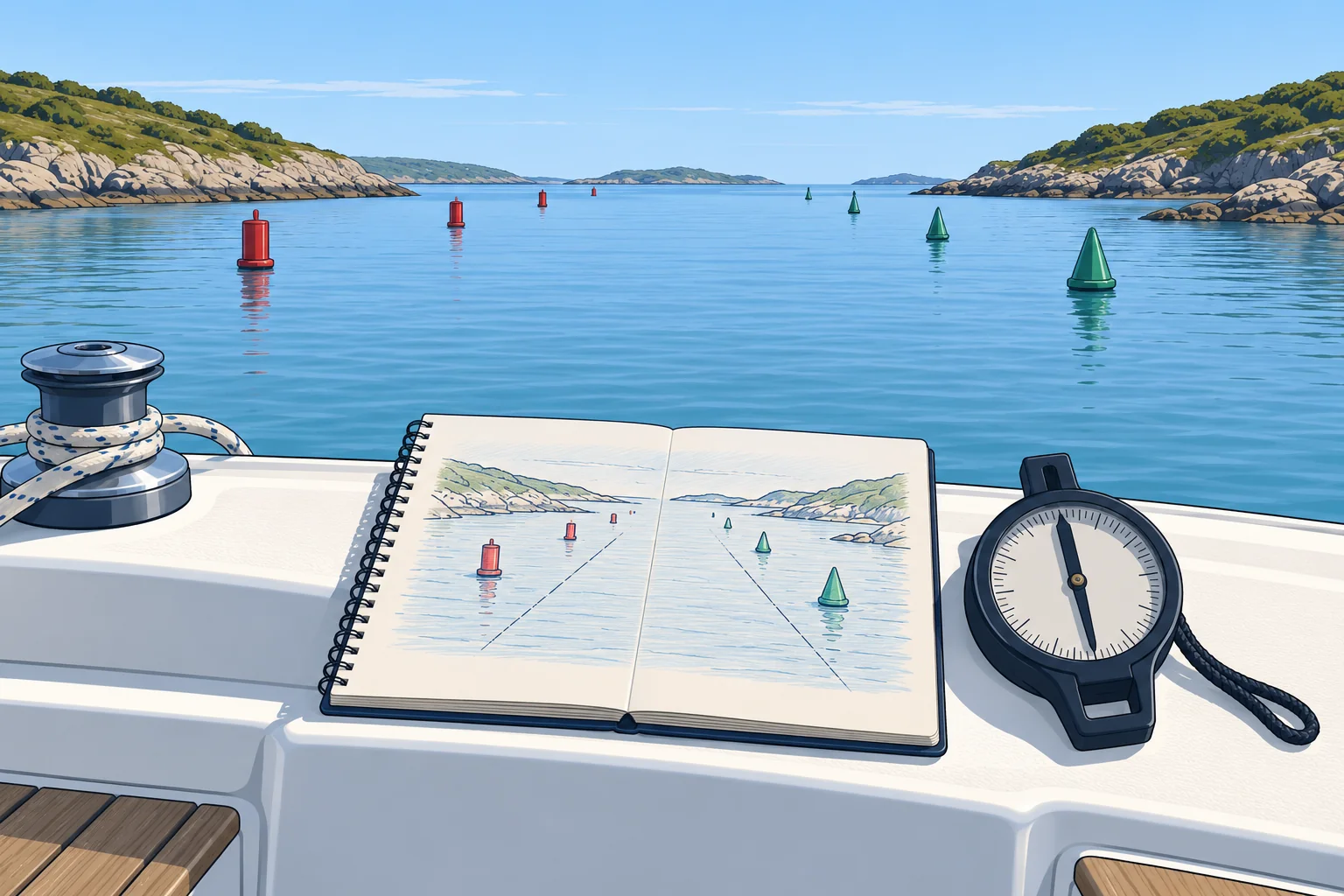
The pilotage plan
1The lesson in plain words
Pilotage uses visible marks, depths and bearings close to hazards. Prepare ahead, then check your position and adapt the plan as you go.
What pilotage is
Pilotage is navigation close to dangers, such as entering a harbour or passing between rocks, using marks you can see, depths and simple bearings. Things happen fast and you may be helming. So the thinking is done beforehand, at the chart table or at home, and carried on deck as a short written plan.
What goes in
Write marks in the order you will meet them. For each mark (a buoy, beacon or natural feature), note its appearance. For each leg (section of the route), note magnetic bearing, distance and expected depth. Record steering-compass courses allowing for deviation, compass error caused by the boat. Add safety lines (next two lessons), turning points and any time or tide you need. Add a simple sketch.
Tide and port rules
Use the shallowest charted depth on the route and the lowest height of tide expected during the pilotage (Tides unit). Compare their sum with your draught plus a safety margin. From the almanac or pilot book, note the VHF channel, traffic signals, speed limits, small-craft channels and reporting points. Check that the chart is up to date, and think about what will look different by night.
On deck
Brief the crew: who steers, who identifies marks, who watches the depth. Keep the plan where the navigator can see it. Tick off each mark as you pass and note the time. If a mark does not appear when expected, slow down or stop in safe water and work out why before going on.
Electronics in support
A plotter helps, but its chart may be less precise than your eyes, and satellite position can be a boat length or more out. Use it to confirm the plan, not to replace the marks. Agree an escape route in advance: the way back to open water if anything goes wrong.
2Key data
- Bearings in the plan
- Magnetic bearings; steering courses allow for compass deviation
- Order
- Marks and legs in the order you will meet them
- Least depth
- Least charted depth + lowest tide expected during pilotage
- Port information
- VHF channel, signals, speed limits, small-craft rules
3Key points
- 1
Prepare the chartwork before arrival; on deck, follow the plan and keep checking it against what you see.
- 2
List marks and legs in order, with magnetic bearings, distances and depths.
- 3
Note the port's VHF channel, signals, speed limits and small-craft rules.
- 4
Mark missing or depth wrong: slow down or stop and find out why.
4Frequent mistakes
Wrong: Work out the bearings as you go.
Right: Close to dangers there is no time. Prepare every bearing and distance before you arrive.
Wrong: Write the bearings in degrees true.
Right: Record magnetic bearings, plus steering-compass courses allowing for deviation.
Wrong: Keep going when an expected mark does not appear.
Right: Slow down or stop in safe water, check the log, depth and other marks, and find out why before going on.
5Practice case & exam keys
You approach an unfamiliar harbour at dusk with a tired crew. Your plan says a green buoy should appear 0.5 M after the fairway buoy, but after travelling 0.6 M over ground you still cannot see it.
Show the answer
Slow down and stay in the deep water you know. Check distance travelled over ground and time, and compare the depth with your plan. Look at the plotter and take bearings of other marks to confirm your position. The buoy may be unlit, hidden by background lights or moved. If you still cannot place yourself, take your escape route back to open water and try again with more light or a fresh plan.
Exam keys
- Pilotage: navigation by eye close to dangers, prepared in advance.
- Plan in order: marks, magnetic bearings, distances, depths, turning points.
- Least charted depth + lowest tide expected during pilotage; allow draught and a safety margin.
- Unexpected situation: slow down, stop or take the escape route.
Finish this unit
When you've read it, match the terms, then answer three questions. Get them all right to finish the unit; opening the page alone doesn't count.
My notes for this unit
No notes