

Clearing bearings and clearing depths
1The lesson in plain words
A clearing bearing is a safe limit drawn on the chart. While your bearing of a mark stays on the safe side of it, you are clear of the danger.
The idea
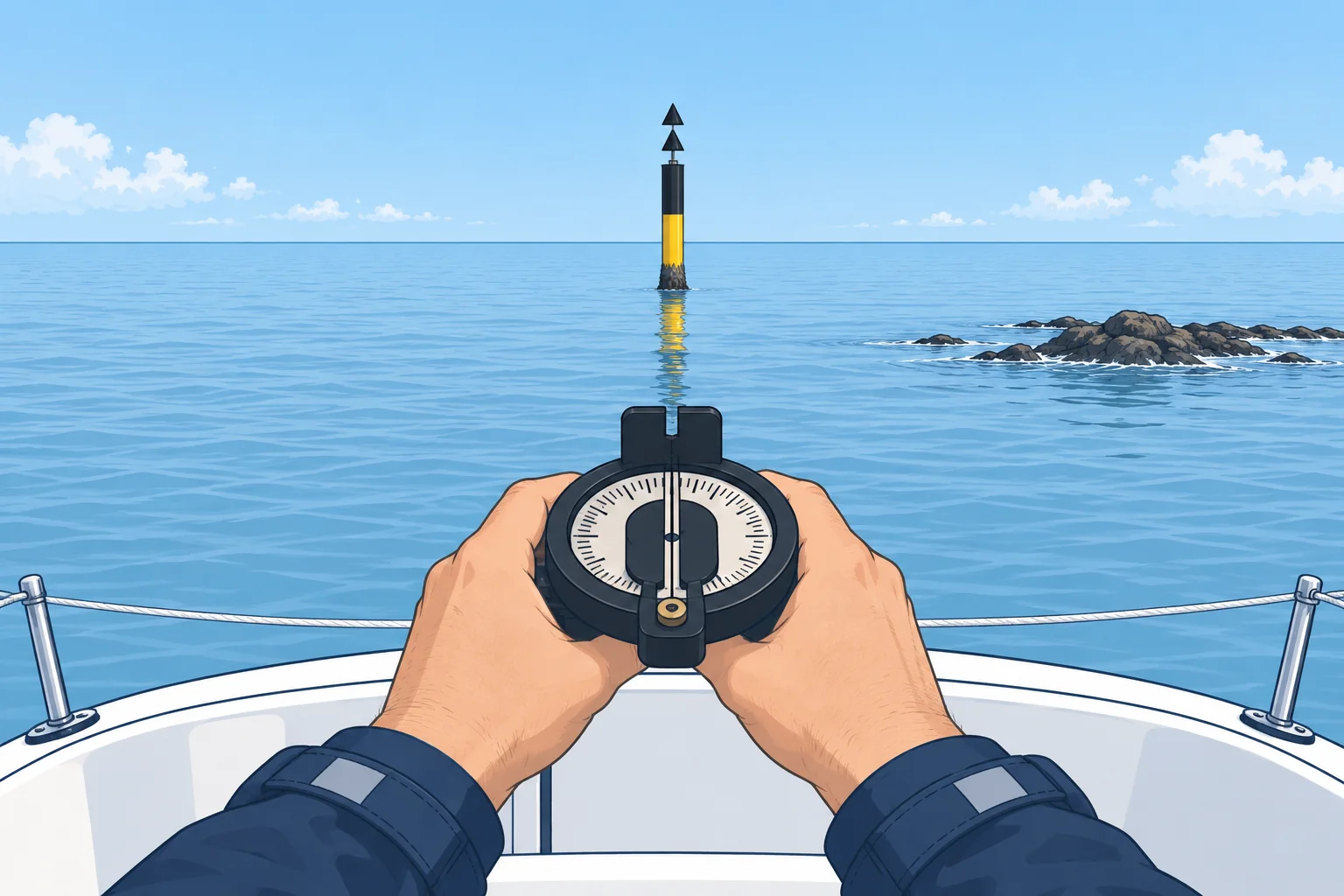
A clearing bearing (or danger bearing) is a line to a clearly identified mark, drawn to pass safely outside a danger. It becomes a simple rule: the bearing of the mark must be not less than (NLT) or not more than (NMT) a stated figure. You check it with a hand-bearing compass; no plotting is needed on deck.
Drawing it
On the chart, draw a line from the mark that passes outside the danger, with a margin for errors and stream. Hatch the danger side. Measure the bearing towards the mark, as you will see it from the boat, and convert it to magnetic.
NLT or NMT?
Imagine yourself on the danger side and take a bearing of the mark: is it more or less than the clearing bearing? Example: a mark lies ahead to the northeast, with rocks east of your approach. A line of 045°M to the mark passes west of the rocks. If you stray east, the mark bears less, say 040°M. So the rule is NLT 045°M.
Two together
For a charted leg towards a mark ahead, limits such as NLT 040°M and NMT 050°M define a permitted sector from 040°M to 050°M. A bearing of 045°M is inside; 035°M and 055°M are outside. Draw both with margins outside the relevant dangers. These limits protect against those dangers only; keep checking depth, position and the planned turning point.
Clearing depth
A clearing depth uses a charted contour, a line joining equal charted depths, outside the danger with a margin. Use it over a steadily sloping seabed. Add the height of tide to its charted depth to get a waterline-referenced limit. Match the sounder reference before comparing (next lesson), and update the limit as the tide changes. Stay deeper than the limit. Isolated steep rocks may give no warning.
2Key data
- NLT
- Bearing of the mark must be not less than the figure
- NMT
- Bearing of the mark must be not more than the figure
- Measured
- From the boat towards the mark, in degrees magnetic
- Margin
- Line passes outside the danger, never touching it
- Clearing depth
- Waterline limit = charted contour depth + height of tide
3Key points
- 1
A clearing bearing passes outside the danger with a margin; hatch the danger side.
- 2
Measure it towards the mark, and convert it to magnetic for the hand-bearing compass.
- 3
Decide NLT or NMT by imagining a bearing taken from the danger side.
- 4
A clearing depth works only where the seabed slopes steadily.
4Frequent mistakes
Wrong: Measure the bearing from the mark to the boat.
Right: Measure from the boat towards the mark, as you will see it through the compass.
Wrong: NLT always means the danger is to port.
Right: It depends on where the mark and the danger lie. Imagine a bearing from the danger side each time.
Wrong: Draw the line along the edge of the danger.
Right: Leave a margin for compass, steering and stream errors.
5Practice case & exam keys
You approach heading 270°M, with a charted beacon ahead to the west. Shoals lie north of your approach. A line of 268°M to the beacon passes safely south of them. What is the rule, and what do you do if the beacon bears 264°M?
Show the answer
From the shoal side, north of the line, the beacon bears less than 268°M, so the rule is NLT 268°M. A bearing of 264°M means you are north of the line, on the danger side. Turn to port, to the south, away from the shoals, until the beacon bears 268°M or more. Then resume the approach on the safe side.
Exam keys
- Clearing bearing: NLT or NMT a figure to a fixed mark, with a margin.
- Bearing measured from the boat to the mark, in magnetic.
- On the danger side: turn back towards the safe side at once.
- Clearing depth: only on a steadily sloping seabed.
Finish this unit
When you've read it, match the terms, then answer three questions. Get them all right to finish the unit; opening the page alone doesn't count.
My notes for this unit
No notes