

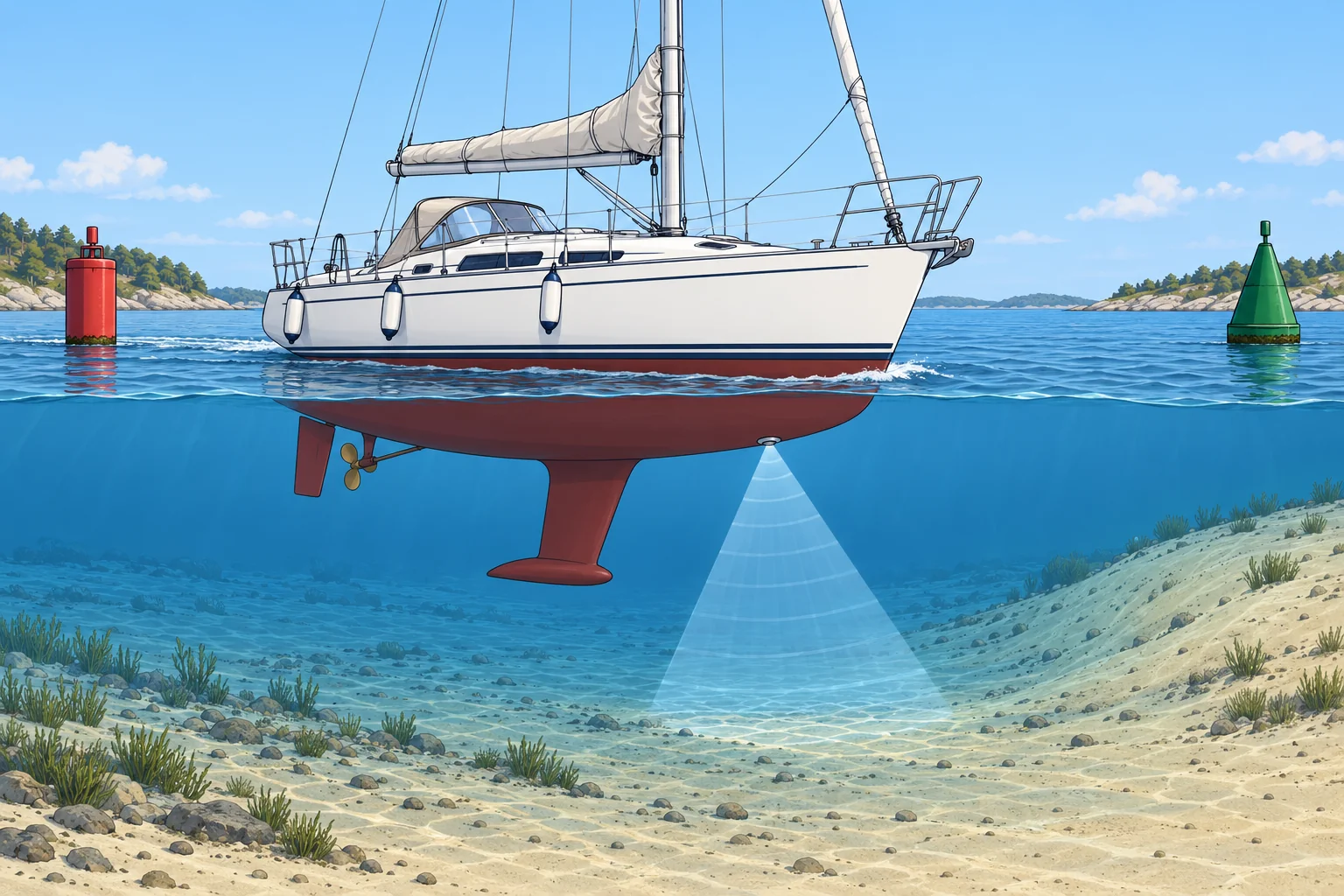
Harbour entry and the depth sounder
1The lesson in plain words
Arrive prepared: know the signals and rules, have lines and fenders ready, and use the depth sounder as a running check on your plan.
Before the entrance
Outside, in safe open water, brief the crew. If entering under power, start the engine and confirm propulsion before lowering or furling sails. Prepare lines and fenders, on both sides if unsure. If the almanac says so, call the harbour or marina on its VHF channel. Keep a good lookout: entrances are busy, and in a narrow channel a sailing vessel or one under 20 m must not impede a ship that can navigate only inside it (COLREG Rule 9).
Signals and rules
Many ports show traffic signals: three red lights in a vertical line mean do not proceed. Some ports add a light that lets small craft move outside the main channel. Read the port's own signals, speed limits and any small-craft channel (a route set aside for small boats) in the almanac or pilot book. Keep as near the channel's starboard edge as is safe and practicable.
The sounder
The echo sounder measures depth below its transducer, the sensor in the hull. An offset adjusts that reading to show depth below the keel or waterline. Set the correct vertical distance and check the manual: sign conventions vary. Confirm and label the display reference; do not rely on the sign alone.
Using depth
Compare each sounding with the plan. Waterline depth is about charted depth + height of tide; subtract draught for under-keel clearance. In poor visibility, a charted depth contour, a line joining equal charted depths, over a steady slope can help guide you, provided it leads through safe water. Use the correct sounder reference, adjust the target depth as the tide changes, and cross-check position with other available information. Set a shallow alarm with a margin.
When it does not fit
If the depth differs from your plan, slow down. If clearance is doubtful, stop the approach and return to known safe water if safe to do so. Check position, sounder reference and tide. Banks and buoys move: check Notices to Mariners and local notices before entering.
2Key data
- Three red lights, vertical
- Do not proceed
- Keel reference
- Raw transducer depth minus transducer-to-keel distance
- Waterline reference
- Raw transducer depth plus sensor depth below waterline
- Depth below waterline
- About charted depth + height of tide
- Narrow channel (Rule 9)
- Keep to starboard where safe; do not impede confined vessels
3Key points
- 1
Prepare the boat and crew outside, in open water.
- 2
Three red lights in a vertical line: do not proceed. Read each port's own signals.
- 3
Know your sounder offset: below transducer, below keel or below waterline.
- 4
Unexpected depth: slow down. If clearance is doubtful, stop the approach and seek known safe water.
4Frequent mistakes
Wrong: The sounder always shows the depth under the keel.
Right: It shows depth below the transducer unless an offset is set. Check and label which one.
Wrong: Three red lights mean proceed with caution.
Right: Three red lights in a vertical line mean do not proceed.
Wrong: Rig fenders and lines once inside the entrance.
Right: Do it outside in open water, so the crew is free to look out and handle the boat inside.
5Practice case & exam keys
You need at least 0.8 m under the keel. Your sounder has no offset and reads 1.9 m; the transducer is 0.4 m below the waterline. Draught is 1.8 m. Charted depth is 1.5 m and tide height 1.2 m. Do you continue?
Show the answer
Expected reading: 1.5 + 1.2 − 0.4 = 2.3 m. Actual clearance: 1.9 + 0.4 − 1.8 = 0.5 m, below your 0.8 m minimum. Do not continue the approach. Slow or stop where safe, check position, sounder reference and tide, and use your planned escape route if needed.
Exam keys
- Prepare outside; follow port signals, speed limits and small-craft channels.
- Three red vertical lights: do not proceed.
- Check the sounder reference, offset distance and manual; offset signs vary by model.
- Expected depth = charted depth + height of tide.
Finish this unit
When you've read it, match the terms, then answer three questions. Get them all right to finish the unit; opening the page alone doesn't count.
My notes for this unit
No notes