

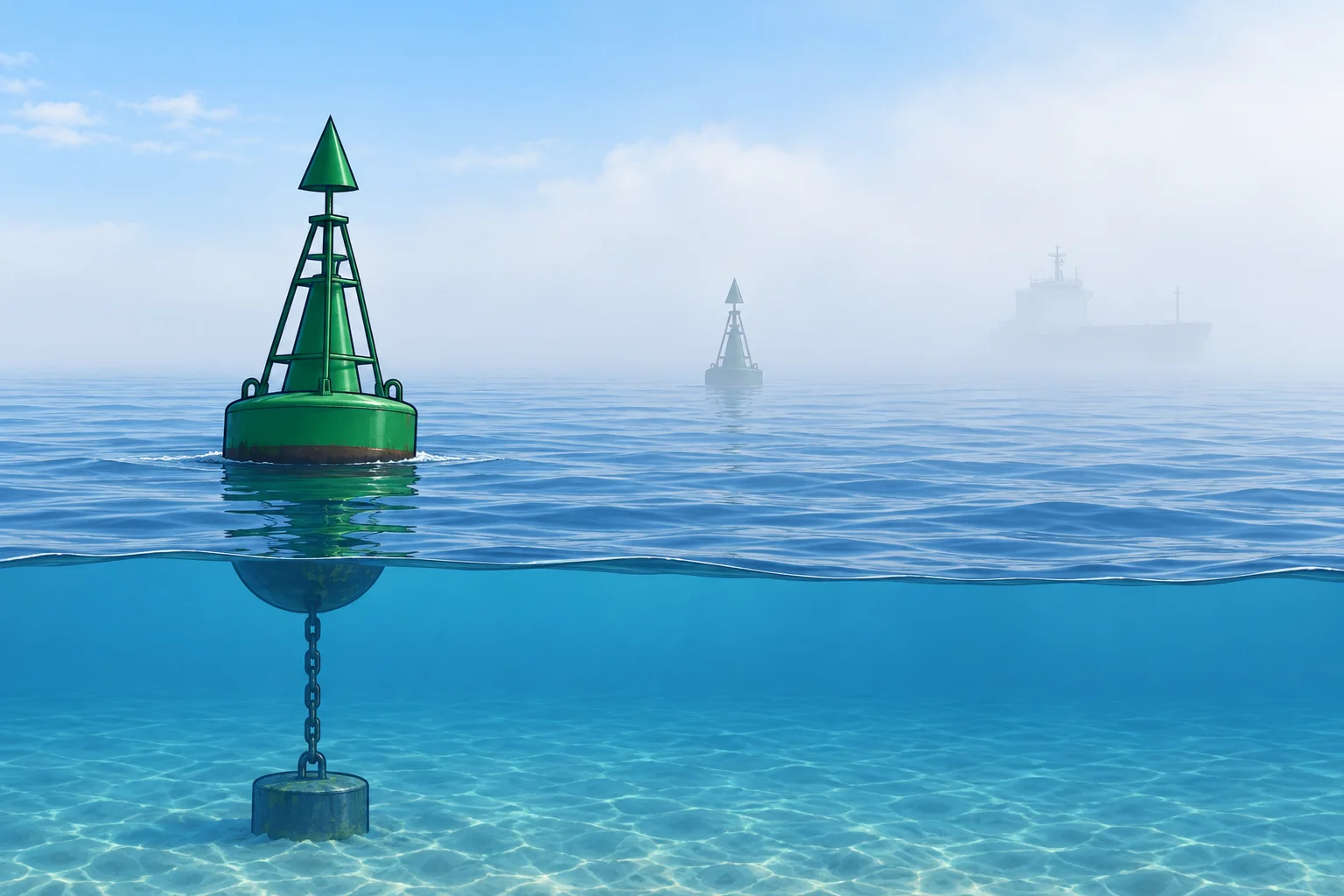
Visibility: fog, mist and haze
1The lesson in plain words
Fog is water droplets cutting visibility below 1,000 m. Mist, haze, rain, snow and spray also cut visibility, each for a different reason.
What visibility means
Visibility is the greatest distance at which you can see and recognise an object. In UK Met Office marine forecasts, distances are nautical miles (NM): good over 5 NM, moderate 2–5 NM, poor 1,000 m to 2 NM, very poor under 1,000 m. Check other services’ definitions. See the Forecast terms lesson.
Fog
Fog is a cloud touching the surface, made of tiny water droplets, that cuts visibility to less than 1,000 m. The Met Office calls it dense fog under 100 m. At sea, fog is one of the main causes of collisions and groundings.
Mist and haze
Mist is the same kind of droplets but thinner: visibility stays at 1,000 m or more, and the air feels damp. Haze is made of dry particles such as dust, salt or smoke, not water.
Other causes
Precipitation means rain, snow or hail. Heavy rain can cut visibility to a few nautical miles or less; snow can be worse than fog. In strong winds, spray and spindrift, fine spray blown from wave crests, also reduce visibility. At night, judge visibility by the lights you can see, not by the darkness.
Effects on board
In poor visibility, other vessels, buoys and the coast appear late. Lights look weaker than their charted range. Wind and temperature layers can bend sound, so a signal’s apparent direction and loudness may mislead you. Radar and AIS (Automatic Identification System, which shares vessel data by radio) help, but neither shows every vessel.
2Key data
- Fog
- Visibility under 1,000 m, water droplets
- Dense fog (Met Office)
- Visibility under 100 m
- Mist
- Water droplets, visibility 1,000 m or more
- Haze
- Dry particles: dust, salt, smoke
- Very poor (UK Met Office)
- Under 1,000 m in UK marine forecasts
3Key points
- 1
Fog: visibility under 1,000 m, made of water droplets.
- 2
Mist: droplets, but visibility 1,000 m or more.
- 3
Haze is caused by dry particles such as dust, salt or smoke.
- 4
Rain, snow and spray also cut visibility.
- 5
Fog signals do not give a reliable direction or distance.
4Frequent mistakes
Wrong: Haze and mist are the same thing.
Right: Mist is water droplets; haze is dry particles such as dust or salt.
Wrong: You can tell where another vessel is from its fog signal.
Right: Wind and temperature layers can bend sound, and loudness is a poor guide to distance. Treat every fog signal as a warning, even if its bearing is uncertain.
5Practice case & exam keys
A UK Met Office marine forecast says "Visibility moderate or poor, occasionally very poor" with mild, moist south-westerly air. You plan to cross a busy shipping route. What visibility could you meet?
Show the answer
Mostly 1,000 m to 5 NM, but occasionally below 1,000 m. Fog is possible; the visibility wording alone does not identify the cause. Another vessel may appear late. Delay the crossing, or prepare fully for restricted visibility before you start, with radar and AIS if fitted, a radar reflector, sound signals and a dedicated lookout.
Exam keys
- Fog: visibility under 1,000 m; mist: water droplets with visibility 1,000 m or more.
- Haze is caused by dry particles, not water droplets.
- UK Met Office marine forecasts: good over 5 NM, moderate 2–5 NM, poor 1,000 m–2 NM, very poor under 1,000 m.
Finish this unit
When you've read it, match the terms, then answer three questions. Get them all right to finish the unit; opening the page alone doesn't count.
My notes for this unit
No notes