

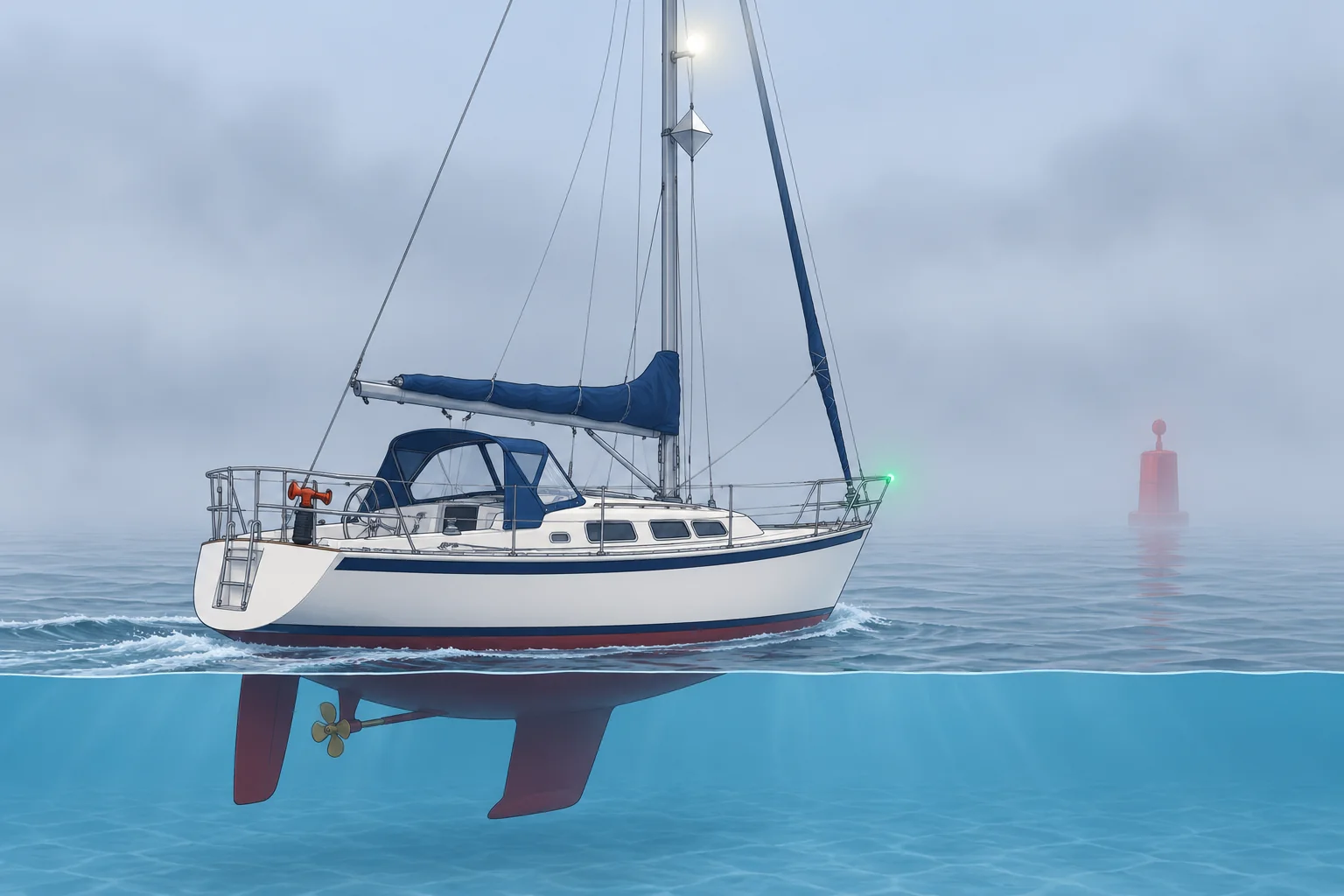
What to do when fog comes
1The lesson in plain words
Prepare before fog arrives: fix your position, be seen and heard, slow down, look and listen, and avoid shipping lanes where safe.
Prepare early
Fog often gives warning: a closing dew point spread, a grey horizon, a forecast of fog patches. Use that time. Fix your position on the chart and log it. Decide on a safe plan: continue, wait in safe water or head for an easy, well-marked harbour.
Be seen and heard
Switch on your navigation lights. Check that your radar reflector, which returns other vessels’ radar signals, is correctly mounted. Switch on any fitted radar target enhancer, a powered device that boosts your radar return, and AIS transmitter; an AIS receiver alone cannot transmit. These aids improve detection chances but do not guarantee it. Prepare sound signals. See COLREG Rules 19 and 35 for conduct and signals. Rule 19 applies to vessels not in sight of one another in or near restricted visibility.
Slow down and keep watch
Use a safe speed that lets you take effective avoiding action and stop within a distance appropriate to the conditions. Post a dedicated lookout where they can safely look, listen and communicate with the helm, away from engine noise where practical. Use radar and AIS if fitted, but remember that small boats may not show on either.
Keep out of trouble
Avoid shipping lanes where safe. A charted anchorage outside traffic may be safer. Check the approach, depth throughout the tide, shelter, holding and swinging room before approaching. Holding means how well the seabed grips your anchor; swinging room is space to turn around it. Shallow water alone is not safe: it can expose you to grounding or breaking seas.
Look after the crew
Everyone on deck wears a lifejacket. Have the liferaft and grab bag ready. Keep the engine ready to manoeuvre, even under sail. Keep a listening watch on VHF channel 16 and the coastguard's broadcasts for warnings and traffic.
2Step by step
When fog is coming
- 1
Fix your position, log it and choose a plan: continue, wait or divert.
Once visibility goes, an accurate starting position is your best navigation aid.
- 2
Lights on; check the reflector; switch on fitted radar enhancer and AIS transmitter.
These improve your chances of being detected; they do not guarantee it.
- 3
Get sound signals ready and follow COLREG Rules 19 and 35.
Rule 19 covers vessels not in sight in or near restricted visibility. Rule 35 gives the required sound signals.
- 4
Reduce to a safe speed and post a dedicated lookout and listener.
Safe speed allows effective avoiding action and a stopping distance appropriate to the conditions.
- 5
Consider a charted, sheltered anchorage outside traffic.
Check approach, depth through the tide, holding and swinging room. Shallow water alone is not safe.
- 6
Crew in lifejackets, engine ready, liferaft and grab bag to hand.
If a collision or grounding happens, there may be little time.
3Key data
- Conduct in restricted visibility
- COLREG Rule 19 (COLREG module)
- Fog signals
- COLREG Rule 35 (COLREG module)
- Safe speed
- Effective avoiding action and an appropriate stopping distance
- Possible refuge
- Checked, sheltered anchorage outside traffic, with depth and room
4Key points
- 1
Fix and log your position before the fog arrives.
- 2
Lights on, reflector checked, fitted AIS transmitter on, required sound signals ready.
- 3
Safe speed and a dedicated lookout and listener.
- 4
Consider a charted, sheltered anchorage outside traffic; check depth, holding and swinging room.
- 5
Lifejackets on, engine ready, grab bag to hand.
5Frequent mistakes
Wrong: With radar and AIS, a lookout is not needed in fog.
Right: Small vessels may not show on radar or AIS. Keep a dedicated lookout and listening watch as well.
Wrong: Speed up to get through the fog quickly.
Right: Use a safe speed that lets you take effective avoiding action and stop within a distance appropriate to the conditions.
Wrong: Wait in the shipping lane until the fog lifts.
Right: Consider a charted, sheltered anchorage outside traffic. Check depth through the tide, shelter, holding and swinging room. Move only when safe.
6Practice case & exam keys
You are outside a shipping lane in a 9 m motorboat without radar. Fog is closing in. A nearby charted anchorage is clear of traffic, sheltered from the forecast wind and deep enough through low water. Do you start the crossing or wait?
Show the answer
Wait in the suitable anchorage before starting the crossing in worsening visibility. Fix and log your position; check the approach, depth, shelter, holding and swinging room. Use a safe speed and a dedicated lookout. Lights on, reflector checked, fitted AIS transmitter on. Use required fog signals and follow the linked COLREG guidance. Put on lifejackets, keep the engine ready and maintain a VHF watch.
Exam keys
- Before fog: fix position, choose a plan, lights on, reflector checked, fitted radar enhancer and AIS transmitter on.
- In fog: safe speed, dedicated lookout and listening watch, sound signals (COLREG Rules 19 and 35).
- Consider a charted, sheltered anchorage outside traffic; check depth through the tide, holding and swinging room.
Finish this unit
When you've read it, match the terms, then answer three questions. Get them all right to finish the unit; opening the page alone doesn't count.
My notes for this unit
No notes