

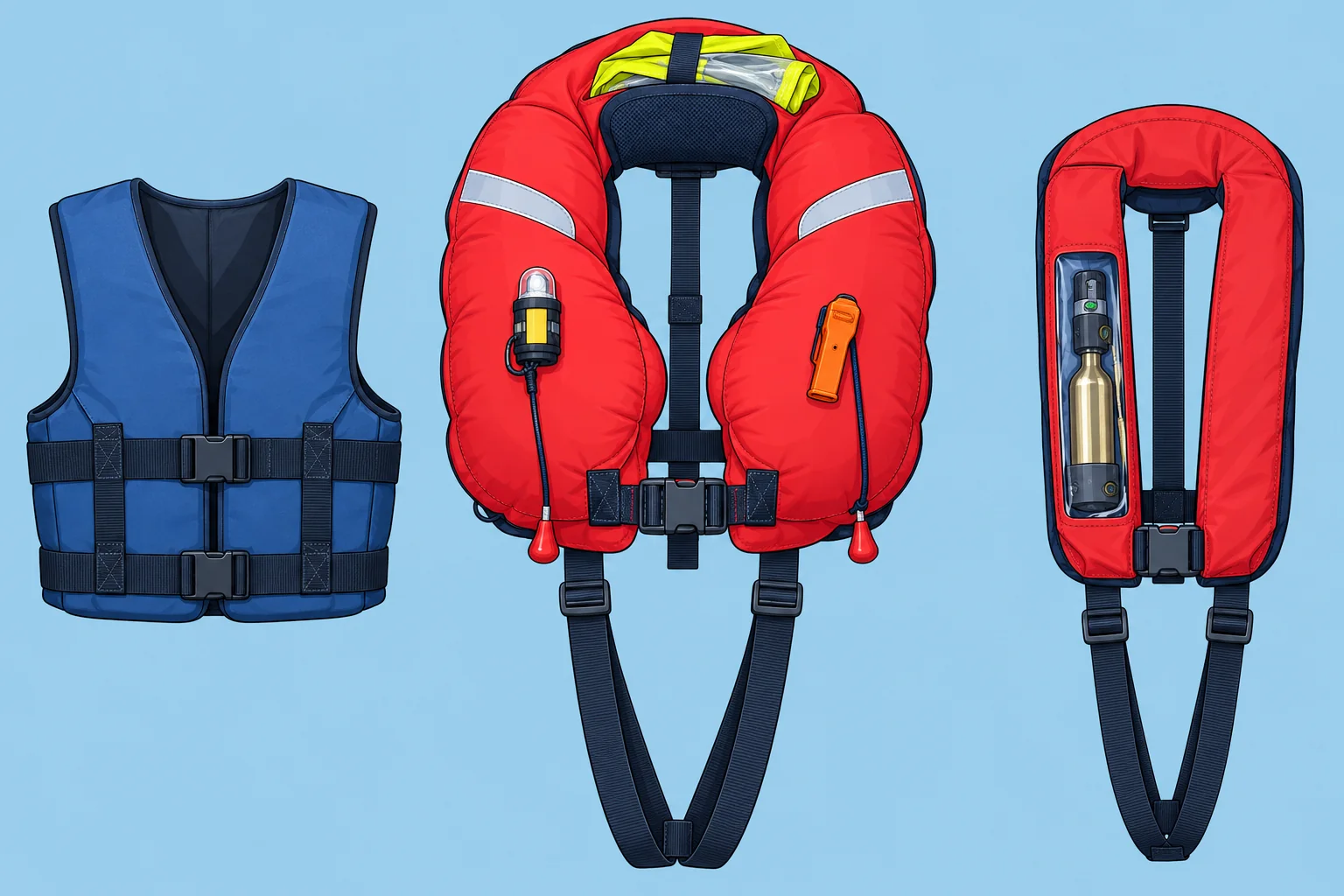
Lifejackets: choose, fit and service
1The lesson in plain words
A lifejacket only saves you if it is the right level, fits snugly with its straps done up, has been serviced and is actually being worn.
Levels of buoyancy
The EN ISO 12402 series rates buoyancy in newtons (N). Level 50 is a buoyancy aid for competent swimmers near help; it is not designed to turn you face-up. Level 100 is for sheltered water; it may not turn an unconscious wearer face-up. Level 150 is the usual sea-going choice, but waterproof clothing can prevent self-righting. Level 275 provides extra buoyancy for severe conditions or heavy protective clothing. No level guarantees face-up flotation in every situation.
Gas inflation
Most yacht lifejackets are gas-inflated: a carbon dioxide (CO₂) cylinder fills the bladder, the inflatable chamber. A manual one inflates when you pull the toggle. An automatic one also fires when immersed. A water-sensitive firing head uses a tablet or bobbin and can fire in heavy spray or a damp locker. A hydrostatic head fires when submerged, at about 10 cm depending on the model; spray will not trigger it. Inflatable lifejackets also have an oral inflation tube for inflation by mouth.
Fit and straps
An inflated lifejacket pulls hard upwards. Without crotch or thigh straps it can ride up over your face, or you can slip out of it. Wear the straps every time and tighten the waist belt until you can only just slide a flat hand under it. Look for a sprayhood, which keeps waves off your mouth, a light, a whistle and retro-reflective patches. Children need a child lifejacket for their weight.
Checks and service
Before each use, check the cover, straps, cylinder security and armed indicators as your maker instructs. At the specified interval, check expiry dates, inspect the bladder and follow the maker’s inflation and leak-test instructions. Arrange servicing at the maker’s interval. Carry the correct rearming kit for each model. An inflated jacket still supports you after firing; an intact bladder can be inflated by mouth. Before reuse, replace the spent cylinder and used activation components as instructed, then check and repack it.
Why wear it
Cold shock makes you gasp and breathe fast on entering cold water; see Medical: cold water. Put your lifejacket on before you need it: at night, in rough weather, alone on deck, in the tender, and whenever the skipper says so.
2Key data
- Level 50
- Swimmers near help; not designed to turn you face-up
- Level 100
- Sheltered water; may not turn an unconscious wearer face-up
- Level 150
- General offshore use; the usual yacht lifejacket
- Level 275
- Offshore extremes, heavy clothing or loads
- Waist belt
- Only a flat hand fits under it
3Key points
- 1
Level 150 is the usual lifejacket at sea; Level 50 is a buoyancy aid, not a lifejacket.
- 2
Crotch or thigh straps stop the lifejacket riding up over your face.
- 3
Hydrostatic heads ignore spray; water-sensitive heads can fire in spray or damp.
- 4
Check readiness before each use; service as instructed and carry the model’s rearming kit.
- 5
Wear it before you need it: cold shock leaves no time to put one on.
4Frequent mistakes
Wrong: A buoyancy aid is good enough offshore.
Right: A Level 50 buoyancy aid is not designed to turn you face-up. Use at least Level 150 at sea.
Wrong: The crotch strap is optional if the belt is tight.
Right: An inflated bladder lifts hard. Without the strap the lifejacket rides up and can push your face down.
Wrong: A lifejacket that has never fired needs no checks.
Right: Cylinders work loose and firing heads expire. Check them and service at the maker’s interval.
5Practice case & exam keys
A guest arrives with an automatic lifejacket. Its cylinder turns by hand, the firing head’s indicator is red, and there is no crotch strap. You are leaving for a night passage. What do you do?
Show the answer
Do not rely on it. A loose cylinder may not inflate it, and a red indicator usually means the head has fired or is not armed. Lend a serviced Level 150 lifejacket from the boat’s stock, fit it with crotch straps done up and the belt snug, and show the guest the manual toggle and oral tube.
Exam keys
- EN ISO 12402 levels: 50 N buoyancy aid, 100 N sheltered water, 150 N offshore, 275 N extreme.
- Automatic inflation: water-sensitive or hydrostatic firing head; manual toggle and oral tube as backup.
- Crotch or thigh straps, light, whistle and sprayhood; belt snug.
- Check readiness before use; inspect, leak-test, service and rearm as the maker instructs.
Finish this unit
When you've read it, answer three questions. Get all three right to finish the unit; opening the page alone doesn't count.
My notes for this unit
No notes