

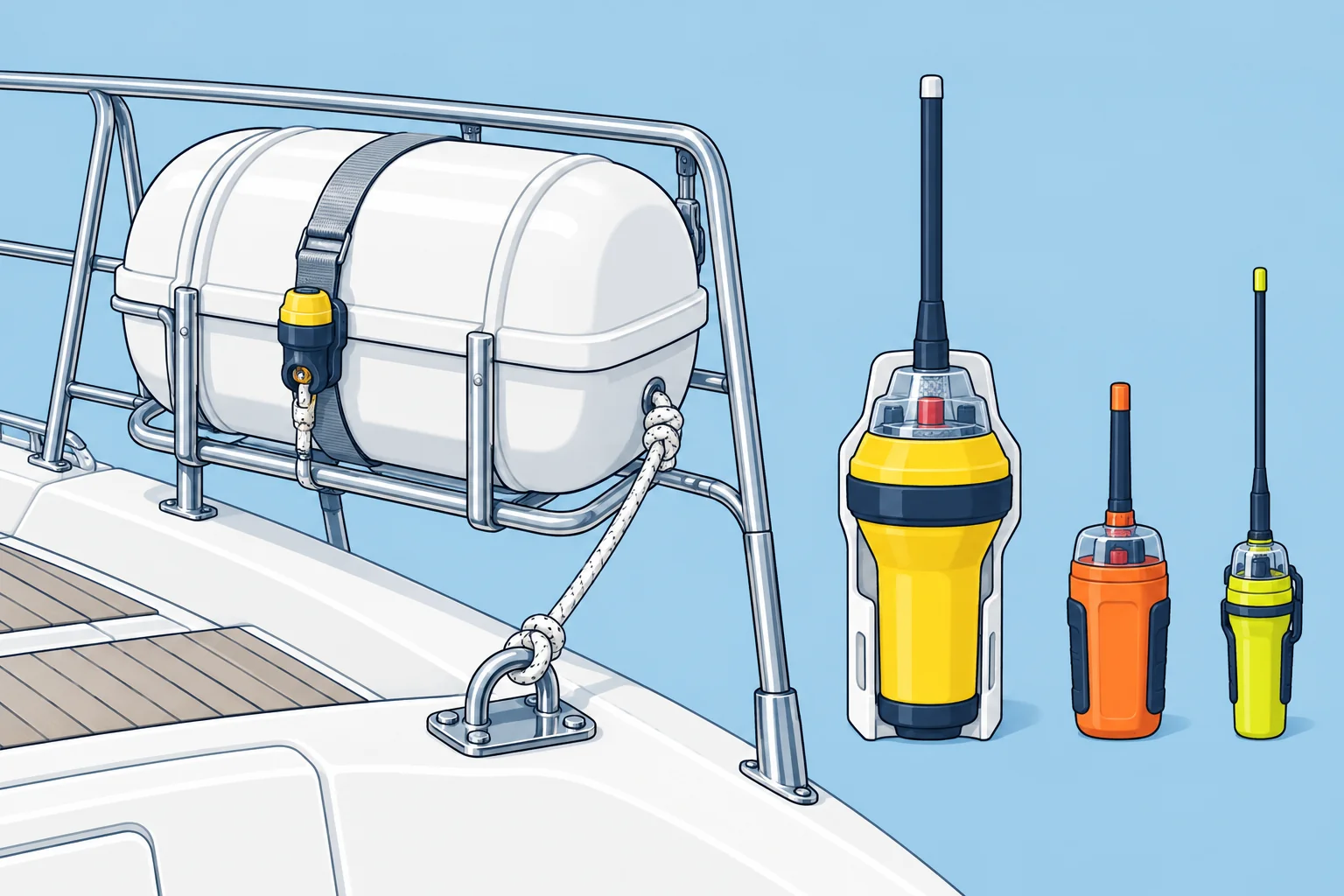
Liferaft and beacons at a glance
1The lesson in plain words
A liferaft is your last refuge and a beacon tells rescuers where you are. Know where they are stowed, how they work and when they were serviced.
Liferaft
A liferaft is an inflatable survival craft packed in a canister or valise, a soft carrying bag. Its painter is the line connecting it to the boat and its inflation system. Yacht rafts use ISO 9650 (offshore and inshore types); ship rafts use SOLAS, the International Convention for the Safety of Life at Sea. Check capacity covers everyone aboard and servicing follows the maker. Check the painter connection against the maker’s installation diagram.
Stowage
Keep the raft accessible and its escape path clear. Secure the canister or valise as the maker specifies. A hydrostatic release unit (HRU) frees a float-free raft if the boat sinks. For an HRU installation, connect the painter through the specified weak link, designed to break so the sinking boat cannot drag the inflated raft under. Use the approved strong point; do not bypass the weak link. Check the HRU expiry or service date. See Emergencies: abandon ship for launching and boarding.
Beacons
An EPIRB (emergency position-indicating radio beacon) belongs to the boat; a PLB (personal locator beacon) belongs to a person. Both send 406 MHz satellite distress alerts: EPIRBs for at least 48 hours, PLBs usually 24 hours. Register them with your national authority. An AIS-MOB beacon uses the automatic identification system to send a local person-overboard position to compatible AIS equipment within radio range; check your boat displays it and gives a warning.
Flares and signals
Flares (pyrotechnics) and other visual signals show rescuers where you are when they are close. Store them dry and in date, and dispose of old ones through approved schemes, never by firing them. Their types and use are in COLREG: distress signals, and in depth in Emergencies: helicopter and flares.
2Key data
- EPIRB
- 406 MHz satellite alert, registered to the boat, 48 h or more
- PLB
- 406 MHz satellite alert for one person, usually 24 h, manual
- AIS-MOB
- Local position signal to compatible AIS equipment in range
- Liferaft standards
- ISO 9650 for yachts; SOLAS for ships
3Key points
- 1
Know the liferaft’s capacity, service date and stowage; keep it accessible.
- 2
Check the painter connection against the maker’s installation diagram, including the specified weak link where fitted.
- 3
EPIRB = the boat’s beacon; PLB = a person’s beacon; both 406 MHz via satellite.
- 4
AIS-MOB sends a position to compatible AIS equipment in range; check your boat displays it and gives a warning.
- 5
Register 406 MHz beacons; keep flares dry and in date.
4Frequent mistakes
Wrong: A valise liferaft can live at the bottom of the cockpit locker under the fenders.
Right: It must come out in seconds. Stow it where nothing can be piled on top.
Wrong: Every distress beacon switches itself on in water.
Right: PLBs usually need manual activation. EPIRBs may be manual or automatic; check your model.
5Practice case & exam keys
At handover, the raft is in date but buried beneath heavy gear. The EPIRB battery is in date, but its registration names the previous owner. The charterer says the dates are all that matter. Is the boat ready?
Show the answer
No. Make the raft accessible and keep its escape path clear. Check its capacity and service date, and the painter connection against the maker’s installation diagram, including the weak link where fitted. Verify the EPIRB registration and update the owner and emergency contacts before sailing. Check its battery expiry and, if fitted, its HRU expiry. Valid dates alone do not make the equipment ready.
Exam keys
- Liferaft: ISO 9650 or SOLAS; check capacity, service date, access and the maker’s painter/weak-link arrangement.
- Where fitted, an HRU frees a float-free raft or EPIRB if the boat sinks; check its expiry or service date.
- EPIRB (boat) and PLB (person): 406 MHz satellite alerts; register them.
- AIS-MOB needs compatible equipment within range; check display and warning. Keep flares dry, in date; use approved disposal.
Finish this unit
When you've read it, answer three questions. Get all three right to finish the unit; opening the page alone doesn't count.
My notes for this unit
No notes