

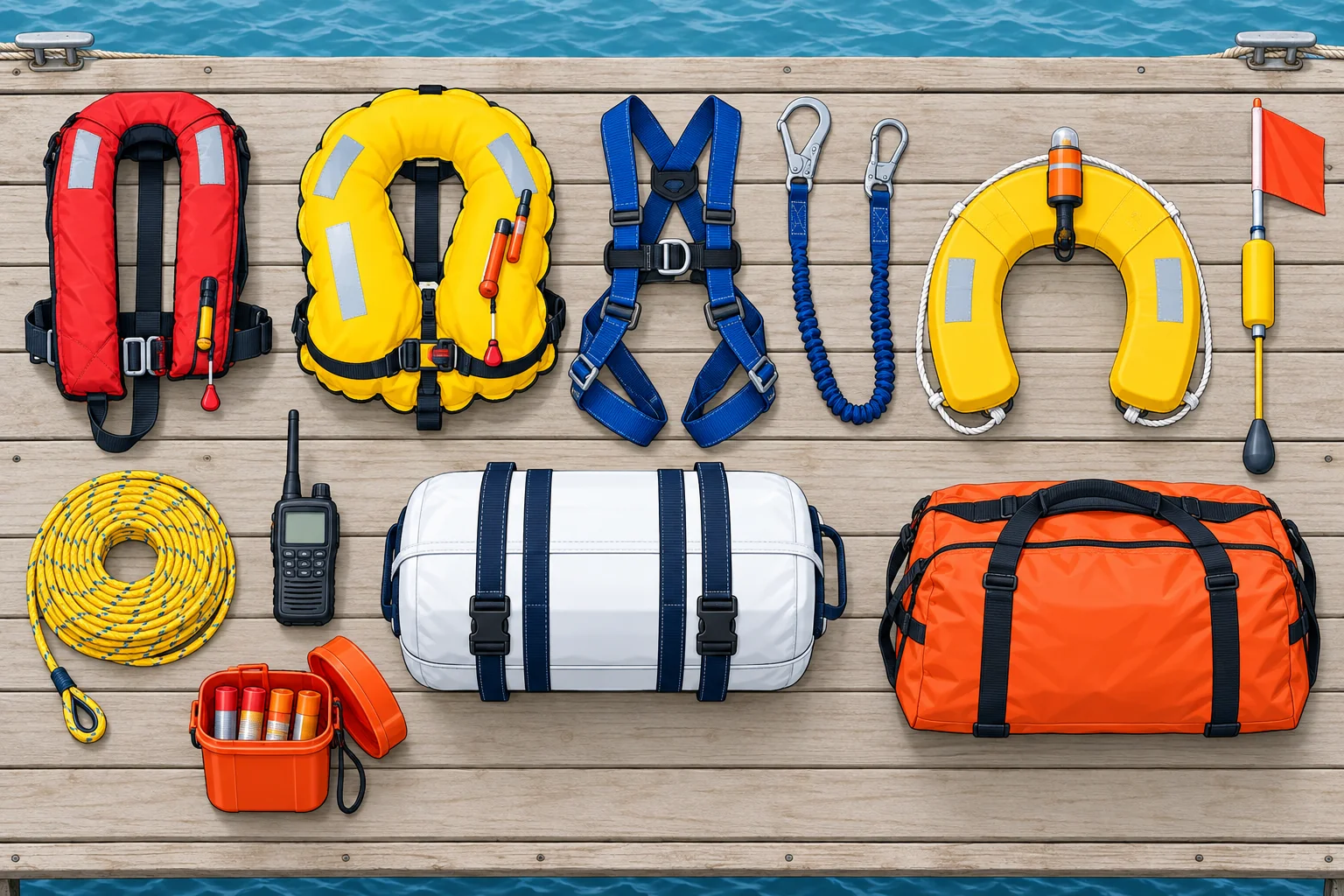
Kit for the trip, and showing it to the crew
1The lesson in plain words
Choose safety kit for your boat, crew, passage risks and applicable rules. Show every crew member where it is and how to call for help.
Rules are national
Your flag state, the country of registration, sets national carriage requirements. Local rules may also apply. Requirements vary with the boat and its use; many countries use distance from the coast or a place of shelter. Check the current rules for your boat and passage. For races, check whether the organiser applies the World Sailing Offshore Special Regulations (OSR).
Scale it to the trip
Always carry lifejackets, a way to call for help, an anchor, a bailer or pump, a torch, a horn and person-recovery equipment. Carry suitable first-aid and fire equipment. Use harnesses whenever conditions require them. Coastal trips typically need a marine VHF radio for voice calls and digital selective calling (DSC) for button-operated distress alerts. Offshore, typically add a liferaft, EPIRB, grab bag of emergency supplies and spare steering. These examples are not a legal checklist; offshore kit may suit inshore risks too.
Ready and marked
Kit must work when you need it. Mark lifebuoys, lifejackets and grab bags with the boat’s name. Keep a safety equipment plan, a simple drawing of where each item is, displayed in the cabin. Write the next service date of each item in your log or a checklist. Check the lifebuoy and danbuoy, a tall floating person-overboard marker, can be released in one movement.
Showing the crew
Before you leave, every person aboard must know where the lifejackets, liferaft, extinguishers, fire blanket, flares, first-aid kit, bungs and pumps are, and how to use the radio to call for help. The full briefing and drills are in Emergencies: drills. A crew that has been shown the kit can save the skipper, not only the other way round.
2Key points
- 1
Carriage rules are set by the flag state; many scale kit by distance offshore.
- 2
Build capability for inshore, coastal and offshore risks; carry first aid, suitable fire kit and recovery equipment on every trip.
- 3
Offshore typically adds liferaft, EPIRB, grab bag; use harnesses whenever conditions require, even near shore.
- 4
Mark kit with the boat’s name and keep a safety equipment plan displayed in the cabin.
- 5
Show every crew member where the kit is and how to call for help.
3Frequent mistakes
Wrong: If the kit meets another country’s list, it is legal anywhere.
Right: Your flag state’s rules apply to your boat. Check them, and any local rules where you sail.
Wrong: Only the skipper needs to know where the safety kit is.
Right: The skipper may be the casualty. Every person aboard must know the kit and how to call for help.
4Practice case & exam keys
You plan an overnight crossing with six people, reaching 30 nautical miles from the nearest safe haven. Your current kit serves short daytime coastal trips. How do you decide what must change?
Show the answer
Review what is aboard against flag-state and local requirements for the boat, people and maximum distance from shelter. Assess darkness and delayed rescue. Check raft capacity, beacon readiness, harnesses and recovery aids. Review first-aid and fire equipment suited to the boat; add or upgrade what is missing. Update service records and the equipment plan displayed in the cabin, then show the crew.
Exam keys
- Carriage requirements are national, often using distance bands; OSR apply to races that adopt them.
- Scale kit to the risks: first aid, suitable fire and recovery kit on every trip; harnesses when needed; raft and beacon for delayed rescue.
- Safety equipment plan displayed in the cabin; kit marked with the boat’s name and in date.
- Every crew member knows where the kit is and how to call for help.
Finish this unit
When you've read it, answer three questions. Get all three right to finish the unit; opening the page alone doesn't count.
My notes for this unit
No notes