

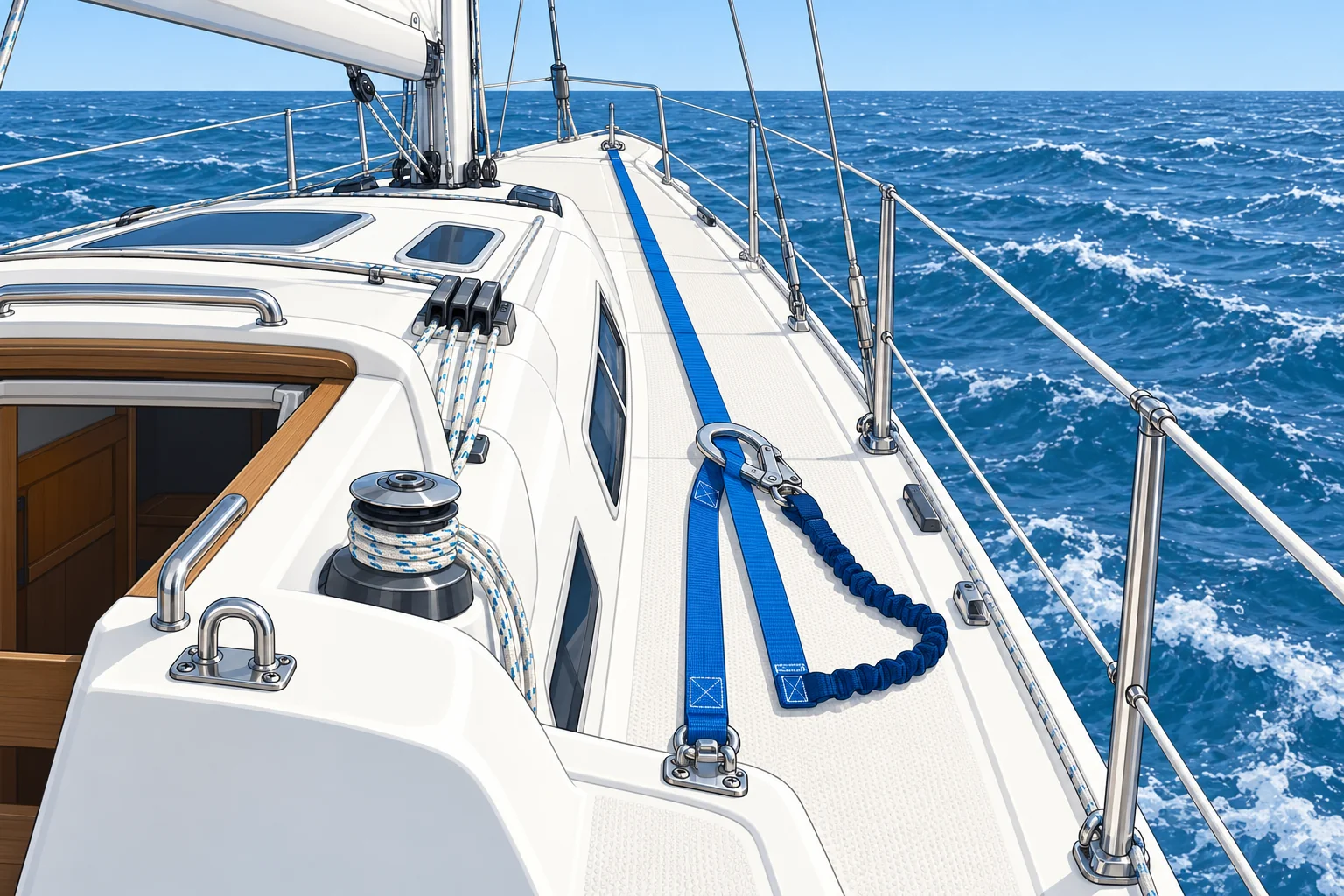
Harness, jackstays and tethers: staying on board
1The lesson in plain words
A lifejacket helps you float; a harness and tether keep you on the boat. Clip on before coming on deck and to points that keep you inboard.
Why clip on
Recovering someone from the water is slow and hard, especially at night or short-handed. The best man-overboard plan is not to go over. A safety harness worn with, or built into, your lifejacket attaches you to the boat with a tether, a short safety line. Use it at night, in rough weather, when alone on deck, when working at the mast or bow, and whenever the skipper says so.
Tethers
Harnesses and tethers are made to ISO 12401. Use a tether at most 2 m long with self-closing, self-locking hooks; check each gate is locked and correctly seated. A multi-hook tether lets you clip short and stay attached when changing points. An overload flag in the stitching shows the tether has taken a shock load: replace it. Some tethers have a chest-end quick-release; follow its instructions.
Jackstays
Jackstays are strong lines, usually flat webbing, running from bow to stern along each side deck. You clip on and walk forward without unclipping. Webbing does not roll under your feet like rope. Rig them so that a clipped-on person cannot reach the water, ideally along the middle of the deck. Check them for sun damage and chafe, wear from rubbing, each season, and take them in when not used.
Strong points
Clip to jackstays or dedicated clipping points, never guardwires (lifelines), sharp-edged cleats or anything that could break or let the hook slide off. Fit a clipping point by the companionway, the opening and steps between cabin and deck. Clip on before coming on deck; unclip only after going below. Near the helm, a short tether stops you falling across the cockpit.
2Key points
- 1
A harness keeps you on the boat; a lifejacket only helps you float once you are in.
- 2
Clip on before coming on deck; unclip only after going below.
- 3
Tethers to ISO 12401, at most 2 m, with self-closing, self-locking hooks; replace after an overload.
- 4
Rig jackstays so a clipped-on person cannot reach the water.
- 5
Never clip to guardwires: they are not designed for a falling body.
3Frequent mistakes
Wrong: Clipping to the guardwire is fine for a moment.
Right: Guardwires can fail under a shock load and let you go over the side. Clip to a jackstay or strong point.
Wrong: A long tether gives freedom to work safely.
Right: A long tether lets you reach the water and be dragged. Clip short and keep inboard.
Wrong: You clip on once you reach the side deck.
Right: Clip on from inside the companionway. Many falls happen in the first step on deck.
4Practice case & exam keys
At night in a rising wind a crew member must go forward to free a snagged jib sheet, the rope controlling the forward sail. The jackstays run along the outer edge of the side decks and the crew has a 2 m single-hook tether. How do you make the trip safer?
Show the answer
Keep the crew in the cockpit until you can provide a route that prevents a fall overboard. Replace the single-hook tether with a suitable short or multi-hook tether and use sound inboard clipping points. Check the whole route keeps them out of the water. Stay clipped on when changing points. Clip on before coming on deck. If you cannot make the route safe, defer the job.
Exam keys
- Harness and tether to ISO 12401; tether at most 2 m with self-closing, self-locking hooks; replace after overload.
- Jackstays: flat webbing bow to stern, rigged so a clipped-on person stays on board.
- Clip to jackstays or clipping points, never guardwires; clip on before coming on deck.
- Wear it at night, in rough weather, alone on deck or when told.
Finish this unit
When you've read it, answer three questions. Get all three right to finish the unit; opening the page alone doesn't count.
My notes for this unit
No notes