

From compass error to deviation: using the results
1The lesson in plain words
Remove the variation to find deviation, compare with the card for that heading, and decide what to trust. One check is one heading.
Variation first
Deviation = compass error − variation, east plus, west minus. In mid-ocean, take variation from an ocean chart's lines of equal variation, updated to the year, or from the plotter's World Magnetic Model (WMM2025, valid 2025 to 2030). Mid-Atlantic, near 16°N 40°W, it is about 14° to 15°W in late 2026.
Compare with the card
Look up the deviation card for that heading. Two checks on 4 December 2026, both on 262°C, gave 1.1°E by amplitude and 0.9°E by azimuth. If the card says about 1°E on 262°C, the compass is behaving. Use the average, 1.0°E.
A big change
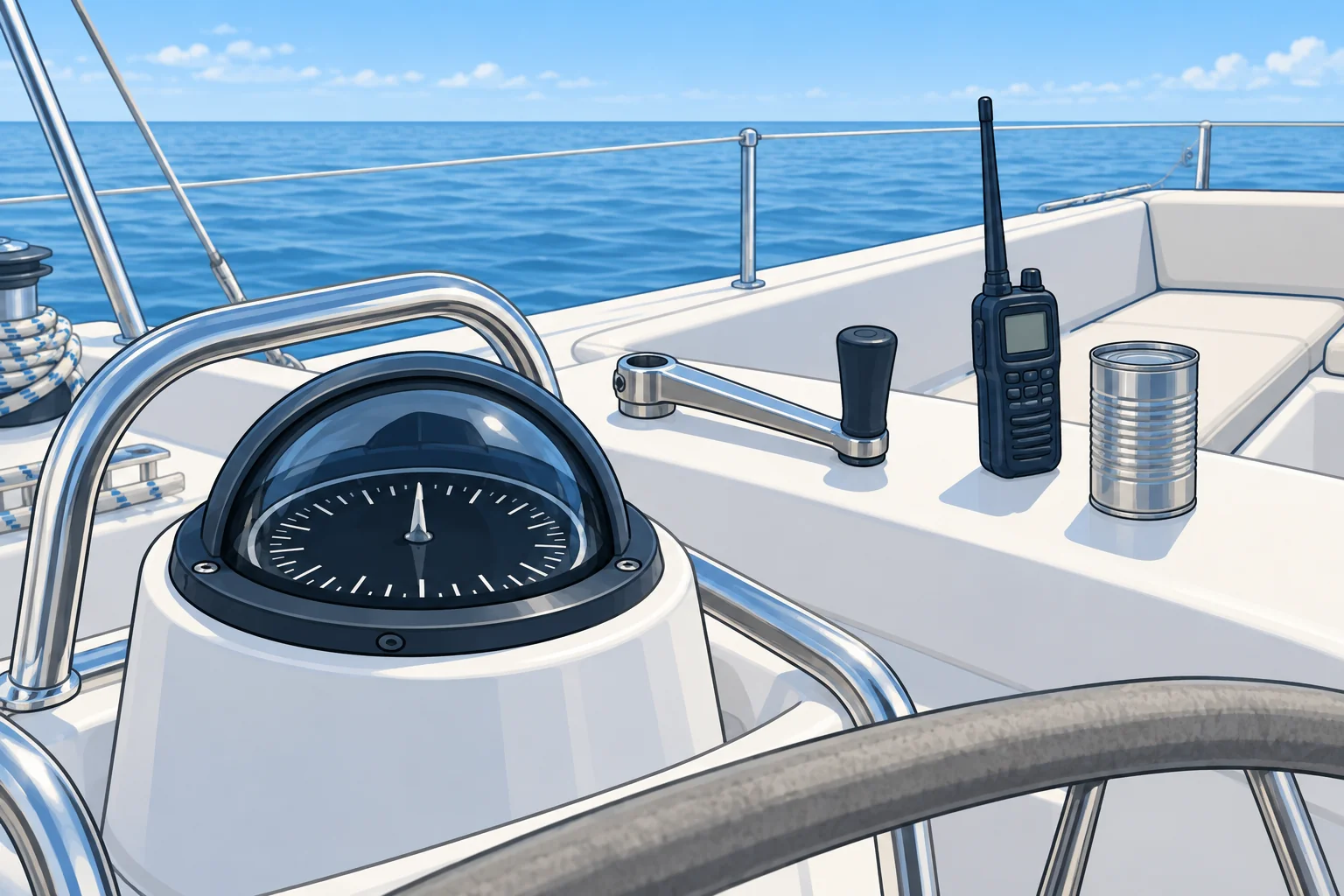
A deviation several degrees from the card is a warning. Check what has moved near the compass: a winch handle, a speaker, a phone, a tin of food, a new instrument. Repeat the check. If it stays, steer by the observed deviation on that heading and plan a proper compass swing in port.
Other headings
Deviation varies with heading, so one check fixes one heading only. On a long reach you may keep one heading for days: that is the one that matters. After a big course change, check again on the new heading.
Errors
A sloppy bearing is the main error: aim for 0.5° on a steady boat. Also: a wrong time (azimuth), a misjudged rising moment (amplitude), an outdated variation. Two methods that agree within a degree give confidence.
2Key data
- Deviation
- Compass error − variation (east +, west −)
- Variation at sea
- Updated chart lines of equal variation, or WMM2025 (2025–2030)
- Mid-Atlantic, late 2026
- About 14° to 15°W near 16°N 40°W
- Worked checks on 262°C
- Amplitude 1.1°E, azimuth 0.9°E: use about 1.0°E
- One check
- Gives the deviation on one heading only
3Key points
- 1
Deviation = error − variation; variation from the ocean chart or the current WMM.
- 2
Compare with the deviation card for the heading steered; two methods should agree.
- 3
A large change needs checking: repeat the observation, check magnetic gear nearby, and log the confirmed result.
- 4
Re-check after any big change of heading.
4Frequent mistakes
Wrong: Variation is small in the open ocean, so ignore it.
Right: Mid-Atlantic near 16°N 40°W it is about 14° to 15°W. Ignoring it would put that whole error into the deviation.
Wrong: Apply today's deviation on 262°C to every heading.
Right: Deviation changes with heading. Check again after a big course change.
Wrong: A single check that disagrees with the card proves the card wrong.
Right: Repeat it, try another method, and look for loose magnetic objects first.
5Practice case & exam keys
Heading 262°C. Yesterday the azimuth check gave deviation 0.9°E. Today, same heading, the amplitude gives 5.8°E. Nothing else has changed, says the crew. What do you do?
Show the answer
Treat it as a warning, not a new value. Look round the compass for anything magnetic moved since yesterday: a handheld radio, a winch handle, a new speaker. Remove it and repeat the check, then confirm with an afternoon azimuth. If 5.8°E persists, steer with it on this heading, log it, and have the compass swung in port.
Exam keys
- Deviation = compass error − variation; per heading.
- Variation at sea: updated chart lines of equal variation, or WMM2025.
- Two independent checks (amplitude, azimuth) should agree within about a degree.
- Large change: look for magnetic objects, re-check, log, swing in port.
Finish this unit
When you've read it, answer three questions. Get all three right to finish the unit; opening the page alone doesn't count.
My notes for this unit
No notes