

15Crossing Situation
1The rule in plain words
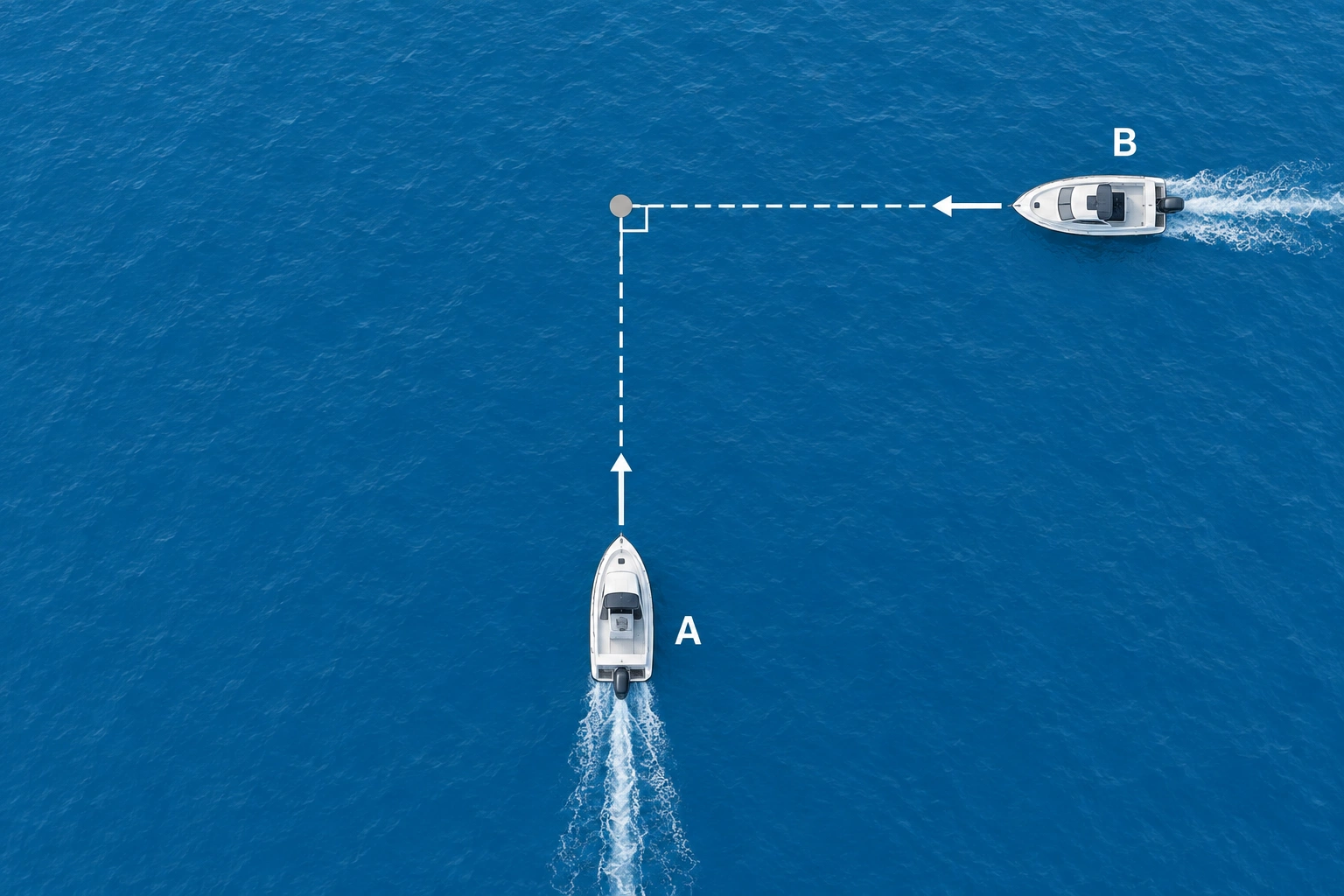
When two power-driven vessels cross with risk of collision, the one with the other on starboard keeps out of her way and avoids crossing ahead if possible.
Who gives way?
If two power-driven vessels are crossing with risk of collision, the one with the other on her starboard side keeps out of the way.
Which manoeuvre do you avoid?
If the circumstances admit, the vessel keeping out of the way avoids crossing ahead of the other.
How can you remember it?
Rule 15 uses the bearing from your vessel. Sidelight colour shows her aspect.
2Key points
- 1
Two power-driven vessels crossing with risk of collision.
- 2
Other vessel on starboard → you keep out of the way.
- 3
If circumstances admit → avoid crossing ahead.
- 4
Sidelight colour shows her aspect; determine her bearing from your vessel.
3Frequent mistakes
Wrong: "If the other vessel is on my starboard side, I keep my course."
Right: If you have the other vessel on your starboard side, you keep out of her way.
Wrong: "I may cross ahead if I get there first."
Right: Avoid crossing ahead when the circumstances of the case admit it.
Wrong: "Rule 15 applies to every crossing between vessels."
Right: It requires two power-driven vessels crossing so as to involve risk of collision.
4Exam keys & interpretation
Exam keys
- "On her own starboard side" identifies the vessel that must keep out of the way: the one seeing the other there.
- When the question says "if the circumstances of the case admit", that condition qualifies avoiding crossing ahead.
- Do not merge "avoid crossing ahead" with "keep out of the way": the former is an added, conditional instruction.
How to read it
- Read the sentence from the observing vessel: where is the other? If it is on starboard, that vessel keeps out of the way.
- Treat "if the circumstances of the case admit" as a condition on avoiding crossing ahead, not permission to ignore the Rule.
5Official text
IMO COLREG 1972U.S. Coast Guard — International Navigation Rules (2024)
Full wording of the rule, reproduced from the official source below.
When two power-driven vessels are crossing so as to involve risk of collision, the vessel which has the other on her own starboard side shall keep out of the way and shall, if the circumstances of the case admit, avoid crossing ahead of the other vessel.Source: U.S. Coast Guard — International Navigation Rules (2024)
Finish this unit
When you've read it, match the terms, then answer three questions. Get them all right to finish the unit; opening the page alone doesn't count.
My notes for this unit
No notes