
13Overtaking
1The rule in plain words
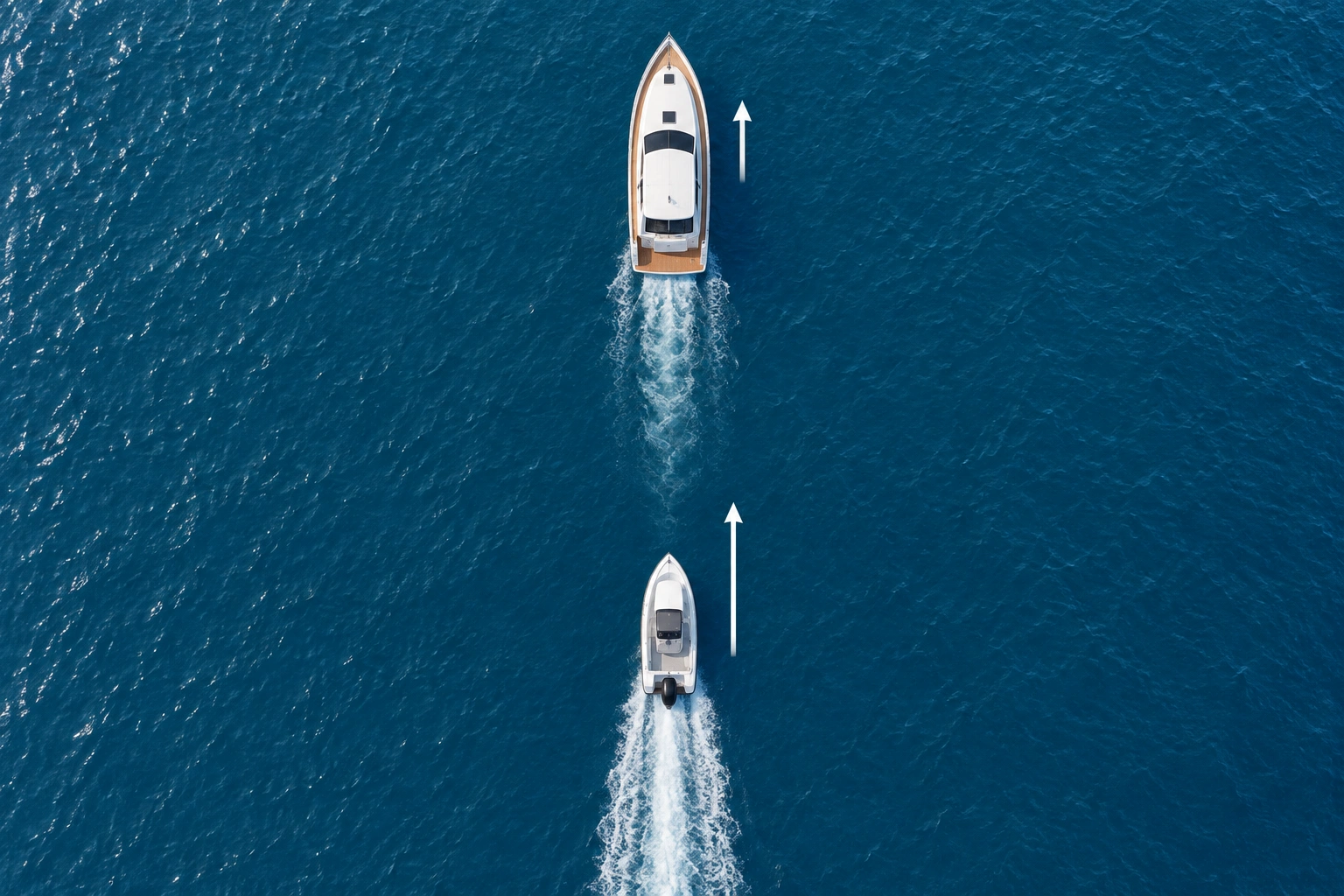
If you overtake another vessel, COLREG requires you to keep clear of her.
What duty comes first?
Notwithstanding Part B, Sections I and II, an overtaking vessel shall keep out of the way of the vessel being overtaken.
When are you overtaking?
When coming up from more than 22.5° abaft her beam; at night you would see only the sternlight, not her sidelights.
What if you are unsure?
If in doubt whether you are overtaking another vessel, assume that this is the case and act accordingly.
Does a later bearing change help?
No: it does not make you a crossing vessel or relieve your duty to keep clear until finally past and clear.
2Key points
- 1
Part B I–II do not change the overtaking vessel's duty.
- 2
More than 22.5° abaft the beam → overtaking.
- 3
Doubt → assume overtaking and act accordingly.
- 4
Later bearing ≠ crossing; wait until finally past and clear.
3Frequent mistakes
Wrong: "If I see only the sternlight, I am crossing."
Right: That position fits an overtaking vessel: she is coming from more than 22.5° abaft the beam.
Wrong: "If the bearing changes, I become a crossing vessel."
Right: A subsequent alteration does not change that status or remove your duty to keep clear.
Wrong: "If I am unsure, I act as though I am crossing."
Right: When in doubt, assume you are overtaking and act accordingly.
4Exam keys & interpretation
Exam keys
- "Notwithstanding" at 13(a): the overtaking vessel keeps clear despite Part B Sections I and II.
- "More than 22.5° abaft": exactly 22.5° does not meet the literal threshold.
- A later bearing alteration does not create a crossing vessel; look for "until finally past and clear".
How to read it
- The test is the geometry described: the bearing and the lights you would see at night, not a passing impression.
- Read "until" as a real limit: the duty continues until you are finally past and clear.
5Official text
IMO COLREG 1972U.S. Coast Guard — International Navigation Rules (2024)
Full wording of the rule, reproduced from the official source below.
(a) Notwithstanding anything contained in the Rules of Part B, Sections I and II, any vessel overtaking any other shall keep out of the way of the vessel being overtaken.
(b) A vessel shall be deemed to be overtaking when coming up with another vessel from a direction more than 22.5° abaft her beam, that is, in such a position with reference to the vessel she is overtaking, that at night she would be able to see only the sternlight of that vessel but neither of her sidelights.
(c) When a vessel is in any doubt as to whether she is overtaking another, she shall assume that this is the case and act accordingly.
(d) Any subsequent alteration of the bearing between the two vessels shall not make the overtaking vessel a crossing vessel within the meaning of these Rules or relieve her of the duty of keeping clear of the overtaken vessel until she is finally past and clear.Source: U.S. Coast Guard — International Navigation Rules (2024)
Finish this unit
When you've read it, match the terms, then answer three questions. Get them all right to finish the unit; opening the page alone doesn't count.
My notes for this unit
No notes