

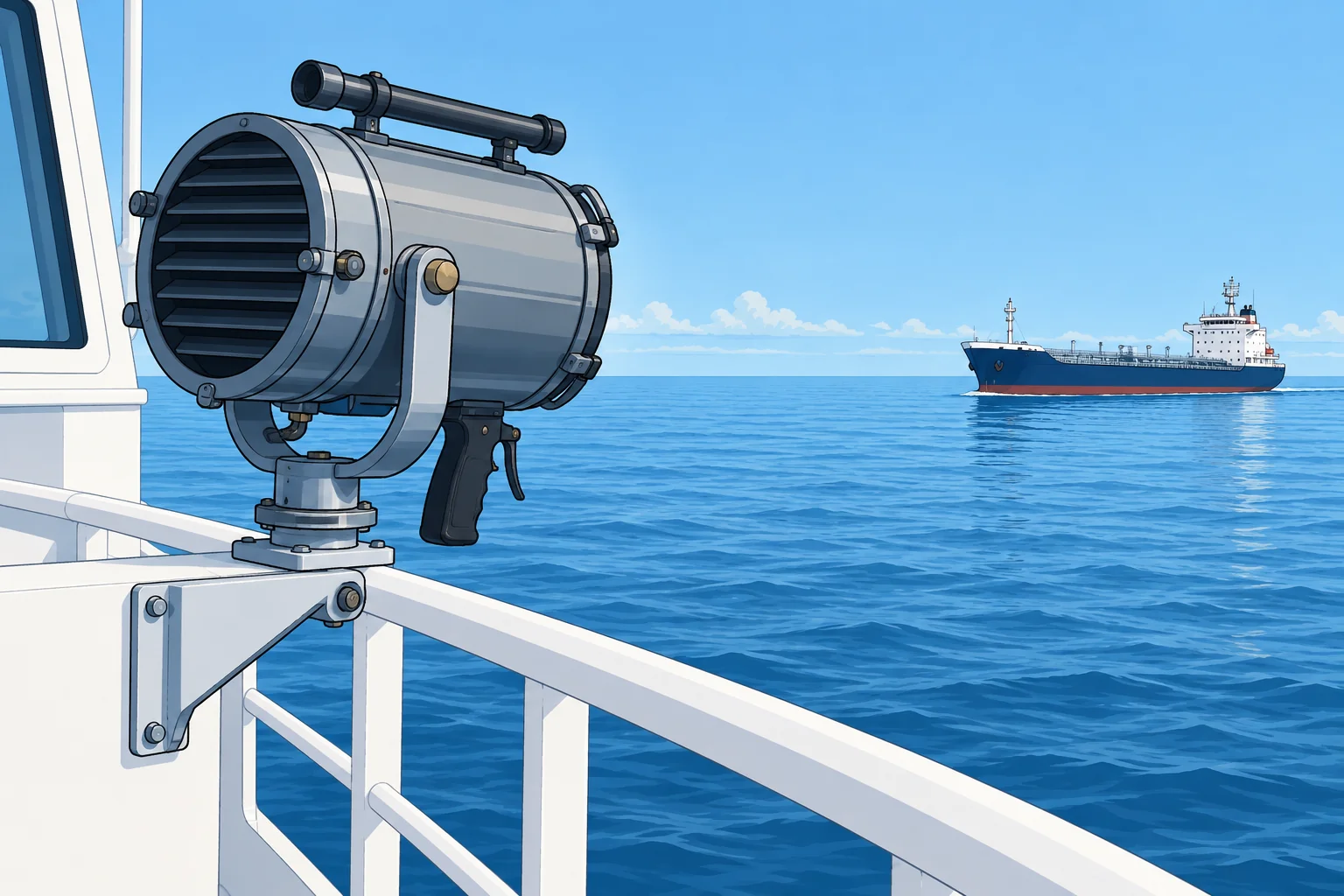
The daylight signalling lamp and when to use light
1The lesson in plain words
SOLAS requires a daylight signalling lamp or equivalent means on ships ≥150 GT and all passenger ships. Use light when VHF or a shared language fails.
The requirement
SOLAS V/19 requires every ship of 150 gross tonnage and upwards, and every passenger ship, to carry a daylight signalling lamp, or other means to communicate by light by day and night. Its power must not depend solely on the ship’s supply. The IMO performance standard, MSC.95(72), adds a portable battery weighing no more than 7.5 kg that runs the lamp for at least 2 hours.
The lamp
Many officers call it an Aldis lamp. A trigger opens a shutter or tilts a mirror, so the beam flashes without switching the lamp on and off. A sight on top lets you aim the narrow beam at the other ship’s bridge. Brace your arms, keep the beam steady on target and test the lamp and battery at each equipment check.
Your STCW competence
STCW table A-II/1 asks an officer of the watch to transmit and receive information by visual signalling. That means using the International Code of Signals, and sending and receiving SOS and single-letter signals by Morse light. Full messages by lamp are now rare and are not the core of the standard.
When light helps
Use VHF first: it is faster and you can talk. Light still helps when a ship does not answer the radio, when a radio has failed, when you share no language, or to reach one ship in a crowd. A single-letter Code signal is quick to send if the receiver knows its meaning. Keep light messages short.
2Key data
- Carriage (SOLAS V/19)
- Ships ≥150 GT and all passenger ships; lamp or equivalent means
- Power
- Not solely dependent on the ship’s supply
- Portable battery (MSC.95(72))
- ≤7.5 kg, at least 2 hours’ operation
- STCW A-II/1 by light
- SOS and single-letter signals in Morse
3Key points
- 1
Ships ≥150 GT and all passenger ships carry a daylight signalling lamp or equivalent means.
- 2
Its power must not depend only on the ship’s supply; check the battery regularly.
- 3
STCW asks for SOS and single-letter signals by Morse light, and use of the Code.
- 4
Use VHF first; light helps when radio or a shared language fails.
4Frequent mistakes
Wrong: Flash the lamp in the general direction of the other ship.
Right: Aim the narrow beam with the sight at the other ship’s bridge and hold it steady.
Wrong: The lamp runs from the ship’s mains, so a blackout is not a problem.
Right: That is why it needs power not solely dependent on the ship’s supply. Keep the portable battery charged.
5Practice case & exam keys
At night, VHF calls go unanswered. You can see the other ship’s bridge. Your lamp works from the mains, but its portable battery is flat. Can you rely on it as an independently powered back-up?
Show the answer
No. With its battery flat, the lamp depends entirely on the ship’s supply. Restore independent power or use a suitable independently powered light-signalling alternative. Light can help after unanswered VHF calls. Use the sight to aim steadily at the other bridge and keep the message short. Keep trying VHF and report the lack of response to the master.
Exam keys
- SOLAS V/19: lamp or equivalent means, day and night; ships ≥150 GT and all passenger ships.
- Power not solely dependent on the ship’s supply; battery ≤7.5 kg, ≥2 h (MSC.95(72)).
- STCW A-II/1: SOS and single-letter signals by Morse light; use of the ICS.
- VHF first; light for radio failure, no response or no common language.
Finish this unit
When you've read it, answer three questions. Get all three right to finish the unit; opening the page alone doesn't count.
My notes for this unit
No notes