
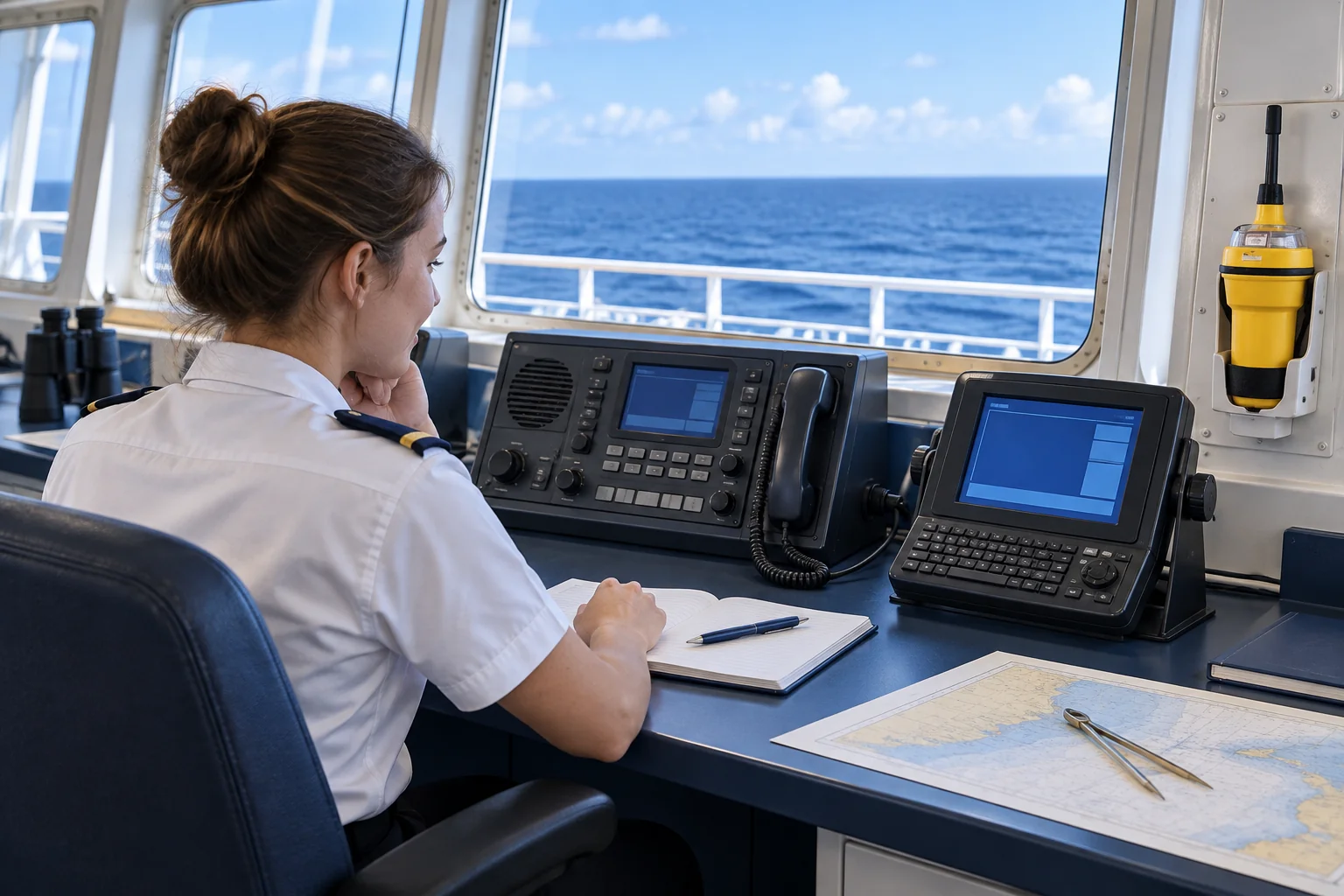
Module 13 — Radio log, publications and station management
1The lesson in plain words
A useful radio log keeps traceable facts: UTC time, identity, equipment, result, defects, actions, and corrections.
What do you keep available?
Keep the station licence and certificates, equipment manuals, and required current service publications available.
What do you record?
So another operator can reconstruct the event, record UTC date and time, identity, channel or equipment, event or test, and result.
How do you handle a fault?
Add the defect or corrective action, state who was responsible, and record the assigned follow-up.
What can you not conclude?
A neat example does not prove a real call. A self-test shows only what it observed; it does not establish coverage, compliance, or RCC status. Keep observation and inference separate.
2Step by step
Traceable radio-log entry
- 1
Identify the relevant station, equipment, service, and identity.
You link the record to the station or service involved.
- 2
Record the UTC date and time and describe the event.
UTC orders events consistently.
- 3
Record the observed result, including any failure.
You preserve what the test or event showed.
- 4
Record who was responsible and what follow-up was assigned.
The log shows who responds and what remains outstanding.
- 5
Preserve the original and make corrections auditable.
Traceability prevents an example being presented as a real event.
3Key data
- Station licence
- Available
- Operator certificates
- Applicable and available
- Equipment instructions
- Available
- Service publications
- Current and required
- Log time
- UTC
- Normal ship MMSI
- MIDxxxxxx
- Ship group identity
- Starts with 0
- Coast station identity
- Starts with 00
4Key points
- 1
UTC time, identity, channel/equipment, result, defect, action, and responsible operator.
- 2
Correct without erasing the original; preserve traceability.
- 3
The flag administration sets many equipment, publication, and retention details.
- 4
An example or self-test proves neither a real event, coverage, nor compliance.
5Frequent mistakes
Wrong: "This sample log proves that the call happened."
Right: A neat example does not prove a real call; keep it identified as fictional.
Wrong: "MCA daily, weekly, and monthly tests apply to every flag."
Right: They are evidence for UK ships, not universal requirements.
Wrong: "If the self-test responds, I know the coverage and RCC status."
Right: A self-test proves only what it observed; coverage and RCC need additional evidence.
6Exam keys & interpretation
Exam keys
- If you see «time», look for «UTC»: it is the log's time basis.
- If you see «MMSI pattern», remember: a pattern does not authorise inventing a real identity.
- If you see «local test», do not conclude «received by the coast station»: evidence is missing.
How to read it
- Think of the log as an evidence chain: another operator should reconstruct what happened and what follow-up was assigned.
- Separate observation from conclusion: a traceable correction improves the record, but an available document is not proven current for this ship or voyage.
7Go deeper: GOC exam level
The detail behind each step for the General Operator's Certificate: the rules, the radio technique and worked cases.
Keeping the equipment available
SOLAS requires the functional availability of the radio equipment. In sea areas A1 and A2 this is met by duplication of equipment, shore-based maintenance, at-sea electronic maintenance capability, or an approved combination. In A3 and A4 a combination of at least two of these methods is required. The ship's actual arrangement is recorded in its certificate and documents.
| Method | What it means in practice |
|---|---|
| Duplication of equipment | A second, independent installation for the critical functions |
| Shore-based maintenance | Contracted repair service in port, documented |
| At-sea electronic maintenance | A qualified person, spares and tools on board |
The radio record
Record incidents connected with the radiocommunication service that appear important to safety of life at sea. The Administration's rules set the detail, but a useful record normally includes:
- Distress, urgency and safety traffic heard or handled, with times in UTC.
- Daily, weekly and monthly tests and their results.
- Battery condition checks.
- Faults, repairs, alarms and anything that affected availability.
- Position updates entered manually when the GNSS feed failed.
Testing without false alerts
GMDSS equipment has specific test modes. The real distress button is never used "to see if it works". Tests of DSC, EPIRB, SART and satellite terminals follow the manuals and IMO circulars, checking the chain without alerting an RCC or disturbing protected channels.
| Interval | Typical routine (follow the ship's own procedures) |
|---|---|
| Daily | DSC internal test without radiation; reserve battery and charger check; printers and paper |
| Weekly | DSC test call with a coast station where possible; reserve source test if it is not a battery |
| Monthly | EPIRB and SART self-tests; battery condition and connections; survival VHF check; satellite terminal test |
The weekly DSC test call. Send an individual call to a coast station's MMSI with the category safety and the telecommand test, on a DSC frequency the station watches (never with the distress category). The coast station answers automatically with a test acknowledgement; no voice follows. Write the result in the radio record. Keep test calls on the distress frequencies to a minimum, and send them only to coast stations that accept them.
Interference and protecting frequencies
- No voice on Channel 70.
- No unauthorized tests on distress frequencies.
- Keep distress traffic free of unnecessary transmissions.
- Use the power and working channels the job needs, to reduce congestion.
- Stop any transmission that interferes with higher-priority traffic.
Publications: where to find a frequency
A professional does not memorize every frequency, channel and schedule. They know where to look, and they check that the edition and corrections are current.
| ADMIRALTY List of Radio Signals | Contents |
|---|---|
| Vol. 1 (NP281) | Maritime radio stations, satellite services, coastguard, TMAS |
| Vol. 2 (NP282) | Radio aids to navigation, DGPS, time signals, AIS AtoN |
| Vol. 3 (NP283) | Maritime Safety Information: weather, navigational warnings, NAVTEX and EGC broadcasts |
| Vol. 4 (NP284) | Meteorological observation stations |
| Vol. 5 (NP285) | GMDSS, distress and SAR, MRCC/MRSC, SOLAS/ITU extracts |
| Vol. 6 (NP286) | Pilot services, VTS, port operations and reporting systems |
The UKHO keeps these up to date through ADMIRALTY Notices to Mariners; the digital ADRS makes searching easier.
The ITU List V (List of Ship Stations and Maritime Mobile Service Identity Assignments) gives ships' names, call signs, MMSIs and accounting authorities. The ITU List IV (List of Coast Stations and Special Service Stations) gives transmit/receive frequencies, coordinates, DSC and voice watchkeeping, services, schedules, medical advice, MSI, VTS and RCCs. National publications, such as Spain's Radioseñales Náuticas from the Instituto Hidrográfico de la Marina, cover their own coasts in detail.
| Need | First place to look |
|---|---|
| Coast station, TMAS, radio contact | ALRS Vol. 1 / national list / ITU List IV |
| NAVTEX, EGC, weather warnings | ALRS Vol. 3 / national list |
| MRCC/MRSC, GMDSS, SAR | ALRS Vol. 5 / ITU List IV |
| VTS, pilot, port channel | ALRS Vol. 6 / national list / port information |
Documents the station must carry
Radio Regulations Appendix 16 and SOLAS together set what a GMDSS ship keeps at the radio station:
| Document | Why it is there |
|---|---|
| Ship station licence | Authorizes the station to transmit |
| Operators' certificates (GOC/ROC) | Prove each operator's competence |
| Radio record (radio log) | Evidence of watches, traffic, tests and faults |
| ITU List IV (coast stations) and List V (ship stations) | Frequencies, watches, services, identities |
| ITU Manual for use by the maritime mobile and maritime mobile-satellite services | Procedures and extracts of the Radio Regulations |
| Safety Radio Certificate with its Record of Equipment (Form R) | Shows the approved installation, sea areas and maintenance methods |
Licences, secrecy and inspections
- Ship station licence. No ship station may transmit without a licence from the flag Administration (Radio Regulations Article 18). Keep it on board with the operators' certificates.
- Secrecy of correspondence. Operators must not divulge or use the content of radio traffic not meant for the general use of the public (Article 17).
- Inspections. Surveys for the Safety Radio Certificate and port-state or Administration inspectors may check the licence, the certificates, the radio record, the publications, the equipment and its tests.
Public correspondence
- Accounting. Paid traffic through coast or satellite stations is billed through the ship's accounting authority, identified by its AAIC (Accounting Authority Identification Code).
- Charges. A paid call is made up of the coast or land earth station charge plus any onward network charge. Distress traffic is free of charge, and so are urgency and safety messages to RCCs and the special services (medical advice, maritime assistance) in most networks.
- Link calls. A radiotelephone call through a coast station into the public telephone network. Call the station on its working channel or frequency (a DSC routine call with telephony telecommand where it supports one), give your ship's name, call sign, AAIC and the number required, and wait to be connected. Satellite services have replaced most of this traffic, but the procedure is still examined.
- Traffic lists. Some coast stations still broadcast, at scheduled times, a list of ships for which they hold traffic; the schedules are in the radio publications.
- Ship reporting systems. Voluntary systems such as AMVER, and mandatory national or regional systems, use position reports so rescuers know which ships are nearby.
- Time signals and weather. Their schedules and frequencies are listed in the ALRS (Volumes 2 and 3).
References: SOLAS IV as amended by MSC.496(105) · IMO GMDSS circulars
GOC exam check
How must a ship trading in sea area A3 ensure availability of its radio equipment?
- By any one of the three methods
- By duplication of equipment alone
- By a combination of at least two methods
- By shore-based maintenance alone
Show the answer
C. By a combination of at least two methods
Why: In A3 and A4 at least two of duplication, shore-based maintenance and at-sea maintenance are combined. One method is enough only in A1 and A2.
How is the weekly DSC test call to a coast station set up?
- Individual call, distress category, telecommand test
- Individual call, safety category, telecommand test
- All-ships call, safety category, telecommand test
- Individual call, routine category, telephony follow-on
Show the answer
B. Individual call, safety category, telecommand test
Why: An individual call to the coast station's MMSI with safety category and test telecommand; the station answers automatically. Never use the distress category to test.
You need the MRCC contacts and SAR arrangements for the next coast. Which ADMIRALTY List of Radio Signals volume do you open?
- Volume 1 (NP281)
- Volume 3 (NP283)
- Volume 6 (NP286)
- Volume 5 (NP285)
Show the answer
D. Volume 5 (NP285)
Why: Volume 5 covers GMDSS, distress and SAR, MRCC/MRSC. Volume 1 lists radio stations and Volume 3 the MSI broadcasts.
You need another ship's MMSI and accounting authority. Which publication lists them?
- ITU List V
- ITU List IV
- ALRS Volume 1
- ALRS Volume 6
Show the answer
A. ITU List V
Why: List V is the List of Ship Stations and MMSI Assignments. List IV covers coast stations and special service stations.
A crew member repeats in the mess what they overheard in a ship-to-shore call for another vessel. Which obligation have they broken?
- The ship station licence (Article 18)
- The radio record requirement
- Secrecy of correspondence (Article 17)
- The protection of distress frequencies
Show the answer
C. Secrecy of correspondence (Article 17)
Why: Operators must not divulge or use traffic not meant for general public use under Article 17. Article 18 is about licensing the station.
How are paid calls through coast or satellite stations billed to the ship?
- Through the RCC that serves the area
- Through the flag Administration's licence fee
- Directly by the coast station to the master
- Through the accounting authority, by its AAIC
Show the answer
D. Through the accounting authority, by its AAIC
Why: Paid traffic is billed through the ship's accounting authority, identified by its AAIC. RCCs coordinate SAR; they do not bill traffic.
Which test belongs to the typical monthly routine?
- EPIRB and SART self-tests
- DSC internal test without radiation
- DSC test call with a coast station
- EPIRB shore-based maintenance
Show the answer
A. EPIRB and SART self-tests
Why: EPIRB and SART self-tests are monthly. The internal DSC test is daily, the coast-station test call weekly and shore-based maintenance at most five-yearly.
During the night watch you heard a PAN-PAN and later ran the daily DSC test. How should they go in the radio record?
- Only the PAN-PAN; routine tests are not recorded
- Both, as they happen, with times in UTC
- Both, summarised at the end of the voyage
- Both, as they happen, with times in ship's time
Show the answer
B. Both, as they happen, with times in UTC
Why: Safety traffic and test results are both recorded as they happen, in UTC. A record written afterwards or in local time is weaker evidence after an incident.
On BOREAL, 15 NM off Valencia at 1900 UTC, a crew member asks for a paid link call home through Valencia Radio. How do you start it?
- Call Valencia Radio on Channel 16 and talk there
- Send a DSC urgency call to Valencia Radio's MMSI
- Send a DSC safety call with the test telecommand
- Use its working channel or a DSC routine call
Show the answer
D. Use its working channel or a DSC routine call
Why: A link call is public correspondence: call the coast station on its working channel, or with a DSC routine call and telephony where it supports one. An urgency call is tempting because it is addressed correctly, but the category must match the real priority.
Same scenario: Valencia Radio answers on the working channel. Besides the ship's name, call sign and the number required, what must you give?
- The MMSI of Valencia Radio
- The ship's IMO number
- The ship's AAIC
- The master's certificate number
Show the answer
C. The ship's AAIC
Why: Paid traffic is billed through the ship's accounting authority, identified by its AAIC, so the station needs it to set up the call. The IMO number identifies the ship but says nothing about who pays.
8Full lesson & sources
Open the full lesson (diagrams and official references)
Keep the ship station licence, applicable operator certificates, equipment instructions and required current service publications available. Exact carriage, display and retention requirements depend on the applicable rules and flag administration; the entire IMO reading list for an RCC is not automatically mandatory aboard every ship. Consult current GMDSS Master Plan and radio-service information before the voyage.
Record safety-significant communications, tests, false alerts and cancellations, equipment defects and corrective action with UTC date/time, relevant identities, channel or equipment, outcome and responsible operator. Keep corrections traceable. A normal ship MMSI is MIDxxxxxx; group ship identities start with 0 and coast station identities with 00. Do not invent station identities for real test calls or present example records as actual events.
A station is a controlled record
Running a GMDSS station means three things: keeping the equipment available, being able to prove what happened, and finding the right frequency or contact when you need it. SOLAS sets the framework and the flag Administration fills in the detail, such as the log format, how long you keep it and the test routine. Learn the purpose of each, and you can work on any flag.
Availability first. SOLAS lets a ship keep its radios working by duplicating equipment, by shore-based maintenance, or by having a qualified maintainer with spares on board. In A1 and A2 one of these (or a combination) is enough; in A3 and A4 you need at least two. A typical A3 bulk carrier uses duplication (a second VHF and a second long-range means) plus a shore-based maintenance contract. The certificate says which; check it before you assume.
What a useful log entry contains
The test of a log entry is whether someone else, months later, could reconstruct what happened. Compare:
- Weak: “DSC test OK.”
- Useful: “0805 UTC. VHF DSC daily internal test, no radiation: passed. 0810 UTC. Weekly MF DSC test call to coast station MMSI 002249999 (fictional) on 2187.5 kHz, safety category, telecommand test: acknowledgement received 0811 UTC. Signed J. Ruiz.”
| Record field | Why it helps | Typical gap |
|---|---|---|
| UTC date/time | Puts events from different stations in order | Local time written by mistake |
| Station or equipment, frequency or channel | Shows exactly what was used | “Radio” with no band |
| What was observed | Separates fact from conclusion | “OK” with no result |
| Defect and action | Starts the repair trail | Defect noted, no follow-up |
| Operator | Shows who is responsible | Unsigned entries |
Corrections stay visible. Strike through the wrong entry with a single line, write the correct one with the UTC time of the correction and your initials, and never use correction fluid or tear out a page. After an incident, the log is the evidence of what you heard and did, so a clean but altered page is worth less than a messy honest one.
Identity without invention
ITU Radio Regulations Article 32.5A requires each Administration to assign and register ship identities and to make the registration data available to RCCs at all times. That is why the MMSI in your radio must match the one on the ship station licence: when an alert arrives, the RCC looks up that MMSI. In exercises, use numbers clearly marked as fictional, and never put an invented MMSI into a real test call.
On the shelf, the station licence says you may transmit; the operators' certificates say who may operate; the manuals say how; ALRS and the ITU lists say where to call. Check the edition date of each one: a 2019 list of coast stations is not proof of who is listening in 2026.
UTC versus inference
Write down what you observed, and label anything you concluded. “Coast station acknowledgement received 0811 UTC” is an observation. “Our MF installation works” is a conclusion, and a fair one after a successful test call. But a daily internal self-test only shows that the radio passed its own checks without transmitting. It does not establish current coverage, prove the antenna radiates, or show that a coast station would hear you. Only a test call that is acknowledged shows the whole path working, and only on the day of the test.
Sources: ITU RR 2024, Article 32.5A; MCA Master's Guide, GMDSS Log Book §§5.1–5.3; IMO GMDSS circular index.
Official references · 2026-09-09
Finish this unit
When you've read it, match the terms, then answer three questions. Get them all right to finish the unit; opening the page alone doesn't count.
My notes for this unit
No notes