
Reading a light on the chart
1The lesson in plain words
A chart legend packs a light’s rhythm, colour, period, height and range into one line. Read it left to right: Fl(3)G.10s15m5M.
The order
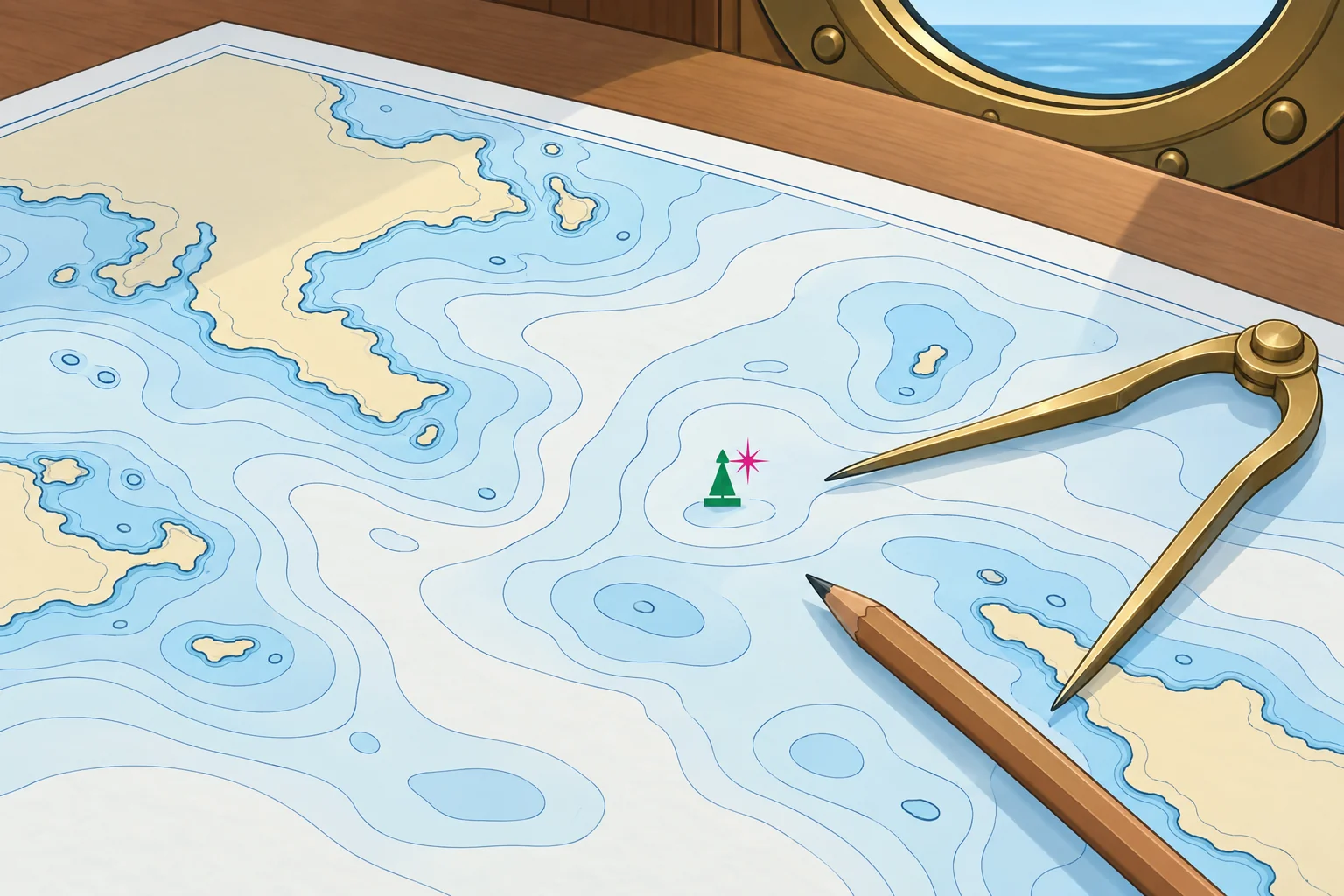
Charts that follow INT 1, the international key to chart symbols, write a light in a fixed order: rhythm, colour, period, elevation, range. A magenta flare beside the symbol shows the mark is lit. Admiralty and US charts use the same order, though spaces and full stops vary between charts.
Worked example
Take Fl(3)G.10s15m5M. Fl(3): group flashing, three flashes. G: green. 10s: the whole sequence repeats every 10 seconds. 15m: the light is 15 metres above the chart’s stated height datum, the reference level for elevations. 5M: its nominal range is 5 nautical miles (NM).
Other pieces
A sector light lists several colours: Iso.WRG.4s shows white, red or green depending on where you are. Dir means a directional light, with a narrow beam marking a direction. Ldg means leading lights, a pair you line up to follow a track. (vert) means lights arranged one above another. Buoys often show only rhythm, colour and period.
Nominal range
The M figure on modern charts is the nominal range: how far the light reaches at night when the meteorological visibility is 10 nautical miles. It measures the light’s strength, not how far you will see it tonight. Height of eye, the curve of the Earth and the real visibility all change that; the lighthouses and ranges unit explains how.
Which mark uses which
Lateral: red or green, any rhythm except Fl(2+1), kept for preferred channel marks. Cardinal: white Q or VQ, alone or in groups. Isolated danger: white Fl(2). Safe water: white Iso, Oc, LFl 10s or Mo(A). Special: yellow; rhythms other than those used by cardinal, isolated danger and safe water marks. Emergency wreck: blue and yellow alternating. The colour narrows it down; the rhythm confirms it.
2Key data
- Lateral
- Red or green; any rhythm except Fl(2+1)
- Preferred channel
- Red or green Fl(2+1)
- Cardinal
- White Q or VQ: continuous, or groups of 3, 6 + LFl, 9
- Isolated danger
- White Fl(2)
- Safe water
- White Iso, Oc, LFl 10s or Mo(A)
- Special
- Yellow; avoid cardinal, isolated-danger and safe-water rhythms
3Key points
- 1
Read a legend in order: rhythm, colour, period, elevation, range.
- 2
Small m is height in metres; capital M is range in nautical miles.
- 3
The charted range is the nominal range, for 10 NM visibility.
- 4
The colour narrows down the mark type; the rhythm confirms it.
4Frequent mistakes
Wrong: 15m in a light legend is the range.
Right: 15m is the light’s elevation in metres. The range is the figure with a capital M.
Wrong: The charted range is how far you will see the light tonight.
Right: It is the nominal range for 10 NM visibility. Height of eye and real visibility change what you see.
Wrong: Any yellow light is a cardinal mark.
Right: Cardinal lights are white. Special marks show yellow; emergency wreck marks alternate blue and yellow. Observe the whole cycle.
5Practice case & exam keys
Your chart shows Fl(2)R.6s8m4M beside a light. What does each part mean, and does 4M guarantee that you will see it from 4 nautical miles tonight?
Show the answer
Fl(2) means two flashes per group; R means red; 6s is the complete period; 8m is the elevation above the chart’s stated height datum; 4M is the nominal range in nautical miles. It is not a guarantee: visibility and your height of eye affect whether you see the light.
Exam keys
- Legend order: rhythm, colour, period, elevation (m), range (M).
- Elevation is measured above the height datum stated on the chart.
- Charted range = nominal range (10 NM visibility).
- White Fl(2) = isolated danger; red or green Fl(2+1) = preferred channel.
Finish this unit
When you've read it, match the terms, then answer three questions. Get them all right to finish the unit; opening the page alone doesn't count.
My notes for this unit
No notes