
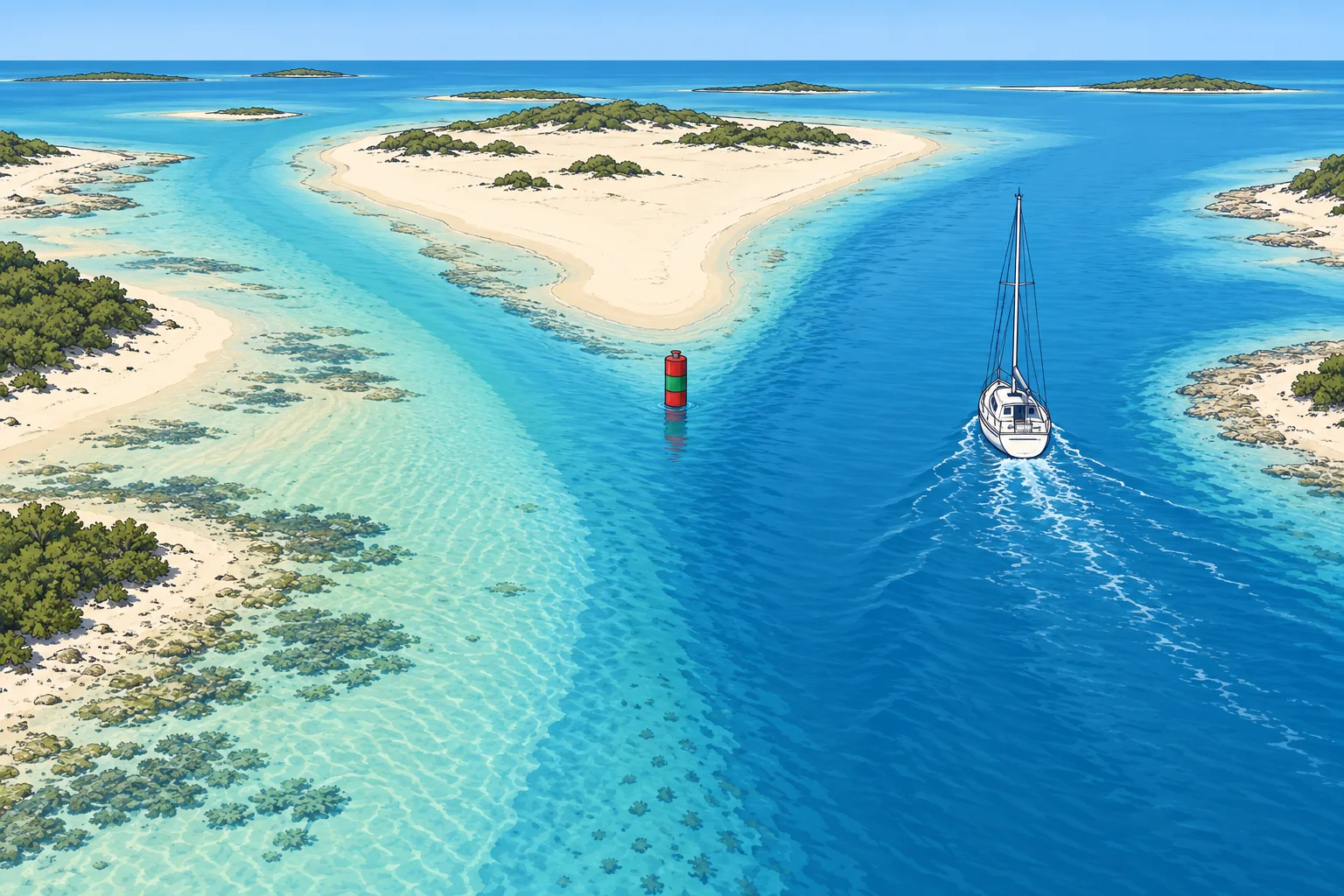
Preferred channel marks
1The lesson in plain words
Going in the direction of buoyage, follow a preferred channel mark as its main colour and shape indicate. Its light, if fitted, is Fl(2+1).
Where they are used
Where a channel divides in the direction of buoyage, the authority may mark the preferred channel, the main or recommended route, with a modified lateral mark at the point of the split. Both branches may be navigable, but the preferred one is usually the deeper channel or the main shipping route.
How it looks
A preferred channel mark keeps the main colour, shape and topmark of a lateral mark, with one broad horizontal band of the other colour. If fitted, its light matches the main colour and shows Fl(2+1): two flashes, a pause, one flash, then a longer pause before repeating. This is called composite group flashing. The period, the time for one complete cycle, is no more than 16 seconds. Red or green Fl(2+1) is reserved for these marks.
How to read it
Going in the direction of buoyage, use its main colour and shape for the preferred channel. In Region A, keep a red can with a green band to port: the preferred channel is to starboard. Keep a green cone with a red band to starboard: the preferred channel is to port. Reverse these passing sides when travelling against the direction of buoyage.
In Region B
Going in the direction of buoyage, the colours swap; the logic does not. Keep a green can with a red band to port: the preferred channel is to starboard. Keep a red cone with a green band to starboard: the preferred channel is to port. With this direction, can to port and cone to starboard still lead you into the preferred channel.
Taking the other channel
Going in the direction of buoyage, use the opposite side of the mark for the secondary channel. Interpret the band colour using the local region. In Region A, a red can with a green band then serves as a green starboard-hand mark. Check the chart first: the secondary channel may be shallower, narrower or less well marked.
2Key data
- Body
- Main lateral colour with one broad band of the other colour
- Light
- Fl(2+1) in the main colour; period no more than 16 s
- Region A, preferred to starboard
- Red can, green band, red Fl(2+1)
- Region A, preferred to port
- Green cone, red band, green Fl(2+1)
- Region B, preferred to starboard
- Green can, red band, green Fl(2+1)
- Region B, preferred to port
- Red cone, green band, red Fl(2+1)
3Key points
- 1
A preferred channel mark is a lateral mark with one broad band of the other colour.
- 2
Its light is Fl(2+1) in the main colour, a rhythm kept for these marks.
- 3
In the direction of buoyage, keep a can to port or a cone to starboard for the preferred channel.
- 4
The band colour gives the mark’s meaning for the secondary channel.
4Frequent mistakes
Wrong: The band colour shows the side to pass for the main channel.
Right: The main colour and shape do. The band gives the meaning for the secondary channel.
Wrong: A red or green Fl(2+1) light can be any lateral mark.
Right: In red or green, Fl(2+1) is kept for preferred channel marks where a channel divides.
Wrong: Preferred channel marks work the opposite way in Region B.
Right: Only the colours swap. In the direction of buoyage, can to port and cone to starboard still lead into the preferred channel.
5Practice case & exam keys
Entering a Region A estuary from seaward, you meet a red can with a broad green band and red Fl(2+1). Your berth is up the secondary branch. A crew member says the band means that branch is closed. How do you decide which side of your boat to leave the mark?
Show the answer
The band identifies a secondary channel; it does not close it. Check the chart and whether that branch’s depths suit your boat. If suitable, take the secondary channel and leave this mark to starboard: its green band gives its secondary-channel meaning. For the preferred channel, leave the red can to port. These sides apply in the direction of buoyage.
Exam keys
- Preferred channel mark: lateral colours with one broad band of the other colour.
- Light Fl(2+1) in the main colour; period no more than 16 s.
- Region A: red can with green band = preferred channel to starboard.
- In the direction of buoyage, keep a can to port or a cone to starboard for the preferred channel.
Finish this unit
When you've read it, match the terms, then answer three questions. Get them all right to finish the unit; opening the page alone doesn't count.
My notes for this unit
No notes