

Navigation areas and required equipment
1The lesson in plain words
Your TIE states the boat's area: inland, coastal or oceanic. That classification decides the required gear, subject to the stated exemptions.
Areas and sizes
Your NPCP defines inland Area 1 (sheltered) and Area 2 (sometimes exposed to significant wind and waves). Coastal navigation stays within sight of land and within 20 NM; oceanic extends beyond either limit. Size classes: miúda (very small) ≤6 m; pequeno porte (small) >6 and <12 m; médio porte (medium) >12 and <24 m; grande porte (large) ≥24 m. Equipment tables retain older headings: follow their explicit length thresholds, including at exactly 12 m.
Classification and signals
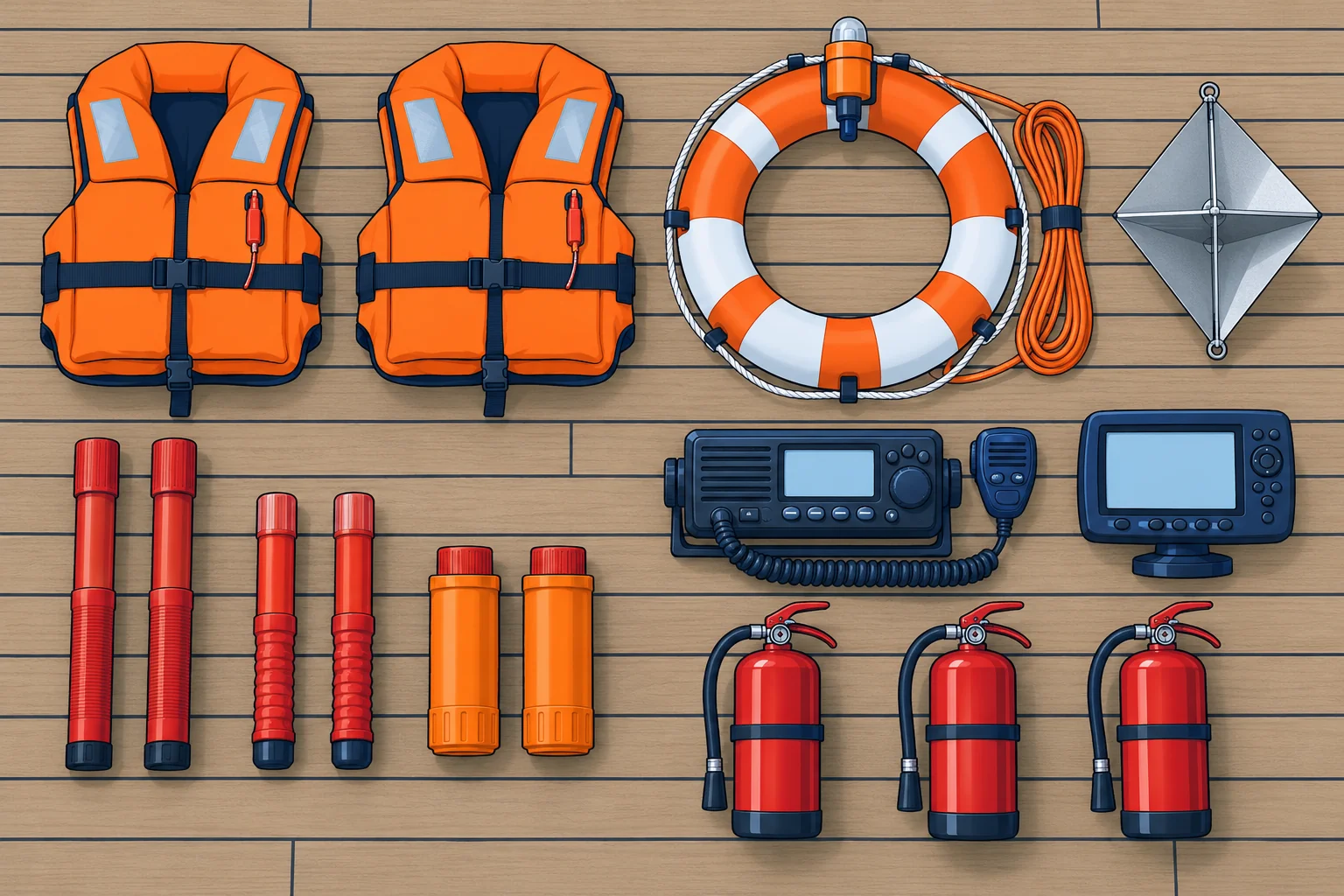
Carry the gear for the area on your TIE (inscription title), subject to the stated exemptions. Your licence must cover your actual area. Coastal boats over 6 m and under 24 m carry 2 red parachute rockets, 2 red hand flares and 2 orange smoke signals; oceanic boats in this length range carry 4 of each. Oceanic-classed boats racing in inland Areas 1 or 2 need not carry liferafts during that regatta.
Lifejackets and buoys
Carry a lifejacket for everyone, with child sizes. Inland boats under 24 m: class III or V; inland large: III; coastal: II; oceanic: I, meeting SOLAS international safety standards. Boats over 6 m and under 12 m carry one lifebuoy; from 12 m, two, including large yachts. Miúda craft need none. At least one buoy needs a floating line: 20 m or twice its stowage height above water, whichever is greater. Coastal/oceanic-classed boats need an automatic light on every lifebuoy, even on inland trips.
Electronics and rafts
Coastal boats over 6 m need fixed VHF short-range radio with DSC (digital selective calling), a GNSS satellite-navigation receiver and radar reflector. Oceanic boats add a second GNSS receiver, 406 MHz EPIRB distress beacon, approved liferaft places for everyone and HF long-range radio with DSC or accepted distress-capable satellite alternative. Large coastal boats also need EPIRB and that long-range link. Large coastal/oceanic boats need a 9 GHz search-and-rescue radar transponder (SART). Inland VHF: compulsory on large boats, otherwise recommended.
Fire below 12 m
B-1 is a fire-extinguisher capacity rating. Motorboats under 6 m need no extinguisher. From 6 m to under 12 m, carry three B-1 units. Recommended positions: two near the engine and one at the helm. With a portable fuel tank up to 27 litres, two units suffice; recommended positions are one near the engine and one at the helm.
Fire from 12 m to under 24 m
Carry four B-1 units; recommended positions are two near machinery, one at the helm and one in the galley (kitchen). Also carry one B-1 or C-1 per main corridor on each accommodation (living-space) deck. Recommended positions keep every space within 20 m of a unit. Primarily sailing boats may replace two B-1 units with one B-2 and omit accommodation units. Quantities are required; positions are recommended.
2Key data
- Coastal limit
- Within sight of the coast, up to 20 NM
- Lifejacket class
- Inland <24 m III/V, large III; coastal II; oceanic SOLAS I
- Coastal pyrotechnics, >6 m to <24 m
- 2 parachute rockets, 2 hand flares, 2 smoke
- Oceanic pyrotechnics, >6 m to <24 m
- 4 parachute rockets, 4 hand flares, 4 smoke
- Coastal electronics, >6 m
- Fixed VHF with DSC, 1 GNSS receiver, radar reflector
- Extinguishers 6–under 12 m, fixed tank
- 3 × B-1; recommended: 2 near engine, 1 at helm
3Key points
- 1
Areas: inland 1 and 2 (NPCP); coastal within sight and 20 NM; oceanic beyond either limit.
- 2
Equipment follows the TIE area, subject to stated exemptions; your licence follows the actual area.
- 3
Jackets: inland <24 m III/V, large III; coastal II; oceanic SOLAS I. Coastal/oceanic-classed boats need buoy lights.
- 4
Coastal boats >6 m and <24 m: fixed VHF with DSC, GNSS, radar reflector; 2 rockets, 2 hand flares, 2 smoke signals.
4Frequent mistakes
Wrong: On a calm inland day trip, a coastal-classed boat may leave the flares ashore.
Right: Coastal-classed boats must carry their required flares even on calm inland trips. The inland-regatta liferaft exemption does not exempt flares.
Wrong: Any lifejacket is fine anywhere.
Right: Inland boats under 24 m need class III or V; inland large boats need III. Coastal boats need II; oceanic boats need SOLAS I.
5Practice case & exam keys
Your 10 m motor cruiser has a fixed fuel tank and a coastal TIE. You stay in NPCP-designated inland waters. You carry class V lifejackets, one lifebuoy, a handheld VHF, no GNSS receiver, two hand flares and two B-1 extinguishers. Is this enough?
Show the answer
No. The coastal TIE decides the gear. Fit class II jackets and a lifebuoy light. Give the buoy a floating line of 20 m or twice its stowage height above water, whichever is greater. Add 2 parachute rockets, 2 smoke signals, fixed VHF with DSC, a GNSS receiver and a radar reflector. The fixed-tank boat needs 3 B-1 extinguishers; recommended positions are 2 near the engine, 1 at the helm. An ARA may skipper in these inland waters.
Exam keys
- Coastal: within sight of the coast and ≤ 20 NM; oceanic: beyond either the sight or distance limit.
- Miúda ≤6 m; pequeno porte >6 and <12 m; médio porte >12 and <24 m; grande porte ≥24 m. Use explicit table thresholds, including exactly 12 m.
- Required gear follows the TIE classification, subject to the stated exemptions.
- Boats >6 m and <24 m: coastal signals 2/2/2; oceanic 4/4/4. Oceanic: approved liferaft places for all, EPIRB, HF with DSC or accepted distress-capable satellite alternative; regatta liferaft exemption applies.
Finish this unit
When you've read it, answer three questions. Get all three right to finish the unit; opening the page alone doesn't count.
My notes for this unit
No notes