

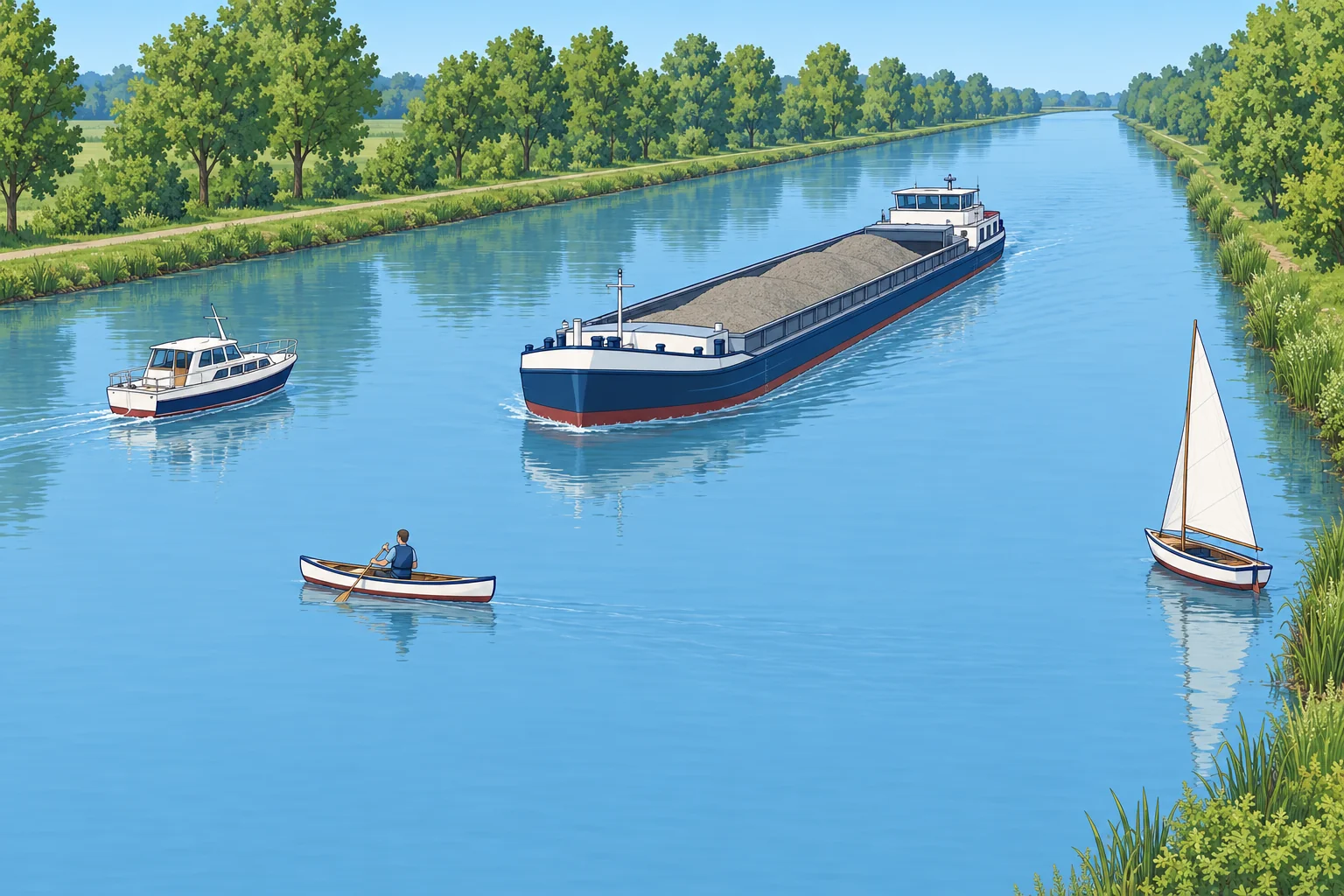
Small craft rules: keep clear of shipping, and who gives way among small boats
1The lesson in plain words
A small craft is under 20 m, with exceptions. Leave vessels not classed as small craft room. Blue-board rules do not apply; small boats have their own give-way order.
What counts as small
A Kleinfahrzeug (small craft) is a vessel with hull length under 20 m, excluding rudder and bowsprit, the spar projecting from the bow. Exceptions include vessels authorised to tow, push or carry alongside non-small craft, vessels authorised for more than 12 passengers, ferries, push barges and floating equipment.
Leave room
You must leave vessels not classed as small craft the room they need for their course and manoeuvres. You cannot demand that they give way. You must give way early to starboard to a vessel showing the blue flashing light (police and emergency boats). If you cannot, show clearly how you will give way.
Blue-board meetings
Blue-board meeting rules do not apply to small craft or towards them. Do not treat a blue board as an instruction to you. Keep clear and leave vessels not classed as small craft the room they need.
Among small craft
Power gives way to muscle and sail; muscle gives way to sail. When meeting, the give-way boat turns to starboard early unless nautical conditions prevent it; then make the alternative clear. Two powered boats, or two muscle-powered boats, meet port to port. When two powered boats or two muscle-powered boats cross with collision risk, give way to the boat on your starboard side.
Under sail
Your tack is the side the wind comes from. Windward means nearer the wind’s source; your windward side is opposite your mainsail (main sail). Opposite tacks: port gives way. Same tack: the windward boat gives way. On port tack, give way if unsure of a windward boat’s tack. Under sail, overtake another sailing boat to windward. When beating close-hauled, do not tack across so that a small craft holding its starboard bank must give way.
Speed near people
Near a bathing shore, a campsite or set fishing gear, a small motorboat may go only as fast as it needs to steer. Do not obstruct or annoy other boats by circling them, or cruise around near fishing gear. Leave people enough room to avoid danger from wash or suction. With an engine fitted, the usual minimum helm age is 16; a restricted exception for holders of a qualifying club card starts at 12 (§ 1.09(5)).
2Key data
- Small craft
- Hull < 20 m, excluding rudder/bowsprit; statutory exceptions apply
- Minimum helm age
- Normally 16; restricted youth exception from 12
- Small craft give-way order
- Power gives way to muscle and sail; muscle to sail
- Near bathers and campsites
- Only steerage speed for small motorboats
3Key points
- 1
Leave vessels not classed as small craft the room they need; you cannot demand that they give way.
- 2
Give way early to starboard to any vessel with a blue flashing light.
- 3
Blue-board meeting rules neither apply to nor are used towards small craft.
- 4
Among small craft: power gives way to sail and muscle; muscle gives way to sail.
- 5
Under sail: port tack gives way; on the same tack, windward gives way. Overtake another sailing boat to windward.
4Frequent mistakes
Wrong: The barge shows a blue board, so I should pass it starboard to starboard as it asks.
Right: The blue-board meeting rules do not apply to your small craft. Leave the barge room for its course and manoeuvres.
Wrong: Under sail I have right of way over a barge, as at sea.
Right: A small craft must leave vessels not classed as small craft the room they need, whatever their propulsion. Sail-over-power applies among small craft.
Wrong: My 12-year-old can steer our hire motorboat while I watch.
Right: The usual minimum helm age with an engine fitted is 16. Ordinary parental supervision alone does not qualify for the restricted club-card exception from 12 in § 1.09(5).
5Practice case & exam keys
In open water on a lake governed by BinSchStrO, you motor a 9 m cruiser. A canoe crosses from left to right, a laden barge closes from astern, and a sailing dinghy approaches on a collision course. Who gives way?
Show the answer
Leave the barge the room it needs. Among the small craft, your powered cruiser gives way to both the canoe and the sailing dinghy. Slow down or pass astern of the canoe. If the canoe and dinghy risk collision, the canoe gives way to the dinghy. Keep your own manoeuvre clear and early.
Exam keys
- § 6.02: leave vessels not classed as small craft room; cannot demand they give way; starboard for the blue flashing light.
- § 6.02(2): blue-board meeting rules (§ 6.04, 6.05) do not apply to or towards small craft.
- § 6.02a: power gives way to muscle and sail; muscle to sail. Opposite tacks: port gives way; same tack: windward gives way. Port tack unsure of windward boat’s tack: give way. When beating close-hauled, do not tack across so that a small craft holding its starboard bank must give way.
- § 1.09: minimum helm age with an engine fitted normally 16; restricted qualifying club-card exception from 12 under § 1.09(5).
Finish this unit
When you've read it, answer three questions. Get all three right to finish the unit; opening the page alone doesn't count.
My notes for this unit
No notes