

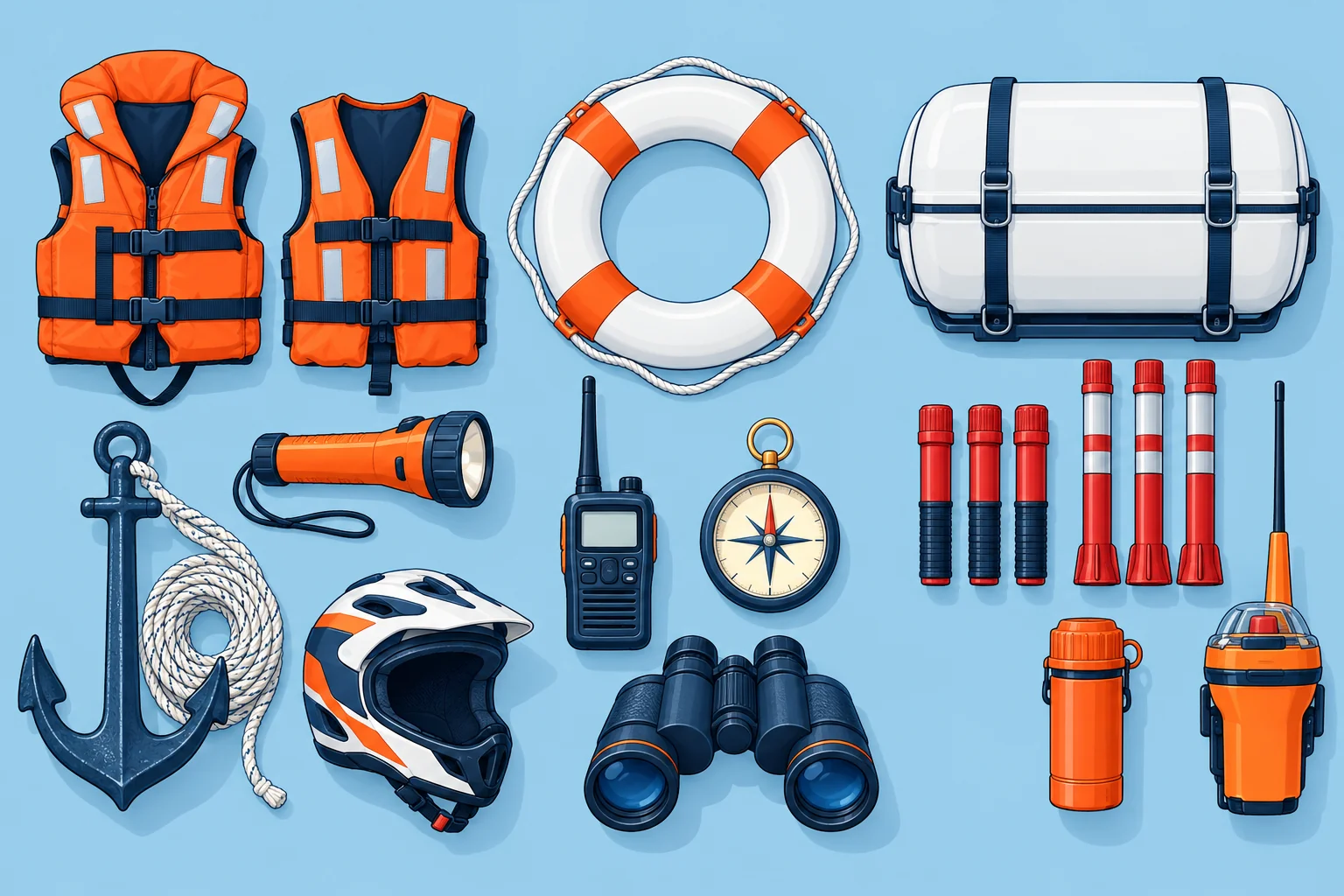
Required gear for private boats, area by area
1The lesson in plain words
Carry lifejackets and a torch everywhere. Compass and charts start in III; VHF radio, flares and a liferaft in II; a satellite distress beacon in I.
Whose rules
The tables below are for Croatian-registered private boats (brodice for personal use). A foreign-flagged boat is equipped to her flag state's rules, but the Croatian table is a good benchmark, and inspectors expect sound basic kit.
In every area
Carry a lifejacket for each adult and child, anchor and line, a towline four times the boat’s length, mooring lines, a waterproof torch, and two boxes of matches or a lighter, kept waterproof. Carry bilge pumps suited to the boat’s layout, and required navigation lights at night and in restricted visibility. A tiller-steered outboard needs a kill cord (engine-stop lanyard) for the driver. Jet ski riders and passengers wear lifejackets and helmets.
Areas III, II and I
Add a lifebuoy, a GNSS satellite-position receiver, a lit compass, binoculars, current official charts, chart tools, a current official small-craft pilot (coastal sailing guide) and List of Lights and Fog Signals (details of navigation aids and fog signals). A sound signal is needed from area IIIb. A first-aid box is carried from IIIc to III.
Areas II and I
Add a liferaft for everyone, to ISO 9650 (the rules still name a tender of matching capacity as an alternative), an additional lifebuoy with self-igniting light and line, lifejackets with whistle and self-lighting lamp, thermal protective aids (covers that reduce body-heat loss), a first-aid cabinet, a sea anchor (device to slow drift) and day shapes (daytime status signals). Carry 3 red hand flares, 3 parachute rockets, and 1 floating smoke signal in II or 2 in I. Area I also requires a 406 MHz EPIRB, a satellite distress beacon.
Fast boats
On a boat whose maximum speed exceeds 20 knots, everyone outside an enclosed space wears a lifejacket whenever under way. The boat needs a kill cord and, in IIIc, IIIb, IIIa, III, II and I, a radar reflector (device that helps radar detect you). At night in those areas, its lifejackets need a whistle and light.
Radio
Areas II and I require VHF marine radio. DSC (digital selective calling) can send digital distress alerts. Boats built from 1 July 2006, or older boats fitting new stations, need DSC; class D suffices.
2Key data
- Every area
- Lifejacket per person, waterproof torch, anchor
- VHF radio: II and I
- DSC: built from 1 July 2006, or older boat fitting a new station
- Lifebuoy
- III: one; II/I: add a second with light and line
- Flares (II and I)
- 3 hand flares, 3 rockets, smoke 1 (II) or 2 (I)
- Liferaft for everyone
- Areas II and I
- Maximum speed >20 knots
- Under way: lifejackets worn outside enclosed spaces; kill cord
3Key points
- 1
Lifejackets for everyone, in every area, children included.
- 2
GNSS, compass and charts start in III. VHF starts in II; DSC depends on build date or fitting a new station.
- 3
Liferaft, flares and rockets: II and I. Smoke: 1 in II, 2 in I. EPIRB: I only.
- 4
On boats capable of more than 20 knots, everyone outside an enclosed space wears a lifejacket under way.
- 5
Jet ski riders and passengers wear lifejackets and helmets.
4Frequent mistakes
Wrong: Every area III boat must carry VHF with DSC.
Right: VHF carriage starts in area II. DSC is required on boats built from 1 July 2006 and older boats fitting a new station; class D is sufficient.
Wrong: Flares are required on every boat.
Right: For private boats the Croatian table asks for hand flares, rockets and smoke only in areas II and I. Carry some anyway if you go far from help.
5Practice case & exam keys
Your Croatian private motorboat was built in 2005 and has its original non-DSC VHF. It is approved for III and can reach 30 knots. Under way at 9 NM, only children wear lifejackets in the open cockpit. You have phone charts but no other navigation kit, kill cord or reflector. Other gear complies. What must change?
Show the answer
Everyone in the open cockpit must wear a lifejacket under way: the boat can exceed 20 knots. Area III needs GNSS, a lit compass, binoculars, chart tools, current official charts, a small-craft pilot and List of Lights and Fog Signals; phone charts do not replace these. Fit a radar reflector and use the kill cord. This pre-July-2006 boat retains its original radio, so no DSC upgrade is required here.
Exam keys
- Every area: lifejackets for all, torch, anchor, towline (4 × length).
- III, II and I: lifebuoy, GNSS, compass, binoculars, current official charts, small-craft pilot and List of Lights and Fog Signals. II/I: VHF; DSC by build/refit rule.
- II/I: liferaft for all, additional lit lifebuoy with line, 3 hand flares, 3 rockets, smoke (1 in II, 2 in I). EPIRB: I only.
- Maximum speed >20 knots: wear lifejackets outside enclosed spaces under way; kill cord; reflector in IIIc–I.
Finish this unit
When you've read it, answer three questions. Get all three right to finish the unit; opening the page alone doesn't count.
My notes for this unit
No notes