

Allegato V: the kit by distance from the coast
1The lesson in plain words
Annex V lists the minimum safety kit by your greatest distance from the nearest coast. A 10 NM trip uses the 12 NM column.
The table
Allegato V lists inland waters and the 300 m, 1, 3, 6, 12, 50 NM and unlimited bands. Choose the smallest band covering your greatest distance from the nearest coast: 10 NM uses the 12 NM column. CE boats carry extinguishers from the owner's manual; non-CE boats follow the engine-power table. Extinguishers need no periodic service, only good condition and a gauge in the green. Follow manufacturers' instructions.
Lifesaving
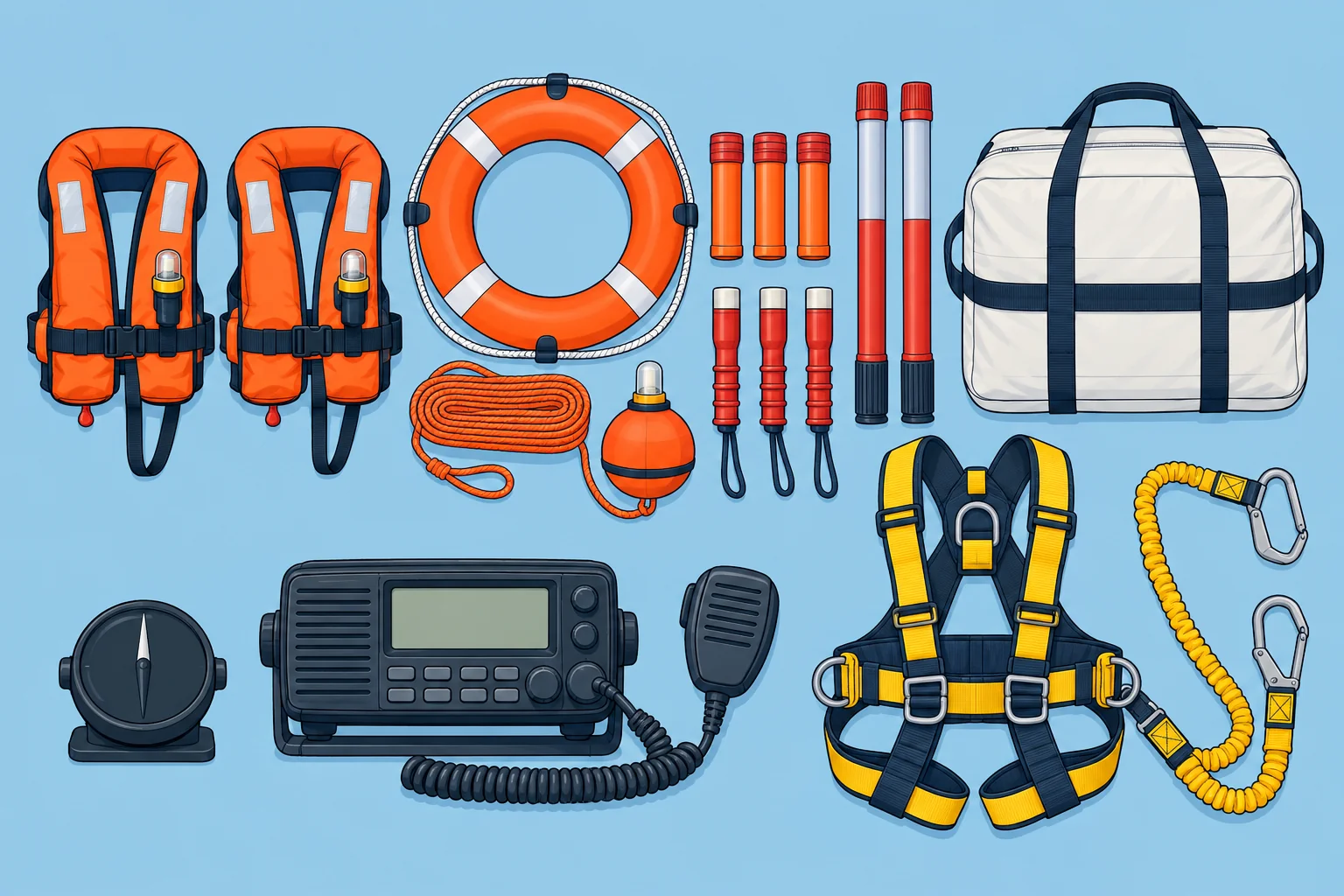
For cruising boats beyond 300 m, carry a lifejacket each: 100 N through 6 NM; 150 N with automatic light beyond. N means newtons, a measure of buoyancy. Inland waters require 100 N. Carry a lifebuoy (rescue ring) with line beyond 1 NM at sea and on inland waters; add its light beyond 3 NM. Carry a coastal liferaft for everyone beyond 6 NM, an offshore raft beyond 12 NM, unless an equivalence applies. Mark jackets with the registered boat's number. Wear one when alone underway at night.
Distress signals
Distress signals depend on the band: over 1 and up to 3 NM, carry 1 smoke signal and 2 red hand flares; over 3 and up to 50 NM, carry 2 smoke signals, 2 hand flares and 2 red parachute rockets. Beyond 50 NM, carry 2 smoke signals, 3 hand flares and 3 rockets. An LED device meeting SOLAS MED rules may replace a hand flare.
Navigation and radio
Navigation lights (COLREG, the collision rules) are required beyond 1 NM. Beyond 6 NM: compass and deviation table for imbarcazioni (deviation is boat-induced compass error), clock, VHF (very high frequency) marine radio and COLREG signal table. Beyond 12 NM: charts, plotting tools, binoculars, barometer, a depth-measuring device or line reaching 20 m, GPS, first-aid kit and radar reflector. Beyond 50 NM: carry a 406 MHz EPIRB (emergency position-indicating radio beacon, a satellite distress beacon), or an Annex V-compliant satellite phone sending distress and position to IMRCC, Italy's rescue coordination centre.
Sailing boats and boards
Since 21 October 2025, sailing boats carry deck harnesses with tethers (safety lines): one over 6 and up to 12 NM, two beyond 12 NM. Sailing-dinghy crews, board sailors, kitesurfers, and jet ski riders and passengers must always wear at least a 50 N buoyancy aid, at any distance.
Equivalences
Inside Italy's search-and-rescue area beyond 12 NM, a coastal raft may replace an offshore raft if you carry GPS plus EPIRB or a compliant satellite phone. Over 6 and up to 12 NM, a CE/ISO 6185 inflatable tender at least 2.5 m long may replace the coastal raft: inflated, upright on deck, ready for manual launch, with boarding aid, survival kit and room for all. CE A/B/C inflatables meeting ISO 6185 parts 3/4 may omit the raft within 12 NM with its survival kit and an extra extinguisher.
2Key data
- Cruising-boat lifejackets
- Sea >300 m–6 NM: 100 N; beyond: 150 N + automatic light. Inland: 100 N
- At sea beyond 300 m
- Pump/bailer (water scoop); black anchor ball if boat over 7 m
- At sea beyond 1 NM
- Navigation lights; whistle and bell if over 12 m (bell: portable OK)
- Unlimited signals
- 2 smoke, 3 hand flares, 3 parachute rockets
- Radio
- VHF beyond 6 NM; EPIRB beyond 50 NM, subject to equivalence
- Liferaft
- Coastal: over 6 to 12 NM; offshore: beyond 12 NM; equivalences apply
3Key points
- 1
Cruising boats at sea: lifejacket each beyond 300 m; 100 N through 6 NM, then 150 N with automatic light. Inland: 100 N.
- 2
Over 1 to 3 NM: 1 smoke signal and 2 hand flares; parachute rockets beyond 3 NM.
- 3
Beyond 6 NM: VHF and COLREG signal table; compass/deviation table for imbarcazioni. Beyond 12 NM: GPS and charts.
- 4
Sailing boats: one deck harness with tether over 6 to 12 NM, two beyond 12 NM, since 21 October 2025.
- 5
Sailing dinghies, boards, kites and jet skis: everyone wears at least a 50 N aid at any distance.
4Frequent mistakes
Wrong: On a 2 NM trip I need parachute rockets like everyone else.
Right: The 3 NM column requires 1 smoke signal and 2 red hand flares. Parachute rockets are required beyond 3 NM, starting with the 6 NM column.
Wrong: A handheld GPS replaces the required charts on a 20 NM trip.
Right: Charts are required beyond 12 NM; approved electronic charts may replace them. A GPS position alone is not a chart.
Wrong: The EPIRB is needed beyond 12 NM.
Right: The EPIRB is required beyond 50 NM, in the unlimited band. A satellite phone meeting Annex V's distress-link requirements may replace it; an SOS button alone is not enough.
5Practice case & exam keys
Your CE-marked 11 m sailing yacht will go 10 NM offshore with four adults. She has four 100 N lifejackets, a lifebuoy with line, two hand flares, one smoke signal and no harness. All other required 12 NM-band gear is aboard. What must you change?
Show the answer
Replace the four lifejackets with 150 N jackets with automatic lights. Add a lifebuoy light, one smoke signal, two red parachute rockets and one harness with tether. The trip is beyond 6 NM, so the 12 NM band applies.
Exam keys
- Cruising boats at sea: lifejacket each beyond 300 m; 100 N through 6 NM, 150 N + automatic light beyond. Inland: 100 N.
- Signals over 1–3 NM: 1 smoke + 2 hand flares; over 3–50 NM: 2 + 2 + 2 rockets; beyond 50 NM: 2 + 3 + 3.
- Raft: coastal over 6–12 NM, offshore beyond 12 NM; equivalences apply. EPIRB beyond 50 NM.
- Sailing harnesses with tethers: one over 6–12 NM, two beyond 12 NM (since 21 Oct 2025).
Finish this unit
When you've read it, answer three questions. Get all three right to finish the unit; opening the page alone doesn't count.
My notes for this unit
No notes