

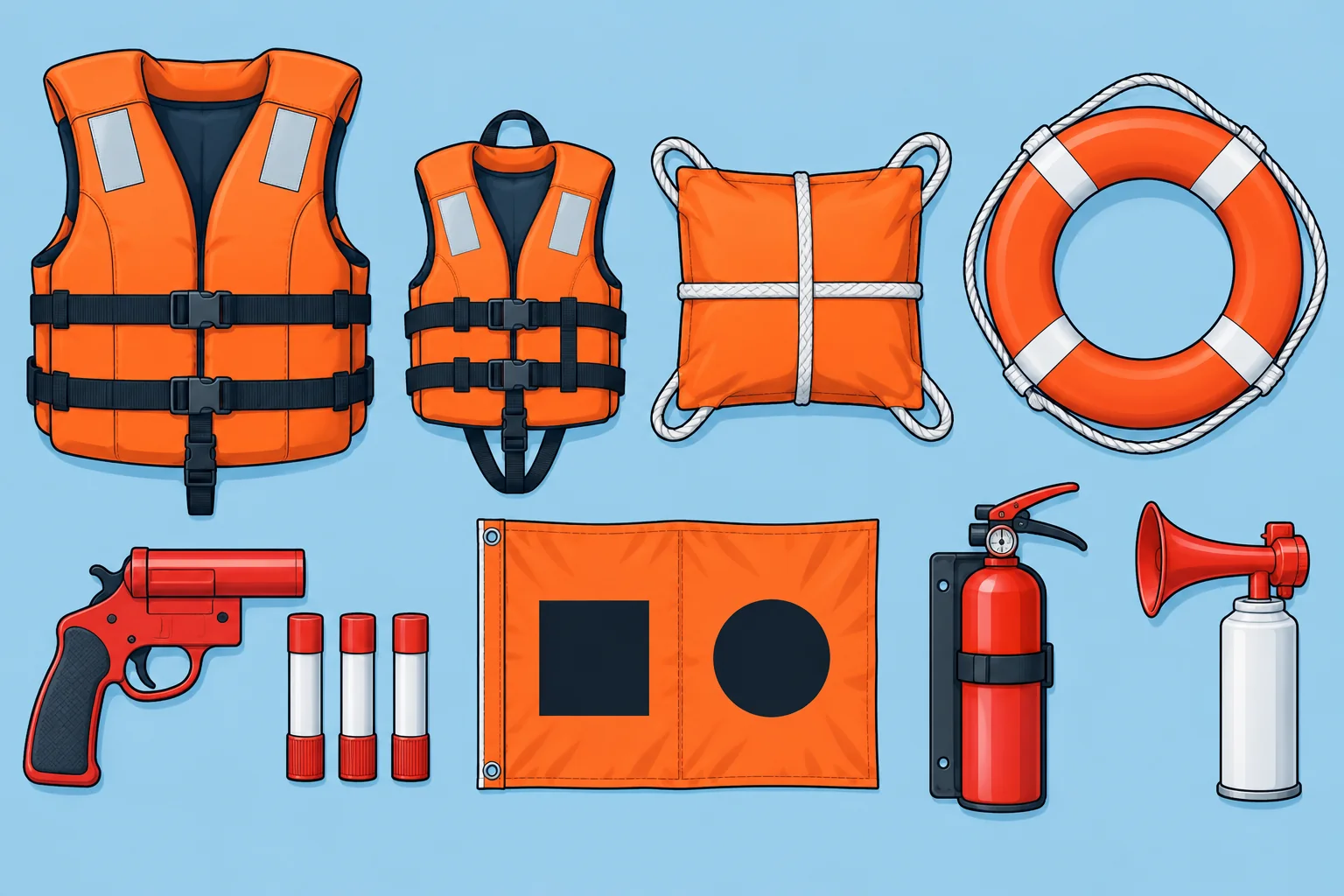
Federal required equipment
1The lesson in plain words
US federal law sets a short, strict list: life jackets, distress signals, fire extinguishers, ventilation and sound signals. Lengths are in feet unless stated.
Where the rules are
Federal recreational-boat equipment requirements appear in several rules, including 33 CFR 175 and 183 (CFR: Code of Federal Regulations). Carry equipment that meets the applicable standard and keep it serviceable. US rules use feet: 16 ft is about 4.9 m, 26 ft about 7.9 m, 40 ft about 12.2 m.
Life jackets
Carry one wearable US Coast Guard (USCG)-approved life jacket for each person, of the right size, readily accessible (not in plastic bags or locked lockers). Boats 16 ft and longer also carry one throwable device (a ring or cushion); canoes and kayaks are exempt from the throwable. Children under 13 must wear a life jacket while under way, unless below deck or in an enclosed cabin; a state's own child rule replaces this on its waters. Keep the throwable immediately available.
Visual distress signals
On coastal waters, the Great Lakes, the territorial sea and connected waters upstream to their first narrowing below 2 nautical miles (NM), carry approved day and night signals. If using pyrotechnics (burning signals such as flares), carry three unexpired signals per period; three dual-purpose flares cover both. Approved non-pyrotechnic alternatives are allowed. Day exemptions: boats under 16 ft, manually propelled boats, open sailboats under 26 ft without propulsion machinery, and boats in organised marine parades, regattas or races. These need night signals between sunset and sunrise.
Fire extinguishers
All motorboats 26 ft or longer need marine Class B extinguishers. Below 26 ft, an open outboard boat may be exempt if it cannot trap fuel vapour and has no permanent fuel tank. For model year 2018 and newer: one 5-B under 26 ft, two from 26 to under 40 ft, three from 40 to 65 ft inclusive. A qualifying fixed engine-space system reduces these counts by one; one 20-B replaces two 5-B. Disposable units expire 12 years after manufacture.
Ventilation, flame arrestors and sound
Ventilation removes explosive gasoline vapour. Enclosed spaces that can trap gasoline vapour need ventilation. On boats built after 31 July 1980, enclosed compartments with permanently installed gasoline engines and electric starters need powered exhaust blowers. Before starting, run the required blower for at least four minutes and check for fuel vapour. A backfire flame arrestor stops backfires igniting vapour; gasoline inboards need one or approved equivalent protection. Carry a sound-signalling device; from 12 m carry a whistle, and from 20 m add a bell.
2Key data
- Life jackets
- 1 wearable/person; throwable ≥16 ft except canoes/kayaks
- Children
- Under 13 on open deck under way; state rule may replace federal
- Distress signals (coastal)
- Day/night required; listed boats and events exempt by day
- Pyrotechnics
- 3 valid for day + 3 for night; 3 dual-purpose cover both
- Extinguishers (2018+ boats)
- 5-B where required: <26 ft: 1; 26–<40 ft: 2; 40–65 ft: 3
- Disposable extinguisher life
- 12 years from manufacture
3Key points
- 1
One wearable USCG-approved life jacket per person; throwable from 16 ft except canoes and kayaks.
- 2
Children under 13 wear a life jacket under way unless below deck or in an enclosed cabin.
- 3
Coastal distress signals: day and night; listed boats and organised events are exempt by day.
- 4
2018+ boats: 1 marine 5-B below 26 ft unless exempt; 2 at 26–<40 ft; 3 at 40–65 ft inclusive, before substitutions.
- 5
Enclosed gasoline engine and fuel spaces need ventilation; gasoline inboards need backfire protection.
4Frequent mistakes
Wrong: Life jackets stowed in their plastic bags are fine.
Right: They must be readily accessible, so out of bags and not under other gear or locked away.
Wrong: Small boats never need distress signals.
Right: On coastal waters, boats under 16 ft need night signals between sunset and sunrise.
Wrong: An old B-I extinguisher is fine on a 2020 boat.
Right: Use serviceable marine-rated 5-B or 20-B extinguishers on 2018+ boats. Disposable units need a legible manufacture date and must be within their 12-year life; rechargeable units need the required maintenance.
5Practice case & exam keys
Your 22 ft gasoline outboard boat (model year 2021) has a cabin and permanent fuel tank. You are the skipper, with four adult passengers and one 10-year-old. You head onto a coastal bay at dusk. What federal equipment do you need?
Show the answer
Six wearable life jackets of the right sizes, and one immediately available throwable. The child wears a jacket under way unless in the enclosed cabin. Carry approved day and night signals: three unexpired dual-purpose flares can cover both. One 5-B extinguisher, as the cabin and fixed tank are fire risks. Ventilation for the gasoline tank space and a suitable sound-signalling device.
Exam keys
- 33 CFR 175 covers life jackets, distress signals and extinguishers; 183 covers ventilation.
- Throwable from 16 ft except canoes/kayaks; under 13 wear a jacket under way unless below deck/in an enclosed cabin.
- Coastal distress signals: day/night unless exempt by day; 3 dual-purpose pyrotechnics can cover both.
- 5-B extinguishers by length for 2018+ boats; disposable units 12 years.
Finish this unit
When you've read it, answer three questions. Get all three right to finish the unit; opening the page alone doesn't count.
My notes for this unit
No notes