

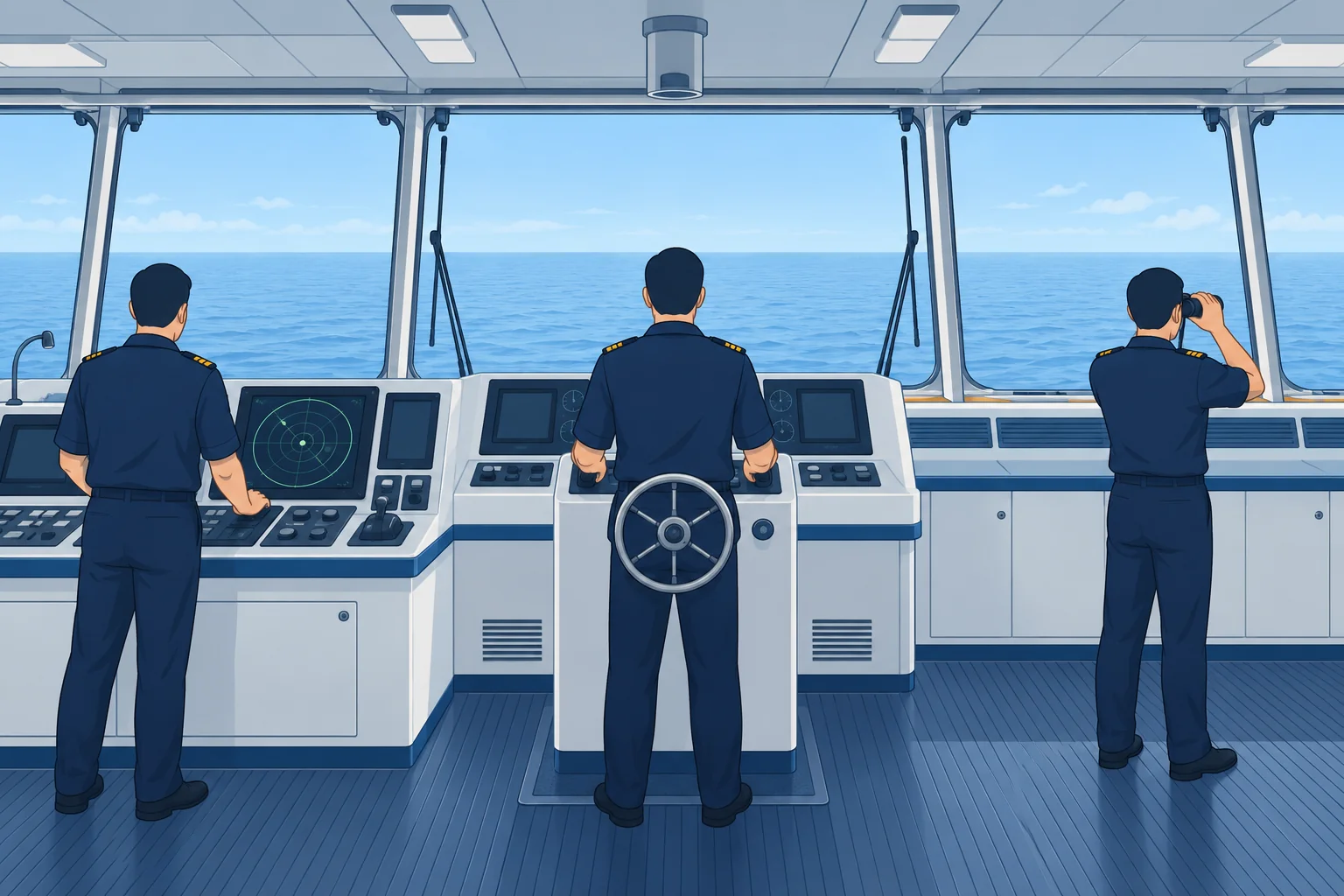
The bridge team and your place in it
1The lesson in plain words
On watch you work for the officer of the watch. You steer, keep a lookout and report, and you speak up when something looks wrong.
Who is who
The master commands the ship. The officer of the watch (OOW) is in charge of the bridge for the master. A pilot on board advises, but does not take over the duties of the master or the OOW. A rating forming part of a navigational watch (STCW II/4) supports the OOW as helmsperson or lookout. An able seafarer deck (STCW II/5) has more experience and also works on deck, at mooring stations and in port.
Your tasks
STCW table A-II/4 covers four competences: steering and following helm orders in English; keeping a lookout by sight and hearing; helping maintain a safe watch; and operating emergency equipment and applying emergency procedures. You also need compass use, changing between autopilot (automatic steering) and hand steering, bearing reports, internal communications, alarms and proper watch handover. Other safety lessons cover the emergency equipment.
Closed-loop talk
In a closed loop, the OOW gives an order; you repeat it, carry it out and report completion. The OOW confirms. Ask again if unsure. Use the ship’s agreed working language. For bridge-to-bridge, bridge-to-shore and pilot–bridge safety communication, SOLAS V/14.4 requires English unless everyone directly involved shares another language. You must understand helm orders in English. The IMO Standard Marine Communication Phrases (SMCP) provide standard English wording.
Fit for watch
You must be rested and sober. STCW requires at least 10 hours of rest in any 24 hours and 77 hours in any 7 days. The 10 hours may be split into no more than two periods, one of them at least 6 hours long, with no more than 14 hours between rest periods. The alcohol limit is 0.05 % in the blood or 0.25 mg/l in the breath; your company’s policy may be stricter.
Speak up
You are part of the team, not a passenger. If you see something the OOW may have missed, say it clearly: ‘The ship on the starboard bow has a steady bearing.’ If the OOW does not respond or seems unwell, call the master at once. Good bridge teams welcome a rating who speaks up.
2Key data
- Rest (STCW A-VIII/1)
- At least 10 h in any 24 h and 77 h in any 7 days
- Splitting rest
- Max 2 periods, one ≥ 6 h; ≤ 14 h between rest periods
- Alcohol limit (STCW A-VIII/1)
- No more than 0.05 % in blood or 0.25 mg/l in breath
- Bridge-to-bridge/shore and pilot–bridge
- English unless all directly involved share another language
3Key points
- 1
The OOW is in charge of the bridge for the master; a pilot does not relieve them of their duties.
- 2
Closed loop: order, repeat, carry out, report done. Ask again if unsure.
- 3
Rest: at least 10 h in any 24 h and 77 h in any 7 days.
- 4
Alcohol on watch: no more than 0.05 % in the blood or 0.25 mg/l in the breath.
- 5
Speak up when something looks wrong; call the master if the OOW does not react.
4Frequent mistakes
Wrong: Once the pilot is on board, the OOW is no longer responsible.
Right: The pilot advises and often gives wheel orders, but the master and the OOW keep their duties and monitor what is done.
Wrong: I half-heard the order, so I’ll carry out what I think it was.
Right: Ask again. Repeat every order back, so the OOW can catch a mistake before you act.
Wrong: Rest hours are just paperwork.
Right: Tired watchkeepers miss lights and mishear orders. Rest hours are a safety limit; tell the OOW if you are not fit.
5Practice case & exam keys
Night. You are the lookout. The OOW has been sitting very still for several minutes and does not answer when you report a light closing on the port bow. What do you do?
Show the answer
Report again, louder, and check the OOW. If there is still no response, call the master at once by the means your ship’s orders give. Keep the lookout going and report the closing light. Do not wait for BNWAS, the bridge watch alarm: it may not alert help before danger develops.
Exam keys
- Master commands; OOW in charge of the bridge; a pilot does not relieve master or OOW of their duties.
- Closed-loop communication: repeat, act, report done; ask if unsure.
- STCW rest: 10 h in 24 h, 77 h in 7 days, max 2 periods (one ≥ 6 h); alcohol ≤ 0.05 % BAC / 0.25 mg/l.
Finish this unit
When you've read it, answer three questions. Get all three right to finish the unit; opening the page alone doesn't count.
My notes for this unit
No notes