

 See units
Pollution prevention on ships: oil record book, garbage plan, SOPEP, ballast water and emission control areas
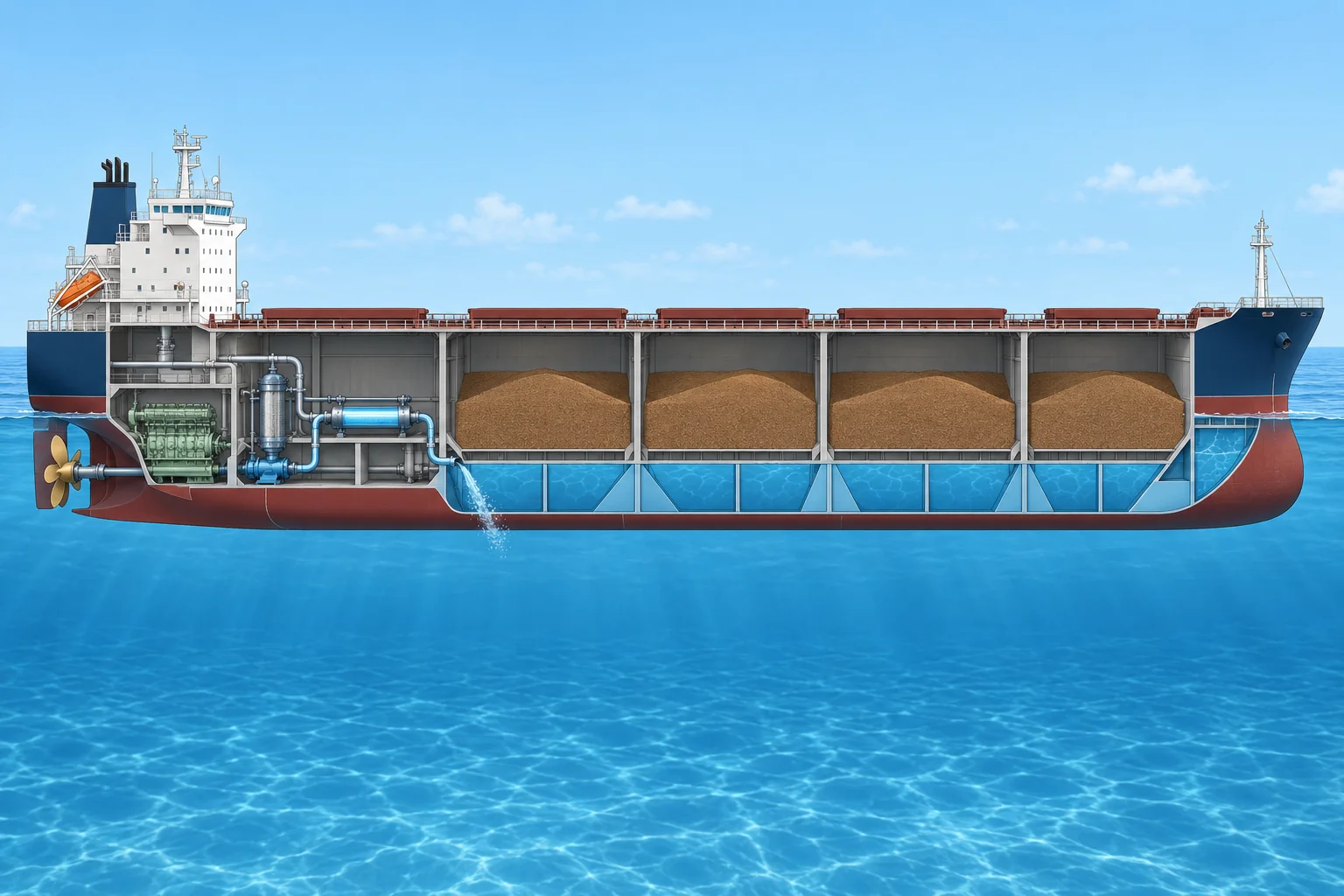
Ballast water management: from exchange to the D-2 standard
1The lesson in plain words
Ships covered by the BWM Convention must now meet the D-2 standard, normally with an approved treatment system, and record every ballast operation.
Why it matters
Ballast water moves organisms from one sea to another, where some become invasive. The Ballast Water Management (BWM) Convention entered into force on 8 September 2017. It applies to ships designed to carry ballast water on international voyages. Each ship needs an approved ballast water management plan (BWMP) and an International Ballast Water Management Certificate from 400 GT.
D-1: exchange
The D-1 standard is ballast water exchange: replace at least 95 % of the volume, or pump three tank volumes through. Normally exchange at least 200 NM from the nearest land in water at least 200 m deep. If impossible, exchange as far from land as possible, at least 50 NM offshore and 200 m deep. Follow the BWMP; the master must not exchange if it would threaten safety or stability. Exchange replaces water; it does not guarantee D-2 compliance.
D-2: performance
The D-2 standard limits discharged organisms: fewer than 10 viable organisms per m³ at least 50 µm in minimum dimension; fewer than 10 viable organisms per mL at least 10 but less than 50 µm; and limits for specified indicator microbes. New ships and existing ships followed different implementation schedules; the final D-2 phase-in deadline was 8 September 2024. D-1 alone is now only an agreed contingency, not routine compliance.
Treatment systems
Most ships meet D-2 with a type-approved ballast water management system (BWMS), using filters plus UV light or active substances. Systems fitted since 1 June 2022 need a commissioning test. Run it as the maker says: wrong flow, a blocked filter or a bypass can make discharged ballast fail D-2, and a bypass must be recorded and reported.
The record book
Record every ballast operation in the ballast water record book (BWRB), with date, time, tank, position, volume and treatment details. The officer in charge signs each entry; the master signs each completed page. New format: 1 February 2025; approved electronic books: 1 October 2025. Keep it on board for at least 2 years after the last entry, then under the company’s control for 3 more years.
What is coming
MEPC 84 agreed amendments for adoption at MEPC 85 in late 2026, expected in force in 2028. They end the experience-building phase, ask for annual sampling of residual active substances and biological tests at surveys, and update the certificate and plan. They are not in force yet. The US applies its own rules and type-approval.
2Key data
- BWM Convention
- In force 8 September 2017
- D-1 exchange
- ≥200 NM and ≥200 m deep (else ≥50 NM, 200 m); 95 %
- D-2 standard
- <10 viable/m³ at ≥50 µm; <10 viable/mL at ≥10–<50 µm; microbes
- D-2 deadline
- All covered ships by 8 September 2024
- BWRB
- New format 1 Feb 2025; electronic since 1 Oct 2025; 2 + 3 years
- Next amendments
- For adoption at MEPC 85 (late 2026); expected in force 2028
3Key points
- 1
D-1 is exchange at sea; D-2 is a discharge standard, usually met by a BWMS.
- 2
All covered ships had to meet D-2 by 8 September 2024.
- 3
Exchange: ≥200 NM from land and ≥200 m deep; if impossible, ≥50 NM and ≥200 m deep.
- 4
Record every operation in the BWRB; electronic allowed since 1 Oct 2025.
- 5
The 2026 amendments are not in force; expected 2028.
4Frequent mistakes
Wrong: Exchanging ballast mid-ocean still satisfies the Convention.
Right: Since 8 September 2024 covered ships must meet D-2. Exchange alone is only a contingency measure or part of an approved method.
Wrong: If the BWMS trips, discharge untreated and fix it later.
Right: Follow the BWMP contingency measures, inform the port state and record the failure. Do not discharge untreated ballast without agreement.
5Practice case & exam keys
Approaching a loading port, your BWMS shows a UV lamp fault and treatment stops. You must discharge 8,000 m³ of ballast to load. The chief officer suggests discharging anyway, since the water came from the open ocean. What do you do?
Show the answer
Do not discharge untreated ballast on your own decision. Follow the contingency measures in the BWMP: try to repair, then contact the port state with the facts. It may accept a contingency measure such as exchange in a set area, discharge to a facility or retaining ballast. Record the failure, the messages and every operation in the BWRB, and tell the company.
Exam keys
- BWM Convention in force 8 Sept 2017; D-2 for all covered ships by 8 Sept 2024.
- D-1: ≥200 NM/≥200 m, or ≥50 NM/≥200 m; 95 % exchange or three tank volumes pumped through.
- D-2: <10 viable organisms/m³ at ≥50 µm; <10 viable organisms/mL at least 10 but less than 50 µm; indicator microbes.
- BWRB: format 1 Feb 2025; electronic 1 Oct 2025; 2 years on board, 3 with the company.
Finish this unit
When you've read it, answer three questions. Get all three right to finish the unit; opening the page alone doesn't count.
My notes for this unit
No notes