

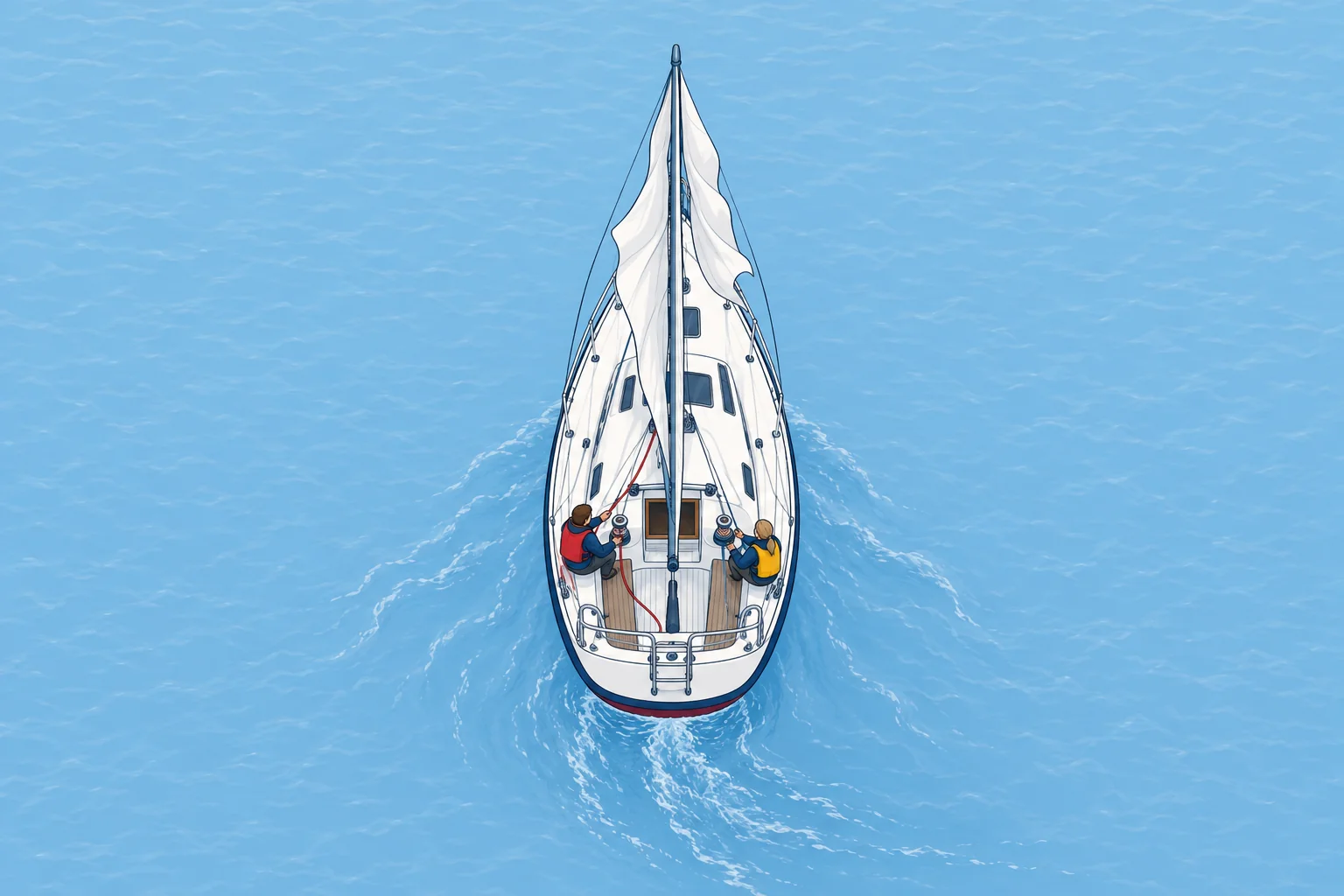
Tacking: turning the bow through the wind
1The lesson in plain words
A tack turns the bow through the wind. Prepare, call it, then turn steadily with enough speed.
What a tack is
A tack turns the bow, the front of the boat, through the wind. On starboard tack, the wind comes over your starboard (right) side; on port tack, over your port (left) side. The boom, the spar holding the mainsail out, moves only a short way. You pass through the no-go zone, where the sails cannot drive you, so carry enough speed to coast through.
Before you start
Build speed close-hauled, as close to the wind as you can sail while the sails still pull. Look all round, including behind the headsail, the sail ahead of the mast. Check your new course is clear. Its sheets are control ropes: the working sheet trims (adjusts) it now; the lazy sheet is the other one. Check the working sheet runs free. Prepare the lazy sheet on its winch; use enough turns for the load before trimming under tension, following the maker’s guidance.
Commands
You call "Ready about". The crew prepares and answers "Ready". Then call "Lee-oh" (in North America also "Helm's a-lee") and begin the turn. The commands warn everyone the boom will move. Under the COLREGs, the collision rules, a port-tack sailing vessel normally keeps clear of a starboard-tack one, so check who has right of way before you tack near others.
The turn
Steer smoothly towards the wind, not with a sudden full rudder, which brakes the boat. As the headsail backs, filling from the wrong side, the crew releases the old sheet and pulls in the new one quickly. The helm keeps turning until the sails fill on the new side, then settles on a close-hauled course. Build speed before sailing closer to the wind.
When it fails
Stopped head to wind with no sail driving, you are in irons. Too little speed or a sharp turn can cause this. To turn the bow to starboard, back the headsail to port. As you gather sternway (move backwards), turn the wheel to port or move the tiller to starboard. Centre the rudder as forward motion resumes, then trim the sails. In waves, keep speed up and choose a flat patch.
2Step by step
Tacking a sloop, step by step
- 1
Sail close-hauled at full speed and look all round, including behind the headsail.
Speed carries you through the no-go zone; the new course must be clear.
- 2
Call "Ready about". Crew clears the working sheet and prepares the lazy sheet on its winch.
Everyone knows the boom will move and sheets will run free.
- 3
Crew answers "Ready". Helm calls "Lee-oh" and steers steadily towards the wind.
A smooth turn keeps speed; a sudden full rudder brakes the boat.
- 4
As the headsail backs, release the old sheet and pull in the new one fast.
Prompt release lets the headsail cross and regain forward drive.
- 5
Settle close-hauled on the new tack, trim both sails, then build speed.
The keel needs water flowing past it before you can sail closer to the wind again.
3Key data
- Commands (UK/RYA)
- "Ready about" – "Ready" – "Lee-oh"
- Commands (US)
- "Ready about" – "Ready" – "Helm's a-lee"
- Turn (cruising yacht)
- About 90° of heading, close-hauled to close-hauled
- In irons
- Stopped head to wind; back the headsail to recover
4Key points
- 1
A tack turns the bow through the wind; the boat changes from one tack to the other.
- 2
Look all round, then call "Ready about", wait for "Ready", then "Lee-oh".
- 3
Turn steadily with full speed; do not slam the rudder over.
- 4
Release the old headsail sheet as it backs; trim the new one fast.
- 5
Stopped head to wind, in irons: back the headsail to push the bow off.
5Frequent mistakes
Wrong: Tack the moment you call "Ready about".
Right: Wait for "Ready". A crew member with a jammed sheet or a hand in a winch is not ready.
Wrong: Keep the old sheet held after every tack.
Right: Brief backing can help the bow finish turning. For a normal tack, release promptly as the sail backs so it crosses and drives again.
6Practice case & exam keys
Close-hauled at 2 knots in a short chop, you tack with a quick, full turn of the wheel. The boat stops head to wind, sails flapping, and starts drifting backwards.
Show the answer
You are in irons: too little speed and a sharp turn stopped the boat. To turn the bow to starboard, back the headsail to port. As you gather sternway (move backwards), turn the wheel to port or move the tiller to starboard. Centre the rudder as forward motion resumes, then trim the sails. Next time, build speed before turning smoothly.
Exam keys
- Tack: bow through the wind; starboard tack = wind over the starboard side.
- Commands: "Ready about" – "Ready" – "Lee-oh" ("Helm's a-lee").
- Enter with speed, turn steadily, release the old sheet as the headsail backs.
- In irons: back the headsail; steering reverses while moving astern.
Finish this unit
When you've read it, answer three questions. Get all three right to finish the unit; opening the page alone doesn't count.
My notes for this unit
No notes