
IMDG Dock Check
Boxes roll onto the quay and it's your job to put the right IMDG signs on them before the crane comes. All the signs are in the chart below the game.
Dangerous goods game
Sign the cargo before the crane comes
Read the manifest, pick the signs, send the box aboard. Get one wrong and it comes back at the end of the round.
All the IMDG signs
Every label, placard and mark in the game, with what it means and how to spot it. Labels go on packages. Placards are the same design at 250 mm or more, on containers and other cargo transport units.
Class 1: explosives
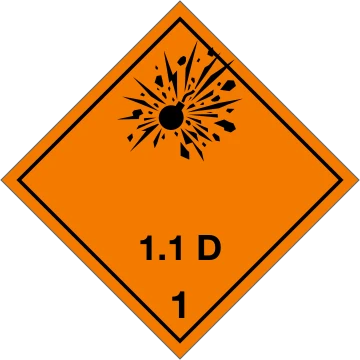
Explosive, division 1.1
Explosives with a mass explosion hazard: the whole load can go up at once.
Orange diamond, black exploding bomb, with 1.1 and a compatibility letter above the class 1.
IMDG Code 5.2.2.2.2
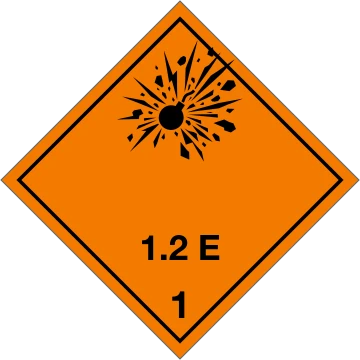
Explosive, division 1.2
Explosives with a projection hazard, but no mass explosion hazard.
Orange diamond, black exploding bomb, with 1.2 and a compatibility letter above the class 1.
IMDG Code 5.2.2.2.2
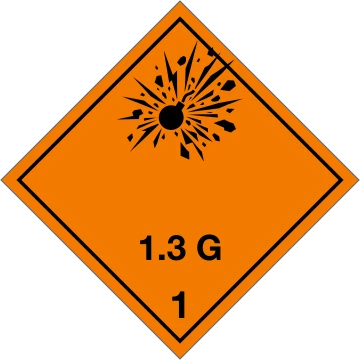
Explosive, division 1.3
Explosives with a fire hazard and a minor blast or projection hazard, but no mass explosion hazard.
Orange diamond, black exploding bomb, with 1.3 and a compatibility letter above the class 1.
IMDG Code 5.2.2.2.2
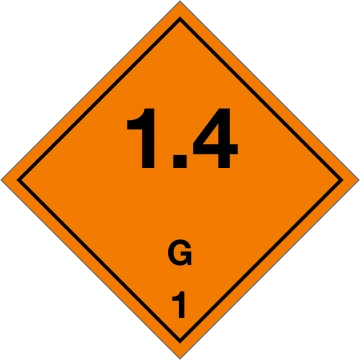
Explosive, division 1.4
Explosives with no significant hazard: if they go off, the effects stay largely inside the package.
Orange diamond with no bomb: a big black 1.4 on top, the compatibility letter and class 1 below.
IMDG Code 5.2.2.2.2
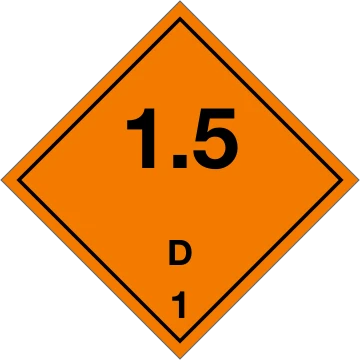
Explosive, division 1.5
Very insensitive substances that still have a mass explosion hazard.
Orange diamond with no bomb: a big black 1.5 on top, the compatibility letter and class 1 below.
IMDG Code 5.2.2.2.2
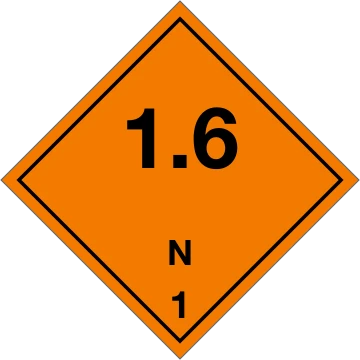
Explosive, division 1.6
Extremely insensitive articles with no mass explosion hazard.
Orange diamond with no bomb: a big black 1.6 on top, the compatibility letter and class 1 below.
IMDG Code 5.2.2.2.2
Class 2: gases
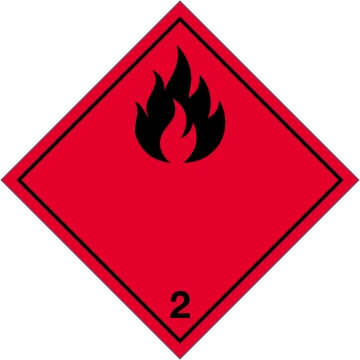
Flammable gas, division 2.1
A gas that burns.
Red diamond, flame in black or white, class 2 in the corner.
IMDG Code 5.2.2.2.2
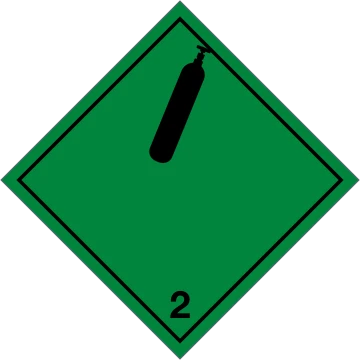
Non-flammable, non-toxic gas, division 2.2
A compressed gas that neither burns nor poisons, but can still suffocate you.
Green diamond, gas cylinder in black or white, class 2 in the corner.
IMDG Code 5.2.2.2.2
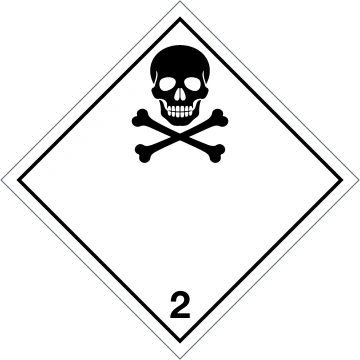
Toxic gas, division 2.3
A gas that poisons when you breathe it.
White diamond, black skull and crossbones, and a 2 in the corner. The 2 is what tells it apart from a 6.1.
IMDG Code 5.2.2.2.2
Class 3: flammable liquids
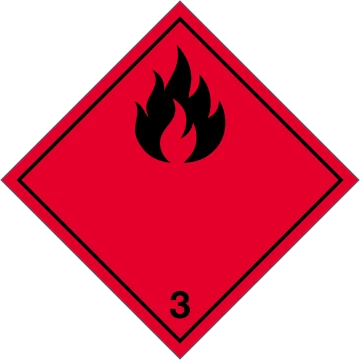
Flammable liquid, class 3
A liquid that gives off vapour that can catch fire.
Red diamond, flame in black or white, class 3 in the corner.
IMDG Code 5.2.2.2.2
Class 4: flammable solids
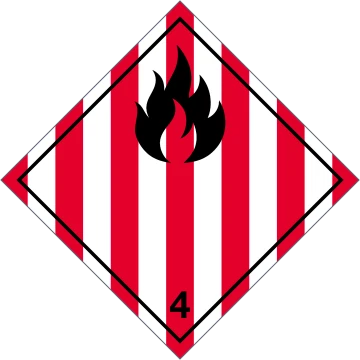
Flammable solid, division 4.1
Flammable solids, self-reactive substances, polymerizing substances and solid desensitized explosives.
White diamond with seven vertical red stripes, black flame, class 4 in the corner.
IMDG Code 5.2.2.2.2
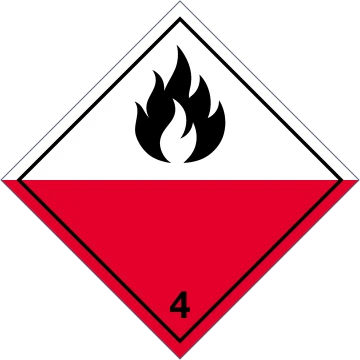
Spontaneously combustible, division 4.2
A substance that can catch fire on its own, with no flame or spark.
Top half white, bottom half red, black flame, class 4 in the corner.
IMDG Code 5.2.2.2.2
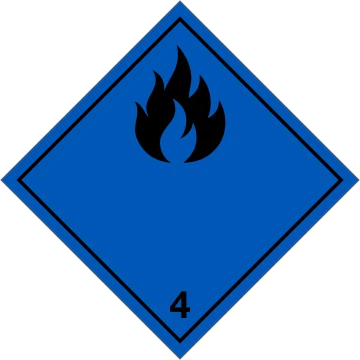
Dangerous when wet, division 4.3
A substance that gives off flammable gas when it touches water.
Blue diamond, flame in black or white, class 4 in the corner.
IMDG Code 5.2.2.2.2
Class 5: oxidizers and organic peroxides
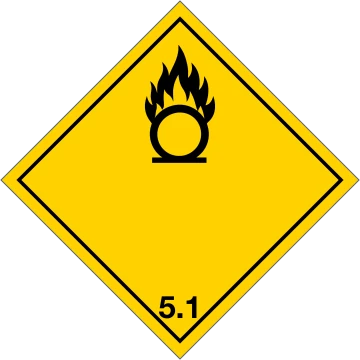
Oxidizing substance, division 5.1
A substance that gives off oxygen and feeds a fire.
Yellow diamond, black flame over a circle, 5.1 in the corner.
IMDG Code 5.2.2.2.2
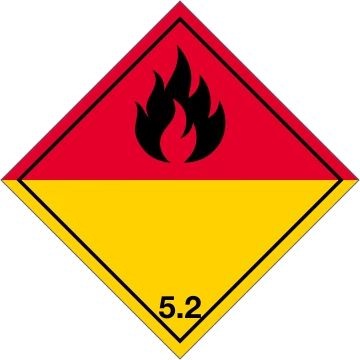
Organic peroxide, division 5.2
An unstable substance that can decompose by itself and burn fiercely.
Top half red, bottom half yellow, flame in black or white, 5.2 in the corner.
IMDG Code 5.2.2.2.2
Class 6: toxic and infectious substances
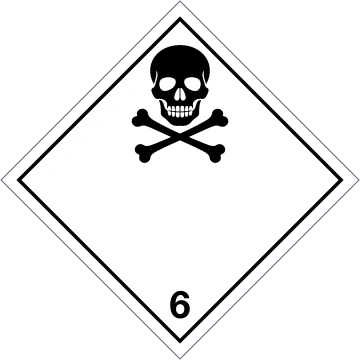
Toxic substance, division 6.1
A liquid or solid that can kill or seriously harm you if swallowed, breathed in or absorbed through the skin.
White diamond, black skull and crossbones, and a 6 in the corner. The 6 is what tells it apart from a 2.3.
IMDG Code 5.2.2.2.2
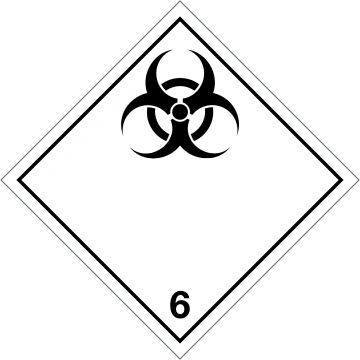
Infectious substance, division 6.2
Material holding germs that can cause disease in people or animals.
White diamond, three black crescents on a circle, class 6 in the corner.
IMDG Code 5.2.2.2.2
Class 7: radioactive material
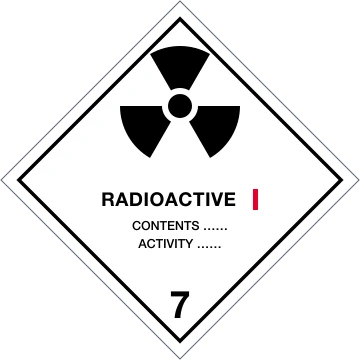
Radioactive, category I-WHITE
Radioactive package with a transport index of 0 and no more than 0.005 mSv/h at the surface.
White diamond, black trefoil, RADIOACTIVE with one red bar, class 7 in the corner.
IMDG Code 5.2.2.2.2
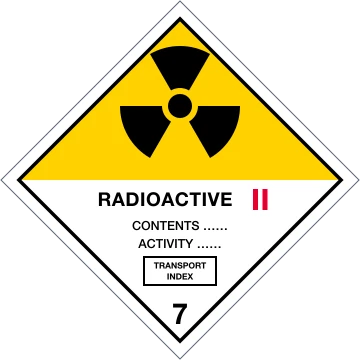
Radioactive, category II-YELLOW
Radioactive package with a transport index up to 1 and no more than 0.5 mSv/h at the surface.
Yellow top, white bottom, black trefoil, RADIOACTIVE with two red bars and a transport index box.
IMDG Code 5.2.2.2.2
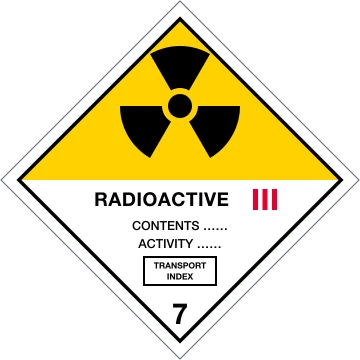
Radioactive, category III-YELLOW
Radioactive package with a transport index up to 10 and no more than 2 mSv/h at the surface.
Yellow top, white bottom, black trefoil, RADIOACTIVE with three red bars and a transport index box.
IMDG Code 5.2.2.2.2
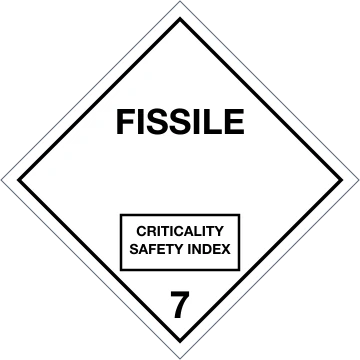
Fissile material
Material that could start a nuclear chain reaction, tracked with a criticality safety index.
White diamond with the word FISSILE on top, a criticality safety index box below, class 7 in the corner.
IMDG Code 5.2.2.2.2
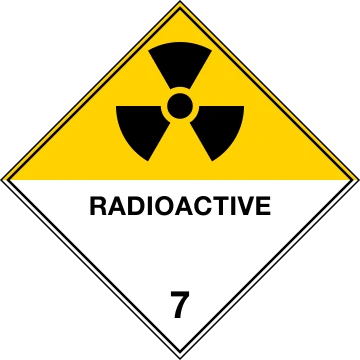
Radioactive placard, class 7
The big placard for the four sides of a large freight container of radioactive material.
Yellow top, white bottom, black trefoil, RADIOACTIVE or the UN number in the lower half, a 7 in the corner, no red bars.
IMDG Code 5.3.1.2.2
Class 8: corrosives
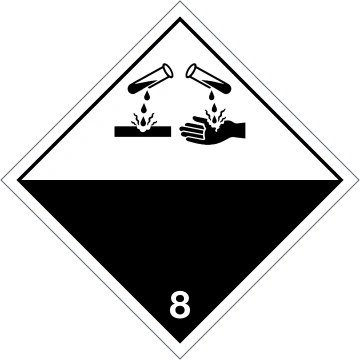
Corrosive substance, class 8
A substance that eats through skin and metal.
Top half white, bottom half black, liquid from two glass vessels attacking a hand and a metal, a white 8 in the corner.
IMDG Code 5.2.2.2.2
Class 9: miscellaneous
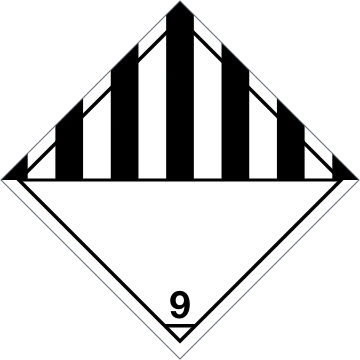
Miscellaneous dangerous goods, class 9
Dangerous goods that fit no other class, including environmentally hazardous substances.
White diamond, seven black stripes on the top half, an underlined 9 in the corner.
IMDG Code 5.2.2.2.2
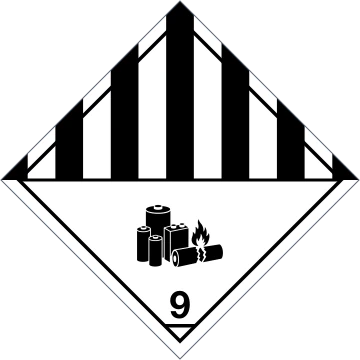
Lithium or sodium ion batteries, class 9 (9A)
Lithium or sodium ion batteries shipped as fully regulated dangerous goods.
Like the class 9 label, with a group of batteries, one broken and burning, on the lower half.
IMDG Code 5.2.2.2.2
Package marks
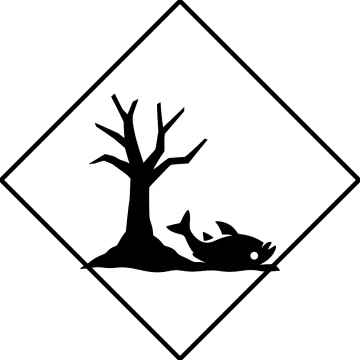
Marine pollutant mark
This cargo harms sea life if it gets into the water.
Diamond with a black dead fish and dead tree. It has no class number, and it goes on as well as the class label.
IMDG Code 5.2.1.6.3

Limited quantity mark
Small inner packagings of dangerous goods, packed under the limited quantity rules.
Diamond with black top and bottom corners and a white band across the middle.
IMDG Code 3.4.5.1
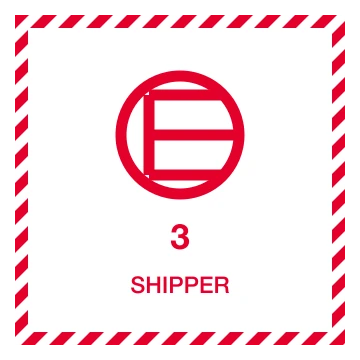
Excepted quantity mark
Very small amounts of dangerous goods, packed under the excepted quantity rules.
Square with a hatched border in black or red, a circled E, the class number and, if it's not elsewhere on the package, the shipper's or consignee's name.
IMDG Code 3.5.4.2
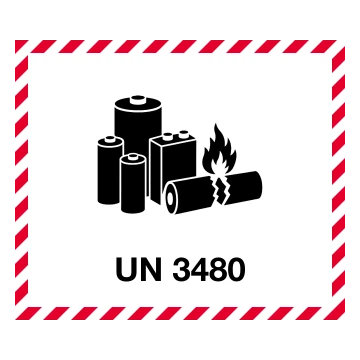
Lithium or sodium ion battery mark
Small batteries prepared under special provision 188, which spares them the 9A label.
Rectangle or square with a red hatched border, the group of batteries, and the UN number.
IMDG Code 5.2.1.10

Orientation arrows
This way up: the liquid inside must stay upright.
Two black or red arrows pointing up over a bar. The frame around them is optional.
IMDG Code 5.2.1.7
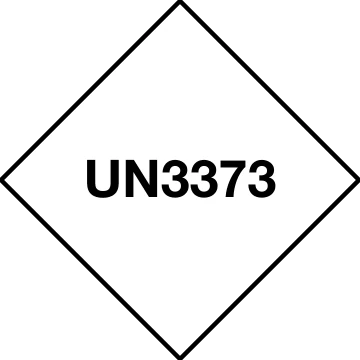
UN 3373 mark
Biological substance, category B: patient samples and the like.
Diamond with UN3373 inside, and the proper shipping name next to it.
IMDG Code P650
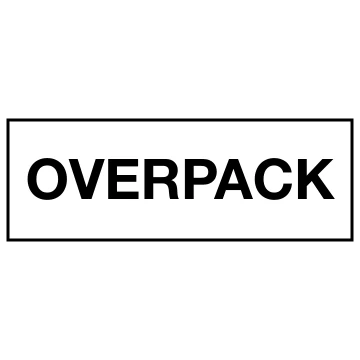
OVERPACK mark
A shrink-wrapped pallet or box hides the package marks inside, so the outside has to carry them.
The word OVERPACK in letters at least 12 mm high, next to the reproduced marks and labels.
IMDG Code 5.1.2.1
Warnings on cargo transport units
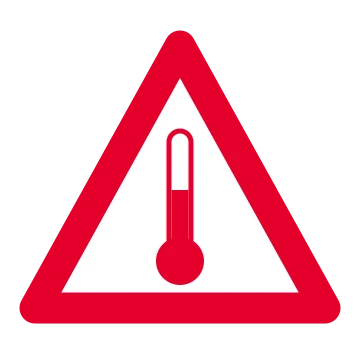
Elevated temperature mark
The unit carries a liquid at 100 °C or more, or a solid at 240 °C or more.
Red equilateral triangle with a thermometer inside, on each side and each end of the unit.
IMDG Code 5.3.2.2
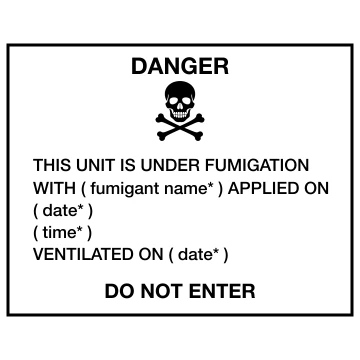
Fumigation warning mark
Toxic fumigant gas may be inside this unit: don't open it or go in.
White rectangle, black print: DANGER, skull and crossbones, the fumigant, the date and time, DO NOT ENTER.
IMDG Code 5.5.2.3.2
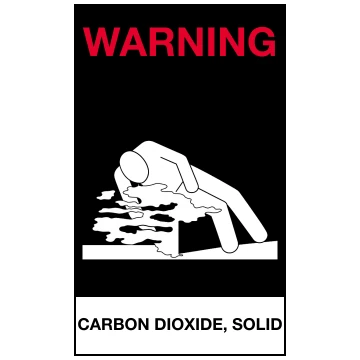
Asphyxiation warning mark
Coolant or conditioner inside this unit can leave the air too thin in oxygen to breathe.
Black panel with WARNING in red or white, a collapsing figure, and the gas name below.
IMDG Code 5.5.3.6.2
Checked against IMDG Code Amendment 42-24, mandatory since 1 January 2026. Amendment 43-26 was adopted in May 2026, can be applied from 1 January 2027 and becomes mandatory on 1 January 2028. This is study material, so always work from the current Code on board. Compatibility letters, the UN number and the class on the excepted quantity mark are examples, and each one changes with the cargo.