

Latitude from the meridian altitude
1The lesson in plain words
Zenith distance plus declination, with names: add for the same name, subtract for contrary names. One rule covers every case.
Zenith distance
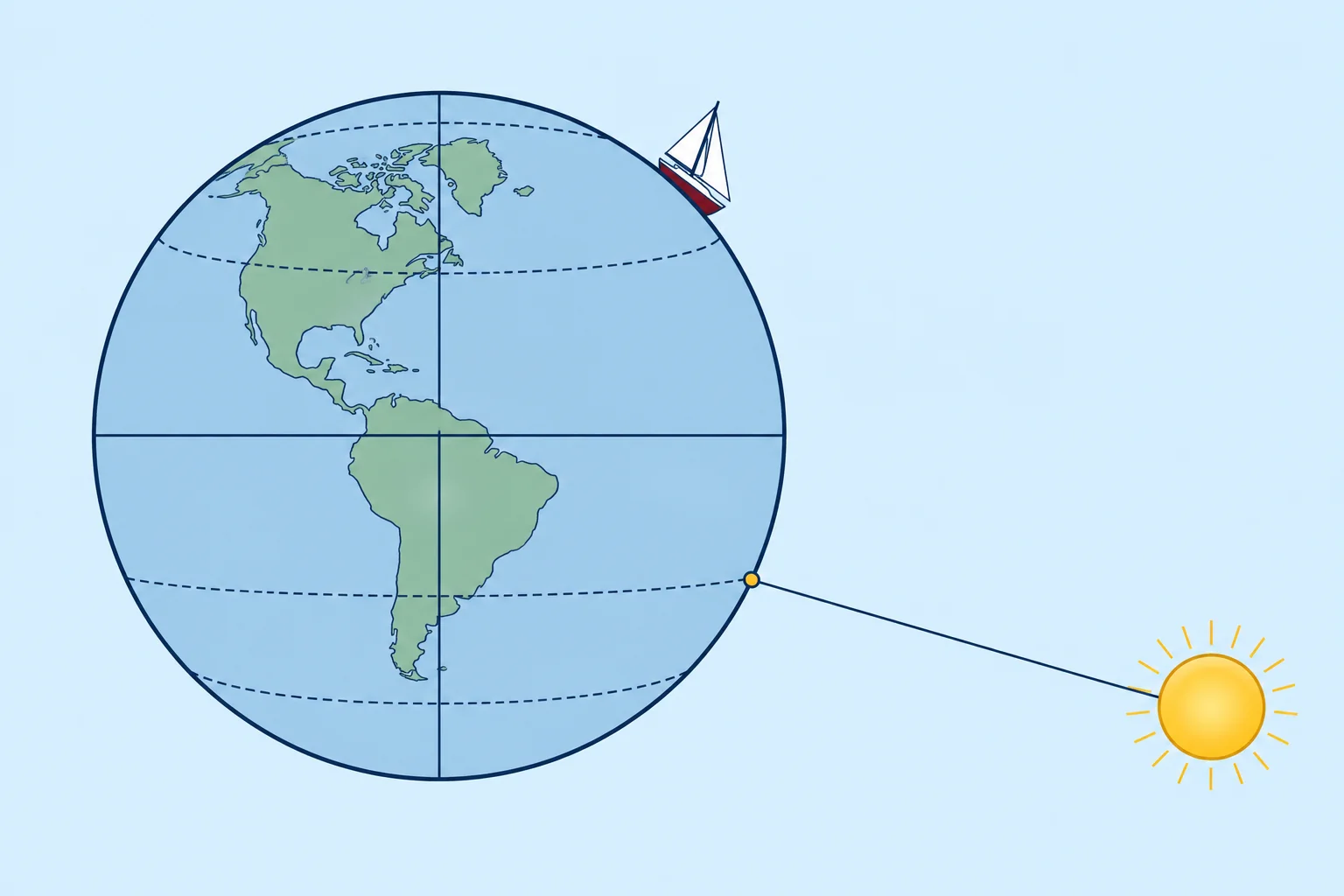
First correct Hs to Ho (Celestial: the sextant). Your zenith is the point directly overhead. The zenith distance, ZD = 90° − Ho, is the angle from your zenith to the Sun. Name ZD opposite to the Sun's bearing: Sun south means ZD north; Sun north means ZD south.
The rule
Your latitude is the zenith distance combined with the declination, by name. Same names: latitude = ZD + Dec. Contrary names: latitude = the difference, named like the larger. Spanish courses write it latitud = distancia cenital ± declinación.
Same name
At about 38°N in May, with Dec N 18°, the Sun bears south, so ZD is named N, like Dec: add. This is the usual case in summer in your own hemisphere.
Contrary names
At about 21°N in November, with Dec S 21°, the Sun bears south: ZD named N, Dec named S. Subtract and name the result like the larger, here ZD: latitude N. You and the point directly beneath the Sun are on opposite sides of the equator.
Polar side
In the tropics, when Dec has your latitude's name but is larger, the Sun passes on the polar side of your zenith. At about 11°N with Dec N 18°, it bears north: ZD named S, Dec N, contrary names. Latitude = Dec − ZD, named N, like the larger Dec. The rule has not changed; only the bearing has.
Accuracy
Each 1′ of error in Ho gives 1 M of error in latitude. A good yacht noon sight is usually within about 1–2 M.
2Key data
- Zenith distance
- ZD = 90° − Ho, named opposite to the Sun's bearing
- Same names
- Latitude = ZD + Dec
- Contrary names
- Latitude = difference, named like the larger
- Polar side
- Dec > latitude, same hemisphere: Sun bears to the pole
- Accuracy
- 1′ of altitude error = 1 M of latitude
- Spanish terms
- Latitud = distancia cenital ± declinación
3Key points
- 1
ZD = 90° − Ho, named opposite to the Sun's bearing.
- 2
Same names: add. Contrary names: subtract, name like the larger.
- 3
Polar-side Sun: ZD and Dec contrary; latitude = Dec − ZD.
- 4
1′ of altitude = 1 M of latitude.
4Frequent mistakes
Wrong: Name ZD after the Sun's bearing: Sun south, ZD south.
Right: Name it the opposite way: you are north of a Sun that bears south, so ZD is N.
Wrong: Use 90° − Hs as the zenith distance.
Right: Correct Hs to Ho first, using the corrections for your observation (Celestial: the sextant). Then calculate 90° − Ho.
Wrong: Contrary names mean latitude = Dec − ZD.
Right: Take the difference and name it like the larger. Usually ZD is larger and keeps its name.
5Practice case & exam keys
On 13 May 2026 near 035°20′W in the tropical Atlantic, your DR is about 11°N. At noon, Ho is 82°30.0′, Dec N 18°28.8′ and the Sun bears north. Your mate adds ZD to Dec and gets 25°58.8′N. Would you accept this? Explain and calculate your latitude.
Show the answer
ZD = 90° − 82°30.0′ = 7°30.0′. The Sun bears north, so ZD is named S. Dec is N: contrary names, subtract and name like the larger. Latitude = 18°28.8′ − 7°30.0′ = 10°58.8′N. Reject the addition: ZD and Dec have contrary names. The result also agrees closely with the DR.
Exam keys
- ZD = 90° − Ho, named opposite to the Sun's bearing.
- Same names add; contrary names subtract, named like the larger.
- Polar-side Sun in the tropics: latitude = Dec − ZD.
- 1′ of altitude error = 1 M of latitude.
Finish this unit
When you've read it, answer three questions. Get all three right to finish the unit; opening the page alone doesn't count.
My notes for this unit
No notes