

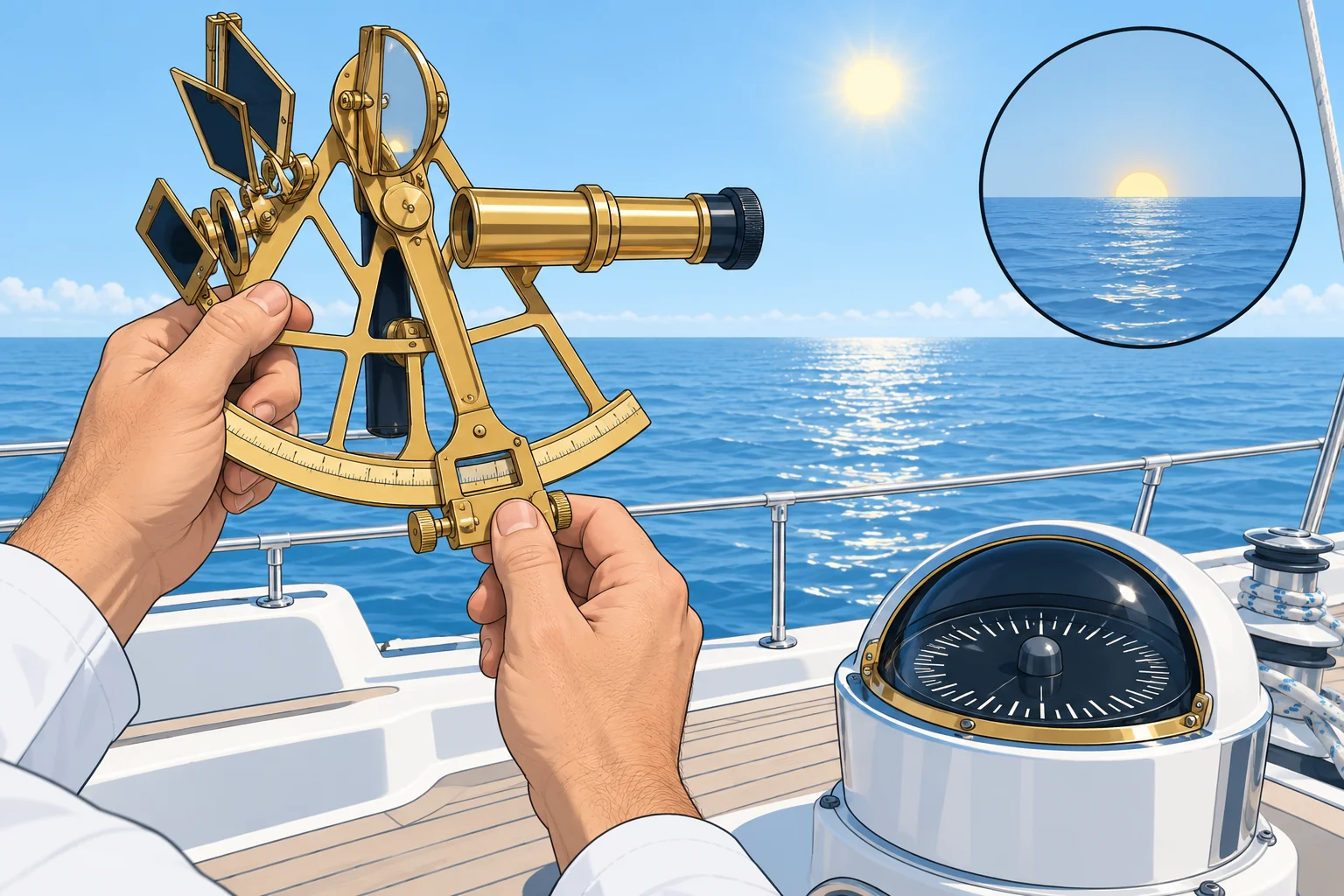
Observing the meridian altitude
1The lesson in plain words
On a slow yacht, follow the Sun up and read its highest altitude as it starts to fall. Note whether it bears north or south.
The Sun hangs
Near noon the Sun's altitude changes very slowly: for a few minutes it seems to stop. Follow it up and read the maximum as it starts to fall. On a slow yacht, this highest sextant reading Hs closely approximates the meridian altitude, the altitude at meridian passage. You do not need the exact moment for this approximation.
A moving vessel
Motion north or south can shift the maximum several minutes before or after meridian passage. On a slow yacht, the altitude difference is usually small, so the maximum is a practical approximation. On a fast north–south run, observe at the computed time of meridian passage.
Name of the bearing
Note whether the Sun bore south or north of you. In northern mid-latitudes it bears south; in the tropics, it can bear north. This name decides the arithmetic in the next part. A glance at the compass is enough.
If you miss it
If cloud hides the Sun at noon, a sight a few minutes either side can still be used, as an ex-meridian sight or a normal intercept sight (Celestial: sight reduction). For those, the time to the second matters again.
2Step by step
Taking the noon sight on a slow yacht
- 1
Start about 10 minutes before predicted noon.
Allow for a small DR longitude error.
- 2
Follow the Sun’s altitude as it rises.
Look for the highest reading.
- 3
Keep observing while the altitude seems unchanged.
The Sun may hang for a few minutes.
- 4
When the Sun's altitude clearly starts decreasing, record the highest sextant reading reached.
On a slow yacht, the maximum closely approximates meridian altitude.
- 5
Record the Sun’s bearing, N or S, and the time.
You need the bearing for latitude and the time for declination.
3Key data
- Start
- About 10 min before predicted noon
- Meridian altitude
- Altitude at meridian passage; close to a slow yacht's maximum
- Time
- Exact time not critical on a slow yacht; log it anyway
- Bearing
- Note N or S: it names the zenith distance
- Fast vessel
- Observe at the computed time of meridian passage
- Spanish terms
- Altura meridiana, altura máxima, meridiana
4Key points
- 1
On a slow yacht, follow the Sun up; read when it starts to dip.
- 2
On a slow yacht, the maximum closely approximates the meridian altitude.
- 3
Note whether the Sun bore north or south.
- 4
Fast vessels: observe at the computed time instead.
- 5
Missed it? Use an ex-meridian or intercept sight.
5Frequent mistakes
Wrong: On a slow yacht, take one sight at the predicted minute and leave it.
Right: Follow the Sun until it stops rising and dips; on a slow yacht, the maximum closely approximates meridian altitude.
Wrong: The Sun always bears south at noon in the northern hemisphere.
Right: In the tropics, when Dec is north and greater than your latitude, it bears north.
6Practice case & exam keys
On a slow yacht approaching predicted noon, the Sun's altitude creeps up, stays the same for about three minutes, then starts to fall. A crew member wants to wait for the exact time from the almanac before reading. What do you advise?
Show the answer
Read the highest altitude reached as the Sun starts to fall. On a slow yacht, this maximum closely approximates meridian altitude. The exact time is not critical for this approximation. Note the bearing, north or south, and log the time. Waiting risks cloud or a bad horizon.
Exam keys
- On a slow yacht, the maximum approximates meridian altitude: read as the Sun starts to fall.
- Start about 10 minutes before predicted noon.
- Record the Sun's bearing N or S.
- Fast vessels use the computed time; missed noon: ex-meridian or intercept.
Finish this unit
When you've read it, answer three questions. Get all three right to finish the unit; opening the page alone doesn't count.
My notes for this unit
No notes