

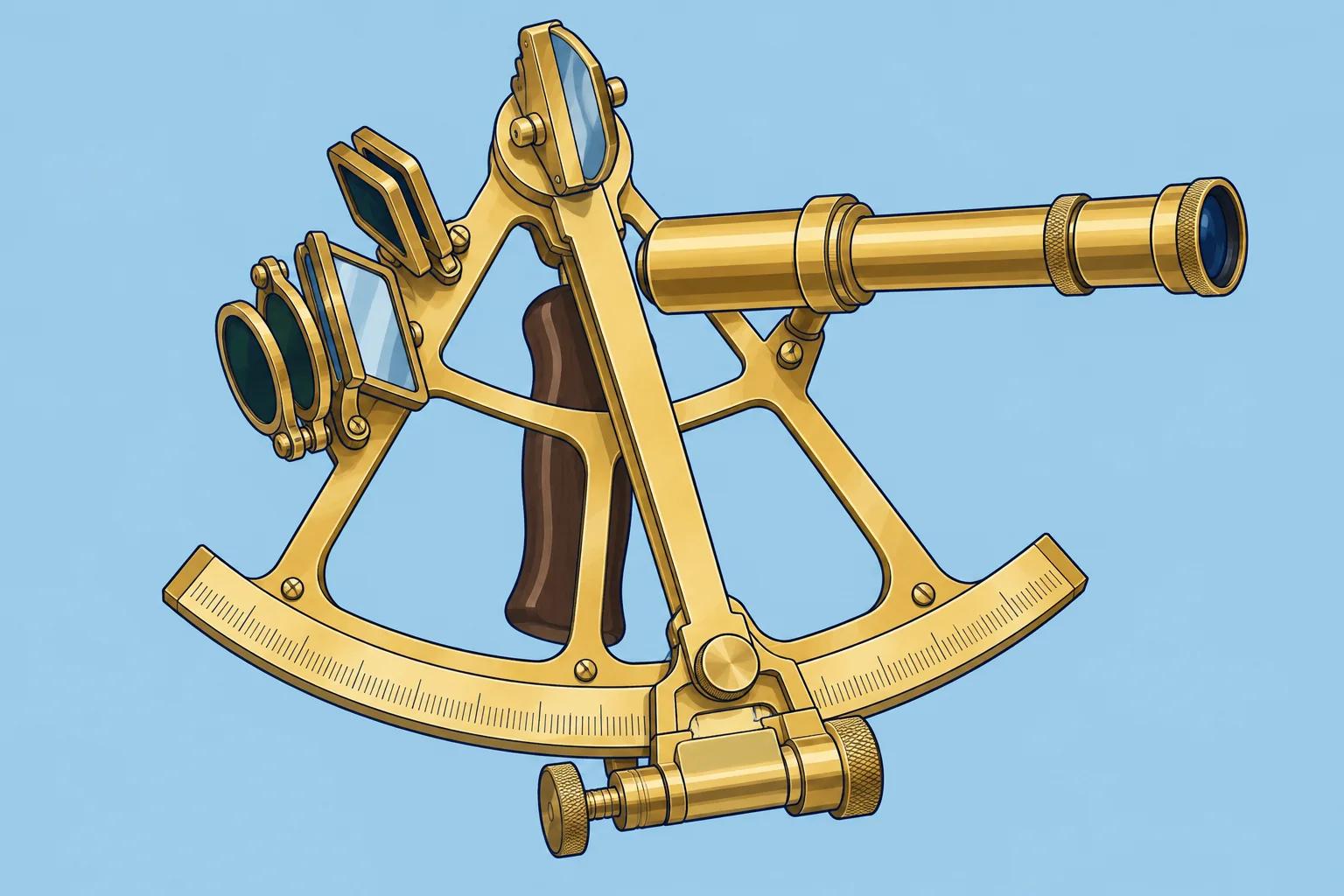
The marine sextant: parts and principle
1The lesson in plain words
A sextant measures the angle between a body and the sea horizon. Two mirrors show both together, so the angle can be read on a moving boat.
What it measures
A sextant measures the angle between two objects. For a celestial sight that is the angle between a body and the sea horizon below it: the sextant altitude, Hs. It works on a rolling boat because you see the body and the horizon together in the eyepiece. They move together, so the angle between them stays readable.
Parts
A frame carries the arc, graduated in degrees. The index arm pivots at the arc's centre and carries the index mirror. The horizon mirror, fixed to the frame, is half silvered or semi-transparent, so you see the horizon through it and the body reflected in it. A telescope looks through it; shade glasses protect your eye. A micrometer drum on the arm reads minutes, and a vernier beside it reads tenths.
Double reflection
Light from the body hits the index mirror, then the horizon mirror, then your eye. The angle between the incoming ray and the ray reaching your eye is twice the angle between the mirrors. So moving the arm 10° changes the reading by 20°. The arc is about one-sixth of a circle, 60°, hence 'sextant', but it is marked to read up to about 120°.
Reading it
Read whole degrees on the arc at the index mark, minutes on the micrometer drum, then tenths on the vernier. Arc 47°, drum 31′ and vernier 0.4 give 47°31.4′. Readings just below zero, used when checking index error, are off the arc.
Types and care
Metal sextants are the standard. Plastic ones are cheaper and lighter but change shape with temperature, so check index error at every use. Lift a sextant by its frame or handle, never by the arm or the mirrors. Stow it in its box, and rinse off salt with fresh water, then dry it. Never look at the Sun without shades in place.
2Key data
- Measures
- Angle between body and horizon: sextant altitude Hs
- Principle
- Reading = 2 × angle between the mirrors
- Arc
- About 60° of frame, marked to about 120°
- Reading
- Arc degrees + drum minutes + vernier tenths
- Eye safety
- Shades in before the Sun enters the view
- Spanish terms
- Alidada, espejo grande, espejo chico, tambor, nonio
3Key points
- 1
A sextant measures Hs, the angle between body and horizon.
- 2
Index mirror moves with the arm; horizon mirror is fixed.
- 3
Reading = twice the angle between the mirrors.
- 4
Read arc, then drum, then vernier: 47°31.4′.
- 5
Lift by the frame; shades before the Sun; rinse and dry.
4Frequent mistakes
Wrong: A plastic sextant gives the same accuracy without extra checks.
Right: It is lighter and cheaper but changes with temperature: measure index error each time you use it.
Wrong: Lift the sextant by the index arm.
Right: Lift it by the frame or handle. Pressure on the arm or mirrors can put it out of adjustment.
5Practice case & exam keys
A new crew member picks up the sextant by the index arm, points it at the Sun with no shades and reads '47 degrees and 31, then 4 on the little scale'. Correct what went wrong and give the reading.
Show the answer
Lift it only by the frame or handle, and put the shades in before the Sun can enter the view: a direct look can damage the eye. The reading is 47° on the arc, 31′ on the drum and 0.4′ on the vernier: 47°31.4′. Then check the index error before the sight.
Exam keys
- Hs is the angle from the visible horizon to the body.
- Index mirror on the arm; horizon mirror fixed; reading = 2 × mirror angle.
- Reading: arc degrees, drum minutes, vernier tenths.
- Care: frame or handle only, shades, fresh-water rinse, box.
Finish this unit
When you've read it, answer three questions. Get all three right to finish the unit; opening the page alone doesn't count.
My notes for this unit
No notes