

From sextant altitude to true altitude
1The lesson in plain words
Hs becomes the apparent altitude after index error and dip; refraction, semi-diameter and parallax then turn it into the observed altitude Ho.
The chain
Hs, the sextant altitude, becomes Ha, the apparent altitude, after the index correction and dip. Ha becomes Ho, the observed altitude measured from the celestial horizon at the Earth's centre, after refraction, semi-diameter and parallax. The Nautical Almanac's altitude correction tables combine those last three for the Sun, stars and planets, and separately for the Moon.
Dip
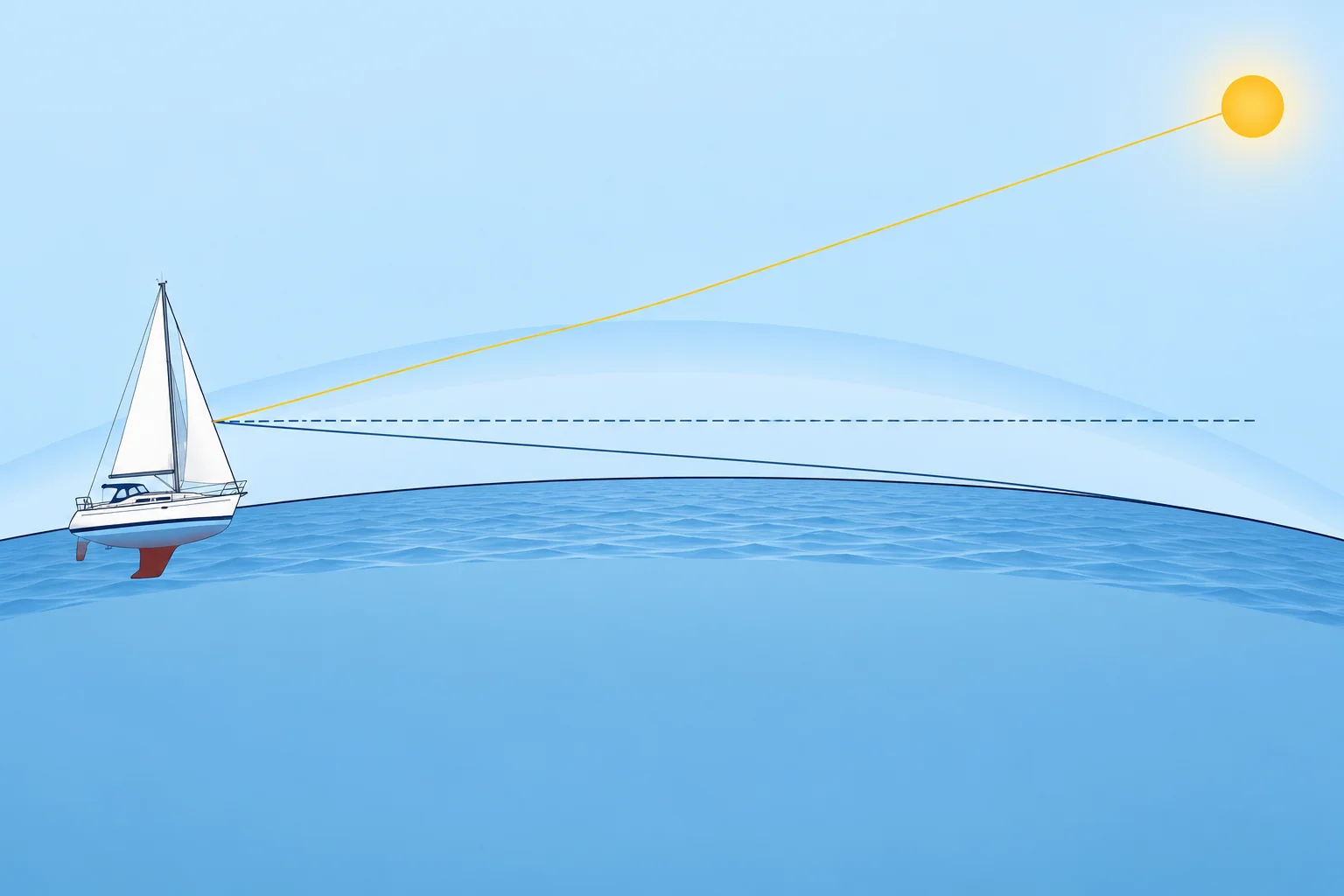
Your eye is above the sea, so the visible horizon lies below the true horizontal. Dip = 1.76′ × √(height of eye in metres), always subtracted. At 2.5 m it is 2.8′; at 9 m, 5.3′. The almanac has a dip table by height of eye.
Refraction
The atmosphere bends light, so every body looks higher than it is: refraction is always subtracted. In standard conditions it is about 5.4′ at 10°, 2.7′ at 20°, 1.0′ at 45° and zero at 90°. Avoid sights below about 10°; for non-standard temperature or pressure, apply the signed additional correction as the almanac directs.
Semi-diameter
The almanac's positions are for the centre of the Sun, but you measured its edge. Add the semi-diameter (SD, 15.7′–16.3′, at the foot of the daily page) for a lower limb; subtract it for an upper limb. Stars are points: they have no SD.
Parallax
Ho is measured as if from the Earth's centre, but you stand on its surface. The difference, parallax in altitude, is always added. It is tiny for the Sun, 0.1′ or less, small for Venus and Mars, and large for the Moon: up to about 1° (Celestial: stars, planets and the Moon).
In practice
Choose the table for your body. For the Sun, enter with Ha and select October–March or April–September, then lower or upper limb. For stars, enter the stars-and-planets table with Ha. Planets use that table with any further correction directed by the almanac. The Moon has separate tables. Detailed planetary and lunar adjustments belong to the later unit. Apply the combined correction once: do not add its components again.
2Key data
- Chain
- Hs + IC − dip = Ha; Ha + main corr. = Ho
- Dip
- Always −: 1.76′ × √(height of eye in m)
- Refraction
- Always −: about 5.4′ at 10°, 1.0′ at 45°, 0 at 90°
- Semi-diameter
- Sun lower limb + SD; upper limb − SD (15.7′–16.3′)
- Parallax
- Always +: Sun ≤ 0.1′; Moon up to about 1°
- Spanish terms
- Depresión, refracción, semidiámetro, paralaje
3Key points
- 1
Hs → Ha with index correction and dip.
- 2
Ha → Ho with refraction, SD and parallax.
- 3
Dip and refraction are always subtracted; parallax always added.
- 4
SD: add for the lower limb, subtract for the upper; none for stars.
- 5
Avoid sights below about 10°: refraction is large and uncertain.
4Frequent mistakes
Wrong: Refraction makes bodies look lower, so add it.
Right: Refraction lifts the image: bodies look higher, so it is always subtracted.
Wrong: Apply the Sun's semi-diameter to a star sight.
Right: Stars are points of light: no semi-diameter. Use the stars and planets table.
Wrong: Dip depends on the body's altitude.
Right: Dip depends only on your height of eye; refraction depends on altitude.
5Practice case & exam keys
Two observers sight the same star at the same moment over a clear horizon. Their index corrections are equal. Eye heights are 2.0 m and 4.0 m; the higher observer reads Hs 1.0′ greater. Does dip explain the difference?
Show the answer
Yes. Only dip differs: 1.76 × √2.0 = 2.5′ and 1.76 × √4.0 = 3.5′, so the higher observer reads 1.0′ more. After each adds the same IC and subtracts their own dip, both Ha agree; refraction then depends on altitude, the same for both. A star has no semi-diameter, and its parallax is negligible.
Exam keys
- Hs + IC − dip = Ha; Ha + main correction = Ho.
- Dip = 1.76′ √h (m), always subtracted.
- Refraction always subtracted, largest at low altitude; parallax always added.
- Sun SD: + lower limb, − upper limb; stars no SD.
Finish this unit
When you've read it, answer three questions. Get all three right to finish the unit; opening the page alone doesn't count.
My notes for this unit
No notes