

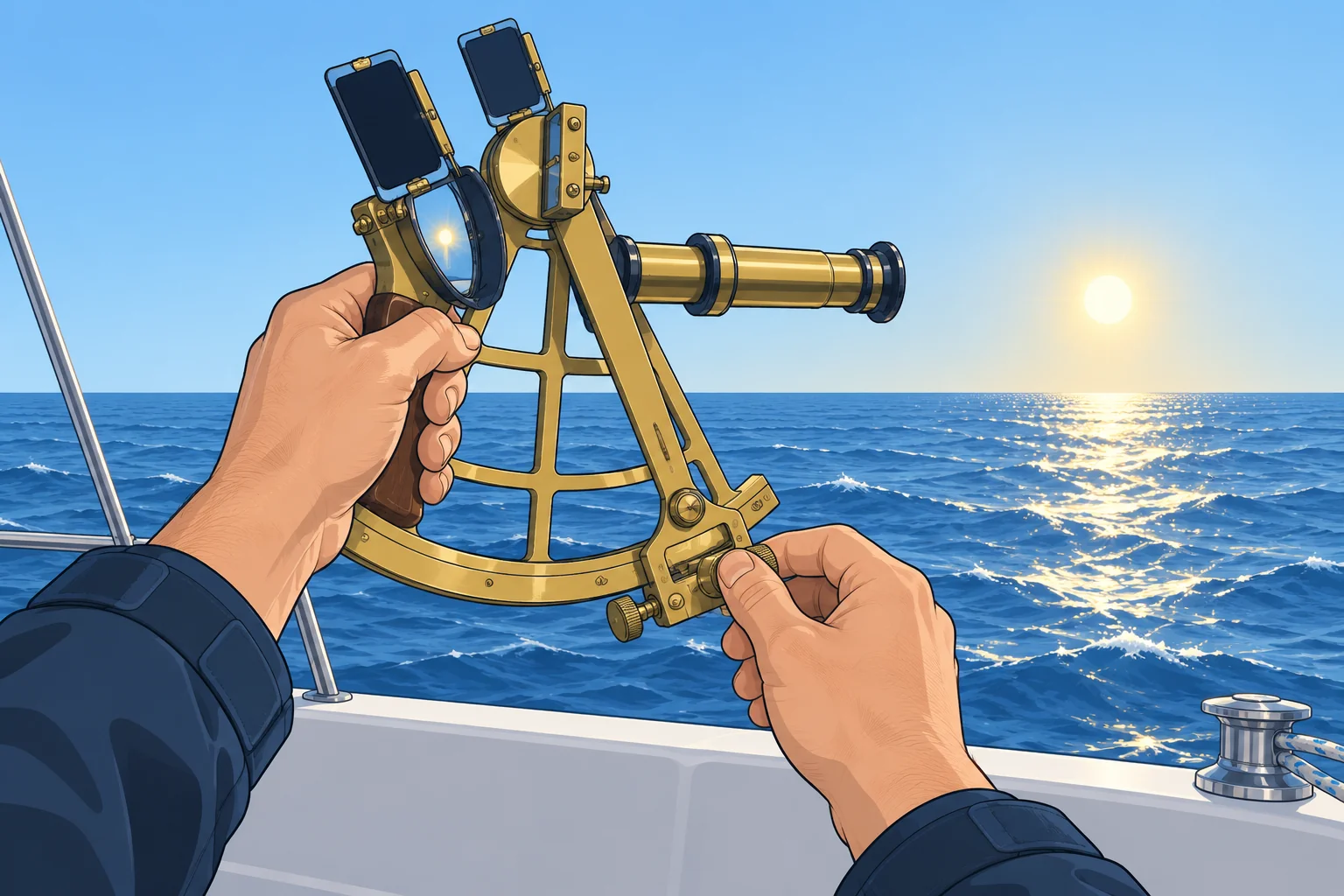
Taking a Sun sight
1The lesson in plain words
Shades first, bring the Sun down to the horizon, rock the sextant and touch the lower limb at the bottom of the swing. Then call the time.
Where to stand
Stand where you can brace yourself and see a clean horizon, often by the shrouds or in the companionway, and clip on. Note your height of eye above the sea, often 2–3 m on a yacht. A higher eye helps you see the horizon over a swell, but the dip correction must use the height you actually had.
Rocking the arc
Rock the sextant gently from side to side about the line of sight. The Sun appears to swing in an arc above the horizon. At the lowest point of the swing the sextant is vertical. Measure there: a tilted sextant gives an altitude that is too large.
Which limb
The Sun is a disc. Normally bring its lower limb, the bottom edge, down to touch the horizon. If cloud hides the bottom edge, use the upper limb and apply the semi-diameter the other way (Corrections part).
Waves and the horizon
Observe near a swell crest to reduce obstruction by nearby waves; use only a clearly defined sea horizon. A hazy horizon gives the largest errors. Bright sunlight on the water under the Sun can dazzle; use the right shades rather than guessing the horizon.
Recording
Record the date, dead-reckoning position (DR, estimated from course and distance run), height of eye, index error (IE), body, limb, Universal Time (UT) and sextant altitude (Hs). Take three to five sights, half a minute apart; reject clear outliers.
2Step by step
Taking a Sun sight
- 1
Put the shades in, then aim at the horizon under the Sun.
Protect your eye before the Sun can enter the view.
- 2
Bring the Sun down to the horizon with the arm, then use the drum.
The clamp gives coarse movement; the drum gives fine control.
- 3
Rock the sextant gently about the line of sight.
The Sun swings in an arc; its lowest point marks the vertical.
- 4
Touch the lower limb on the horizon at the bottom of the swing.
With the sextant vertical, you measure Hs to the visible horizon; corrections come later.
- 5
Call 'stop', note the exact time, then read the sextant.
Time to the second; altitude to 0.1′.
- 6
Take three to five sights and compare them.
A steady trend shows which sights are good.
3Key data
- Rock the arc
- Measure at the lowest point of the swing
- Limb
- Lower limb normally; upper limb if the bottom is hidden
- Height of eye
- Often 2–3 m on a yacht: use it for dip
- Swell
- Observe from the top of a swell
- Set of sights
- 3–5 sights; reject one that breaks the trend
- Spanish terms
- Limbo inferior, limbo superior, altura instrumental
4Key points
- 1
Shades first, every time.
- 2
Rock the arc and measure at the lowest point of the swing.
- 3
Lower limb normally; upper limb if the bottom is hidden.
- 4
Observe from the top of a swell; record time to the second.
- 5
Take a set of sights and reject an outlier.
5Frequent mistakes
Wrong: Hold the sextant still; rocking it only blurs the sight.
Right: Rocking finds the vertical. Measure at the bottom of the swing, or the altitude will be too large.
Wrong: Use the height of the deck for dip.
Right: Use the height of your eye above the water at the sight, standing where you were.
6Practice case & exam keys
Five morning sights at half-minute intervals read 32°05.2′, 32°10.9′, 32°13.6′, 32°22.4′ and 32°28.1′. The Sun is rising at about 5.7′ every half minute. Which sight do you reject, and why?
Show the answer
Successive increases are 5.7′, 2.7′, 8.8′ and 5.7′. The third sight should be about 32°16.6′, so 32°13.6′ is 3.0′ low. A nearby wave crest may have raised the apparent horizon. Tilt would make the reading too high, so it cannot explain this low outlier. Reject that sight and retain the other four with their recorded times.
Exam keys
- Shades in before the Sun enters the view.
- Rock the arc: a tilted sextant reads too high.
- Lower limb normally; upper limb if needed, SD subtracted.
- Record height of eye, IE, limb, UT and Hs; take a set and reject outliers.
Finish this unit
When you've read it, answer three questions. Get all three right to finish the unit; opening the page alone doesn't count.
My notes for this unit
No notes