

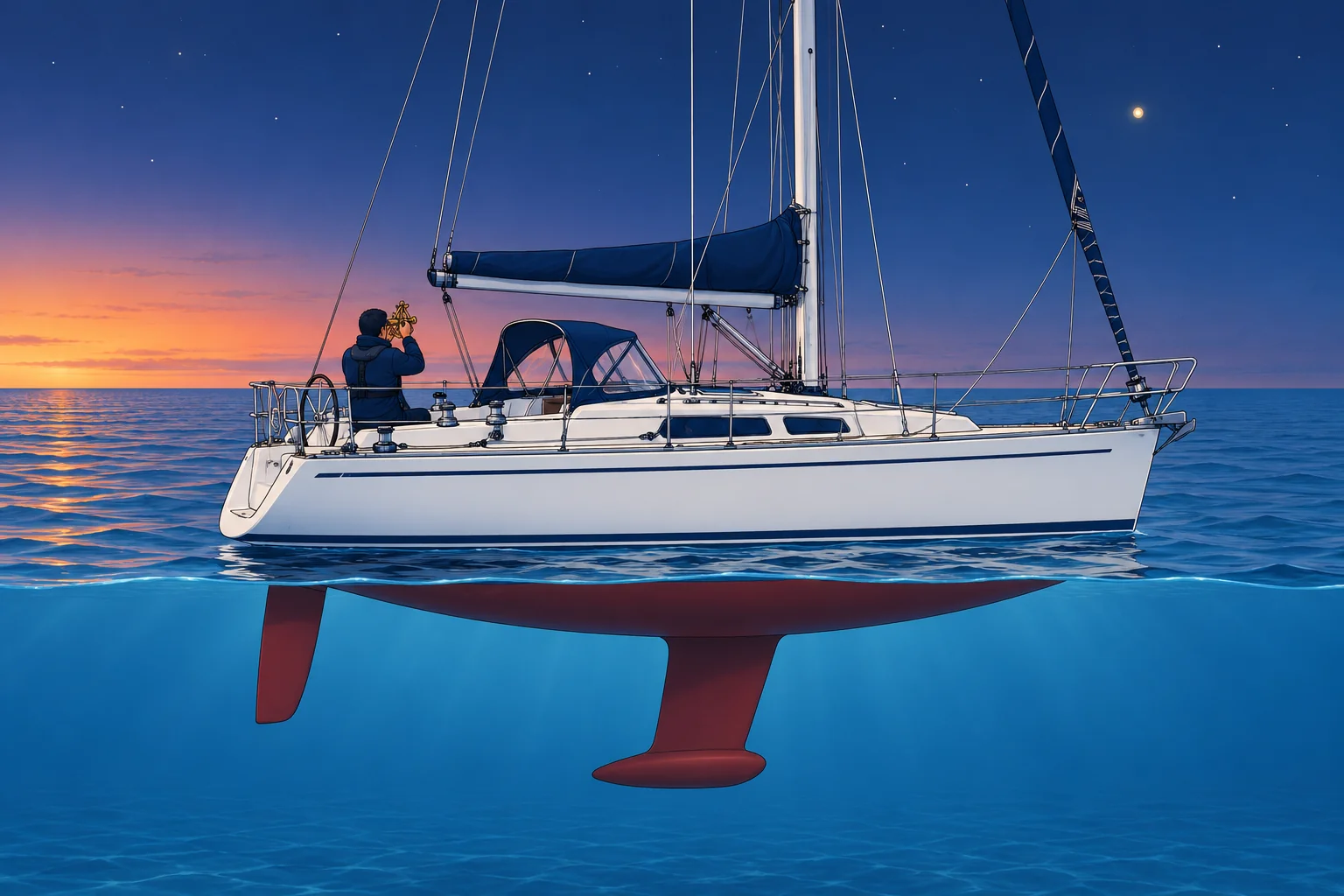
Twilight: the window for star sights
1The lesson in plain words
Twilight usually gives you visible stars and a clear horizon together. Plan your sights from the almanac's twilight times.
Why twilight
A star sight needs two things at once: the star visible in the sextant, and a sharp horizon under it. At night the horizon is usually lost; by day most stars are invisible. Your usual observing window is twilight, before sunrise and after sunset. That window lasts roughly 20 to 40 minutes in the tropics and longer in high latitudes.
Civil and nautical
Civil twilight ends in the evening when the Sun's centre is 6° below the horizon: the brightest stars and planets are out and the horizon is still crisp. Nautical twilight ends at 12° below: the horizon is usually too dark by then. Most star sights fall between the two. In the morning, the same window runs the other way.
The almanac's times
The Nautical Almanac's daily pages list sunrise, sunset, and civil and nautical twilight for latitudes from 60°S to 72°N. The times are local mean time (LMT); add west longitude in time, or subtract east, to get UT. Interpolate for your latitude.
Worked: 24 November 2026
Two days out of Las Palmas, at DR 26°05′N 019°10′W. Sunset is at about 1825 UT, civil twilight ends about 1850 UT and nautical twilight about 1918 UT. Plan to be ready at 1845 UT, with the stars precomputed and the deck watch checked.
Order of sights
In the evening, the eastern horizon darkens first, so take the stars in the east first and finish in the west. In the morning, stars fade first in the east as the sky brightens: take them first. Note the UT of each sight to the second.
2Key data
- Civil twilight
- Sun's centre 6° below the horizon
- Nautical twilight
- Sun's centre 12° below the horizon
- Star-sight window
- Mostly between the end of civil and nautical twilight
- Almanac times
- LMT for latitude; UT = LMT + W longitude in time (− E)
- Worked, 24 Nov 2026
- 26°05′N 019°10′W: sunset 1825, civil 1850, nautical 1918 UT
- Spanish terms
- Crepúsculo civil, crepúsculo náutico, hora civil del lugar
3Key points
- 1
Twilight usually provides the visible stars and sharp horizon you need.
- 2
Civil twilight: Sun 6° below. Nautical twilight: 12° below. Most sights fall between.
- 3
The almanac gives twilight in LMT: convert with longitude in time to UT.
- 4
Evening: eastern stars first, as that horizon fades first. Morning: eastern stars first, as they fade first.
4Frequent mistakes
Wrong: Wait for full darkness so that more stars are visible.
Right: By the end of nautical twilight the horizon is usually lost. Sight the bright stars while the horizon is still sharp.
Wrong: The almanac's twilight times are in UT.
Right: They are local mean time for your latitude. Add west longitude in time, or subtract east, to get UT.
5Practice case & exam keys
Evening, 24 November 2026, at 26°05′N 019°10′W. A crew member wants to start star sights at 1930 UT 'when it is properly dark'. What do you advise?
Show the answer
Too late. Nautical twilight ends about 1918 UT, and by then the horizon is usually too dark to trust. Start soon after the end of civil twilight, about 1850 UT, with the precomputed stars, taking the eastern ones first while that horizon is still sharp.
Exam keys
- Civil twilight 6°, nautical twilight 12° below the horizon (Sun's centre).
- Star sights: between the end of civil and the end of nautical twilight (evening).
- Almanac twilight times are LMT; convert with longitude in time.
- Evening: take the eastern stars first; that horizon fades first.
Finish this unit
When you've read it, answer three questions. Get all three right to finish the unit; opening the page alone doesn't count.
My notes for this unit
No notes