

Precomputing and identifying stars
1The lesson in plain words
Work out in advance where each star will be: its altitude and azimuth at the planned time. Then set the sextant, look along the bearing and find it.
GHA of a star
The almanac does not list each star's GHA. It lists GHA Aries hourly, and for 57 selected stars their SHA (sidereal hour angle) and declination, which change only slowly. GHA star = GHA Aries + SHA; subtract 360° if needed. Then LHA = GHA − west longitude, + east, as for the Sun.
Precomputing
Choose a time, say 1912 UT. For each candidate star, reduce from your DR as if you had a sight: Hc and Zn. Pick three or four stars at 15°–70° altitude, spread around the horizon. Set the sextant to each Hc, face the Zn, and the star appears in the horizon mirror.
Worked: 1912 UT, 24 November 2026
DR 26°05′N 019°10′W. GHA Aries at 19h 348°45.0′, plus 3°00.5′ for 12 min: 351°45.5′. Hamal (SHA 327°49.2′, N23°35.5′): Hc 36°21′, Zn 079°. Fomalhaut (SHA 015°12.8′, S29°28.8′): Hc 33°13′, Zn 167°. Vega (SHA 080°32.5′, N38°48.7′): Hc 44°04′, Zn 300°.
Other tools
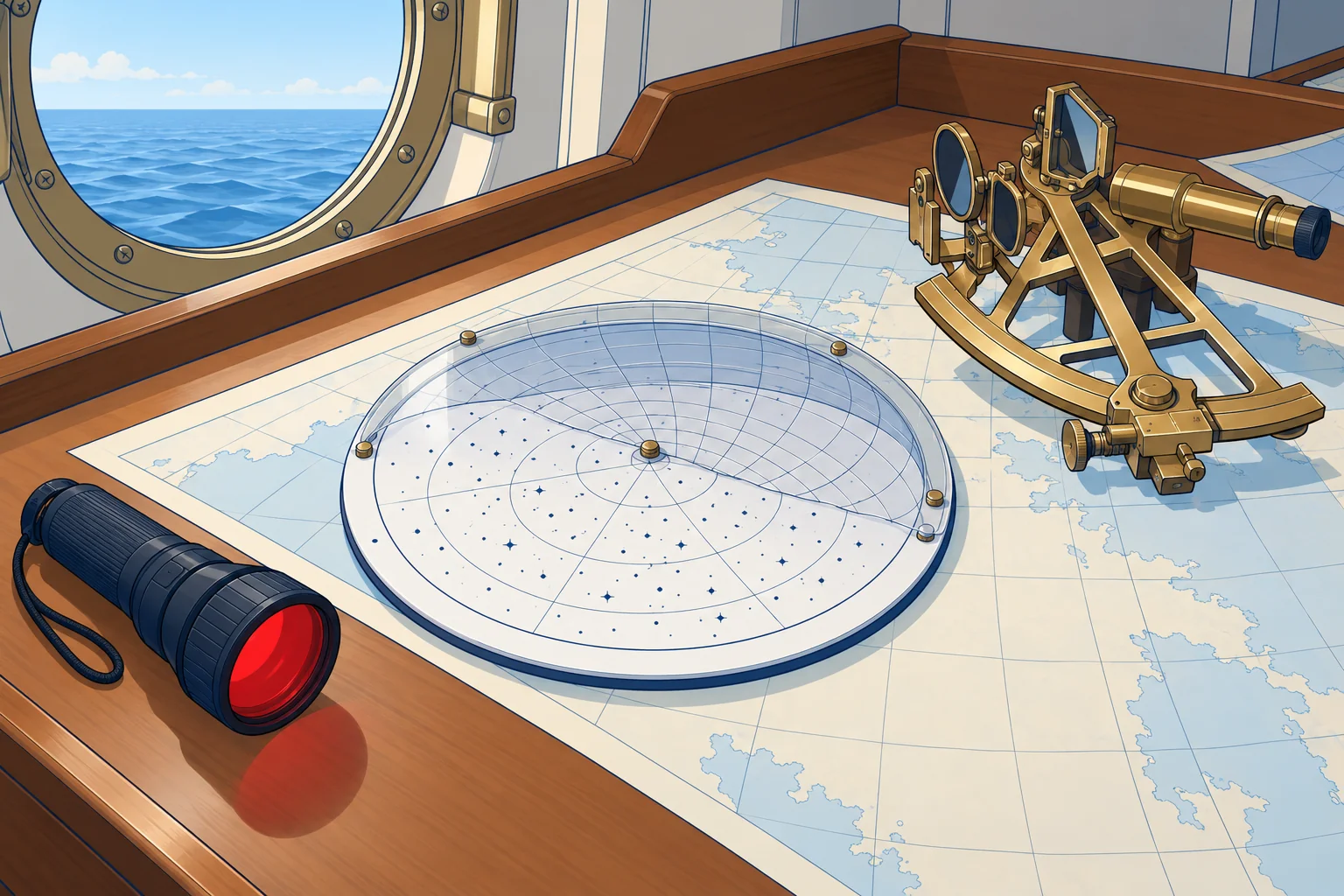
A star finder, such as the 2102-D, does the same with a plastic disc and an overlay for your latitude. HO 249 Volume 1 lists seven well-placed stars for each LHA Aries and latitude, marking three for a good fix. Navigation apps precompute too. Use any of them, but learn one way that needs no battery.
Unknown star
Measure the star's sextant altitude, compass bearing and exact UT. Correct the altitude to Ho and the bearing to true (allowing for compass error). From your DR latitude, solve backwards for declination and LHA. SHA = LHA star − LHA Aries; add 360° if negative. Match both SHA and declination in the almanac's star list. A planet needs its own almanac data.
2Key data
- GHA of a star
- GHA Aries + SHA (subtract 360° if needed)
- Almanac stars
- 57 selected stars: SHA and Dec on the daily pages
- Good choice
- Three or four stars, 15°–70° up, spread round the horizon
- Worked GHA Aries
- 24 Nov 2026, 1912 UT: 348°45.0′ + 3°00.5′ = 351°45.5′
- Worked stars
- Hamal 36°21′/079°, Fomalhaut 33°13′/167°, Vega 44°04′/300°
- Tools
- Star finder 2102-D; HO 249 Volume 1; apps
3Key points
- 1
GHA star = GHA Aries + SHA; then LHA as for any body.
- 2
Precompute Hc and Zn for the planned time; set the sextant and look along Zn.
- 3
Choose three or four stars, 15°–70° up, spread around the horizon.
- 4
An unknown star: work backwards to its SHA and declination, then search the list.
4Frequent mistakes
Wrong: GHA star = GHA Aries − SHA.
Right: SHA is measured westward from Aries, like GHA, so you add: GHA star = GHA Aries + SHA.
Wrong: Choose the brightest stars, wherever they are.
Right: Spread matters more than brightness. Three stars bunched in one quarter cut badly and hide a constant error.
Wrong: A star very low on the horizon is as good as any other.
Right: Below about 15°, refraction is larger and less certain. Above about 70°, the sextant is hard to swing. Prefer the middle.
5Practice case & exam keys
At 1912 UT on 24 November 2026, near 26°N 019°W, a crew member sets the sextant to 44°04′ and looks north-east for Vega. Nothing appears. What has gone wrong, and where should they look?
Show the answer
They are looking in the wrong direction. The precomputed azimuth is 300°T, west-north-west, not north-east. Keep the sextant at 44°04′, face 300°T, and sweep the horizon gently: Vega should appear close to the horizon in the mirror.
Exam keys
- GHA star = GHA Aries + SHA; LHA = GHA ± longitude.
- Precompute Hc and Zn from the DR for the planned UT.
- Choose 3–4 stars, 15°–70° altitude, spread in azimuth.
- Tools: star finder, HO 249 Vol 1 (selected stars), almanac star charts.
Finish this unit
When you've read it, answer three questions. Get all three right to finish the unit; opening the page alone doesn't count.
My notes for this unit
No notes