

The three-star fix and the cocked hat
1The lesson in plain words
Bring three star lines to one time for a fix. With stars about 120° apart, the equidistant point cancels an equal altitude error alone.
Reducing
Reduce each star exactly like a Sun sight: GHA (from Aries and SHA), LHA, Dec, then Hc and Zn and the intercept. With tables, each star has its own AP. With a calculator, reduce all from one DR. Correct each sextant altitude for index error, dip and refraction; stars need no semi-diameter or parallax (Celestial: the sextant).
A common time
The sights are minutes apart, and the boat moves. Bring them to one time, usually the last sight. At 6.5 kn, a sight 5 minutes earlier is 0.5 M behind: move its line along the ground track, or its AP, by that distance.
The cocked hat
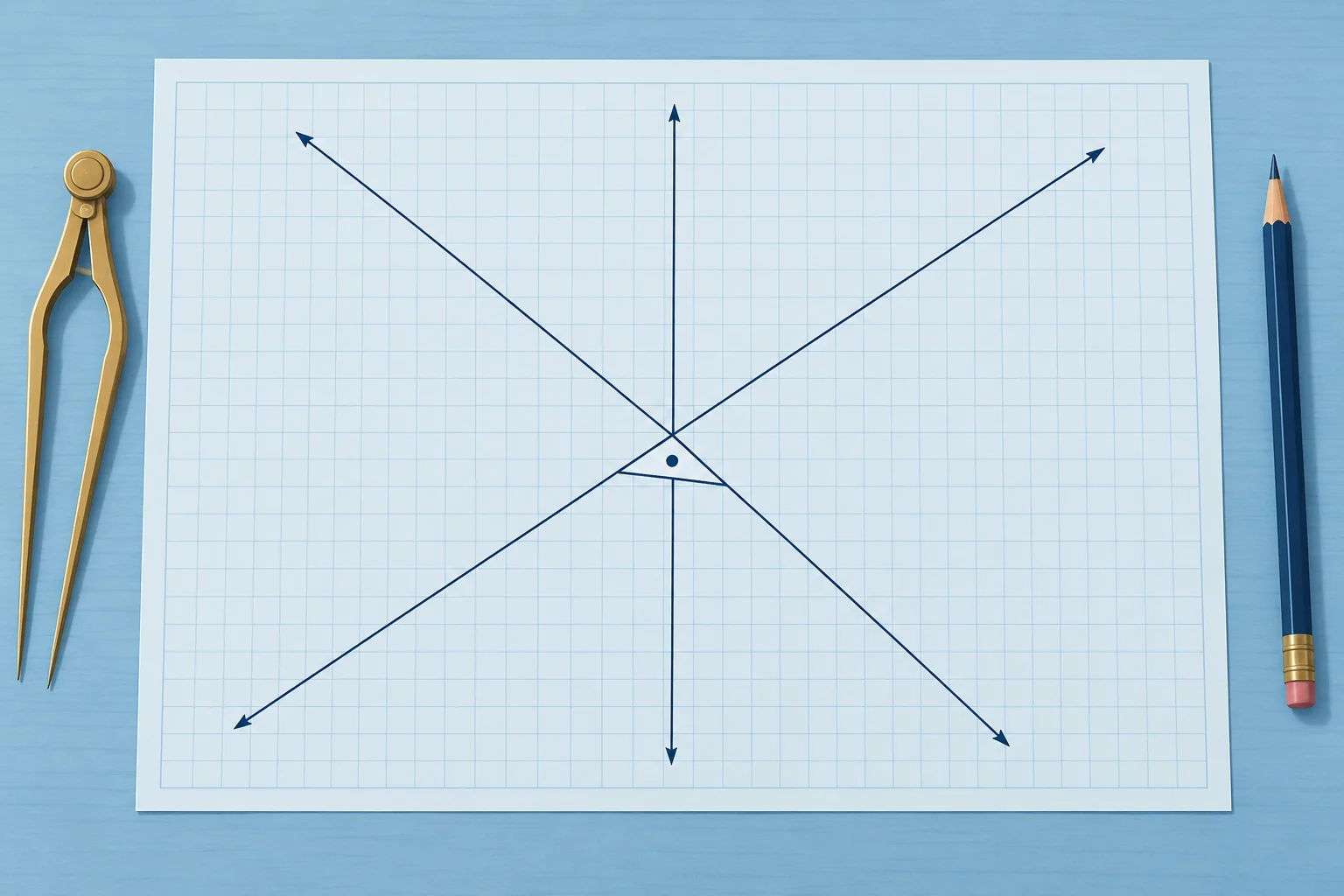
Three position lines usually form a triangle, the cocked hat. Its size depends on sight errors and crossing angles. A small triangle shows agreement but does not prove accuracy. A large one calls for checking times, identification, corrections and plotting.
Constant error
A wrong index correction or height of eye can shift all three lines equally, towards or away from their bodies. With stars surrounding you, about 120° apart, the point equally distant from the lines cancels a common altitude error if other errors are negligible. Random errors can put your true position outside the cocked hat. Check corrections and repeat doubtful sights.
Worked plan
For 24 November 2026: Hamal at 079°, Fomalhaut at 167° and Vega at 300°. The gaps are 88°, 133° and 139°: a good spread, all three between 33° and 44° altitude. Take a fourth star, if time allows, to check agreement between the lines.
2Key data
- Reduction
- As for the Sun; stars have no semi-diameter or parallax
- Common time
- Move earlier lines by the run: 6.5 kn × 5 min ≈ 0.5 M
- Cocked hat
- Size shows agreement; a small triangle can still give a poor fix
- Best spread
- Three stars about 120° apart in azimuth
- Constant error
- Equal altitude errors cancel ideally with well-spread stars
3Key points
- 1
Reduce each star like the Sun; stars need no semi-diameter or parallax.
- 2
Bring all lines to one time by the run between sights.
- 3
A small cocked hat shows agreement but does not guarantee accuracy.
- 4
For an equal altitude error alone, stars about 120° apart preserve the point equidistant from the lines.
4Frequent mistakes
Wrong: Plot every line for its own time; a few minutes do not matter.
Right: At 6.5 kn, five minutes is half a mile. Advance earlier lines to the time of the last sight.
Wrong: Three stars within 40° of azimuth make a strong fix because the lines are close together.
Right: Bunched azimuths give a long, thin triangle and hide a constant error. Spread them round the horizon.
5Practice case & exam keys
Your three star lines form a triangle about 14 M along each side. You applied a 2.0′ off-the-arc index error as on-the-arc. The stars were 120° apart. Assume other errors are negligible. What happens when you correct it?
Show the answer
The wrong sign made every altitude 4.0′ too low, shifting each line 4 M away from its body. At 120° spacing, this produces a triangle with sides about 13.9 M. Correct the index correction and replot. In this ideal case, the lines meet at the previous equidistant point.
Exam keys
- Star sight reduction: GHA Aries + SHA; corrections for IE, dip, refraction only.
- Advance earlier lines to the time of the last sight.
- Cocked hats can result from random and constant errors.
- For an equal altitude error alone, stars about 120° apart preserve the equidistant point.
Finish this unit
When you've read it, answer three questions. Get all three right to finish the unit; opening the page alone doesn't count.
My notes for this unit
No notes