

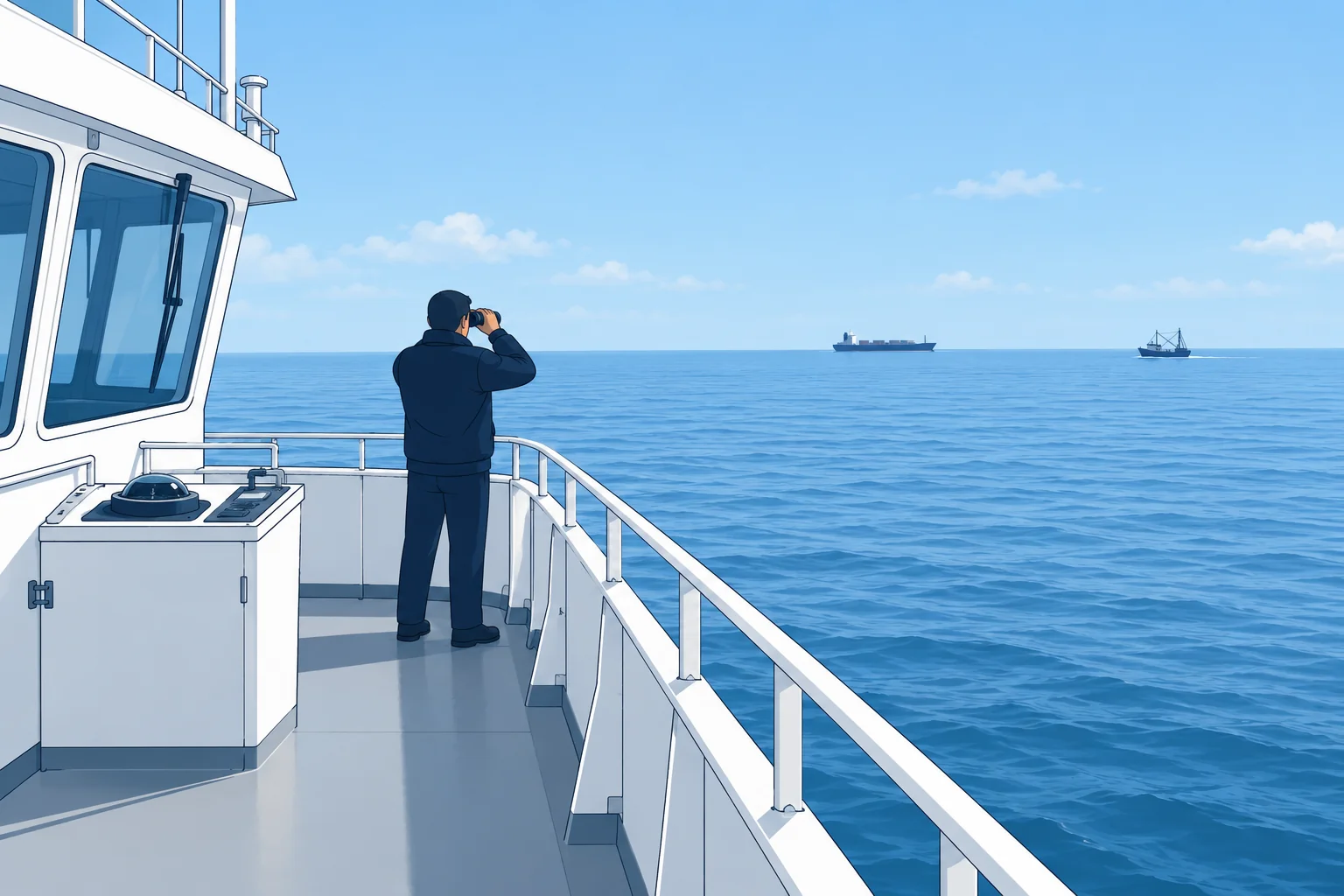
The lookout’s job: Rule 5 on a ship
1The lesson in plain words
A lookout watches and listens all round and tells the officer of the watch about everything seen or heard. It is a full-time job.
Why a lookout
Rule 5 of the collision-prevention rules (COLREGs) requires a proper lookout at all times. Use sight, hearing and every other means suited to the conditions, such as radar and the Automatic Identification System (AIS). You need a full picture of the situation and any collision risk. The officer of the watch (OOW) runs the bridge watch. You report what you see and hear.
Full attention
The Standards of Training, Certification and Watchkeeping for Seafarers (STCW) Code (section A-VIII/2) says the lookout must give full attention to the job. You must not be given any other duty that could get in the way. The helmsperson, the person steering, does not count as the lookout while steering, except on small ships with an unobstructed all-round view from the wheel, unimpaired night vision and no other impediment to keeping a proper lookout.
Where you stand
Your post is where you see and hear best: usually the bridge or a bridge wing, the open platform at each side of the bridge. In fog or heavy rain the master may post a lookout on the forecastle, the raised deck at the bow, away from engine noise. Keep a radio or telephone so you can report at once. Look all round, astern too: an overtaking ship comes up from behind.
Night vision
Your eyes take about 20 to 30 minutes to adapt fully to darkness. One glance at a bright white light spoils it. Keep screens dim, use the ship’s approved dim lighting, and shield task lights so they do not dazzle anyone. At night look slightly to one side of a faint light: the edge of your eye picks it up better than the centre.
How to search
Sweep the horizon in small steps, pausing a few seconds at each step, then sweep the water closer in. Use the binoculars to check and identify, not to search all the time: they narrow your view. A higher post lets you see farther. Tired eyes miss things, so come on watch rested.
2Key data
- Legal basis
- COLREG Rule 5; STCW Code A-VIII/2 (watchkeeping principles)
- Helmsperson as lookout
- Small ships only: clear view, night vision and no other impediment
- Dark adaptation
- About 20–30 minutes; one white light spoils it
- Distance to the sea horizon
- About 2.1 × √(height of eye in metres) nautical miles
- Example: eye 25 m above the sea
- 2.1 × 5 ≈ 10 nautical miles to the horizon
3Key points
- 1
Rule 5: a proper lookout at all times, by sight, hearing and all available means.
- 2
The lookout gives full attention; no other job that could interfere.
- 3
The helmsperson is not the lookout while steering (small-ship exception only).
- 4
Protect night vision: avoid bright light and shield task lights; full adaptation takes 20–30 minutes.
- 5
Sweep with your eyes; use binoculars to examine targets without losing the all-round watch.
4Frequent mistakes
Wrong: Radar and AIS make a human lookout unnecessary.
Right: Rule 5 asks for sight and hearing as well as all other means. Small boats, debris and people in the water often show on neither radar nor AIS.
Wrong: The helmsperson can keep the lookout as well.
Right: While steering, the helmsperson is not the lookout, except on small ships with an unobstructed all-round view from the wheel, unimpaired night vision and no other impediment to keeping a proper lookout.
Wrong: Look straight at a faint light to see it better.
Right: At night, look slightly to one side of it. The edge of your eye sees faint lights better than the centre.
5Practice case & exam keys
Night, open sea, traffic ahead. You are the only lookout on the bridge wing. A crew member asks you to help carry stores along the deck for a few minutes. What do you do?
Show the answer
Stay at your post and keep looking out. The lookout must give full attention, and you must not take on a job that could get in the way. If the work really must be done now, tell the OOW: the OOW decides and can call someone else to keep the lookout while you help.
Exam keys
- Rule 5: proper lookout at all times by sight, hearing and all available means.
- The lookout gives full attention; the helmsperson is not the lookout while steering (small-ship exception).
- Night vision takes about 20–30 minutes to adapt; avoid bright light and shield task lights.
Finish this unit
When you've read it, match the terms, then answer three questions. Get them all right to finish the unit; opening the page alone doesn't count.
My notes for this unit
No notes