

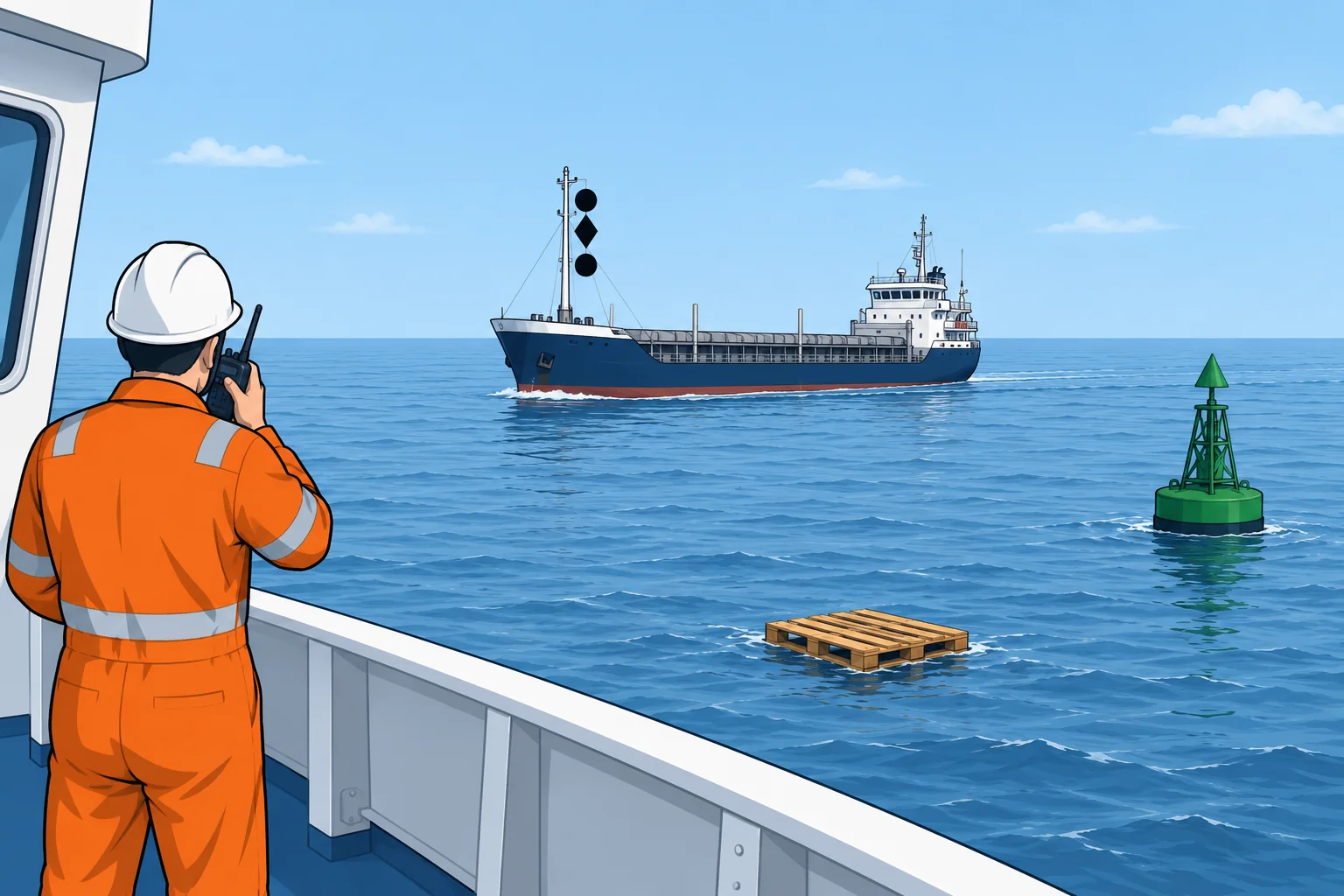
Reporting what you see: lights, shapes and objects
1The lesson in plain words
Report everything you see: what it is, where it is, how far off it seems and what it is doing. Then wait for the OOW to acknowledge.
Report everything
Report every light, shape, vessel, buoy, coastline, floating object and change in visibility, even if you think the OOW has already seen it. Report at once anything urgent: a person in the water, a flare or orange smoke, breaking water ahead, or a light very close. A report that turns out unnecessary costs nothing. A missed one can cost a ship.
Lights
Describe what you see before you name it: the colours, how many lights, and how they are arranged, one above the other or side by side. For example: ‘Two white lights, one higher than the other, and a green light’. If a light flashes, count and time it: it may be a buoy or a light on shore. The COLREG lights pages explain what each combination means.
Shapes by day
By day, vessels show shapes: black balls, cones, diamonds and cylinders hoisted where they can best be seen. Report them from the top down, for example ‘ball, diamond, ball’. Also report flags you can see and any vessel that seems stopped, towing or fishing.
Follow up
Report again when something changes: a target shows new lights, its bearing stops changing, it gets close, or you lose sight of it. Report faults on your own ship too, such as a navigation light out. On the phone or radio, start with ‘Bridge, lookout’ so the OOW knows who is calling.
2Step by step
Making a lookout report
- 1
Say what you see: colours, number and arrangement of lights, or the shapes from top down.
A description is more reliable than a guess at the type of vessel.
- 2
Say where: the relative bearing in points or degrees.
The OOW can find the target at once by eye or on radar.
- 3
Give an estimated distance if you can judge it; otherwise say ‘distance unknown’.
Distances at sea are hard to judge; ‘about’ tells the OOW it is an estimate.
- 4
Say what it is doing: drawing ahead or aft, bearing steady, closing.
Movement tells the OOW whether there may be a risk of collision.
- 5
Wait for the acknowledgement; repeat the report if there is none.
A report that is not acknowledged may not have been heard.
- 6
Keep watching and report every change.
The situation moves on; the OOW needs the latest picture.
3Key points
- 1
Report everything you see or hear, even if the OOW may already have seen it.
- 2
Order: what, where (relative bearing), how far (about), what it is doing.
- 3
Describe lights by colour, number and arrangement; shapes from the top down.
- 4
Wait for the acknowledgement; repeat the report if there is none.
- 5
Report again when anything changes, and report your own ship’s faults.
4Frequent mistakes
Wrong: The OOW has radar, so I only report what is close.
Right: Report every light and object. Radar and AIS can miss small craft, debris and people; your report may be the first warning.
Wrong: I report what I think the vessel is: ‘a fishing boat’.
Right: Describe first: colours, number and arrangement. Add what you think it is only after the description.
Wrong: There was no reply, so the OOW heard me.
Right: No acknowledgement means the report may not have arrived. Repeat it until the OOW acknowledges.
5Practice case & exam keys
At night you see a green light two points on the port bow. You cannot judge its distance or movement. You report it, but the OOW gives no acknowledgement. What do you do?
Show the answer
Report what you know: ‘Green light, two points on the port bow, distance and movement not yet clear.’ Repeat promptly until acknowledged. Keep watching and report changes. Do not invent a range or vessel type.
Exam keys
- Report everything; urgent items (person in the water, flares, close lights) at once.
- Report pattern: what – where (relative bearing) – how far – what it is doing.
- Closed loop: the OOW acknowledges; repeat the report if not acknowledged.
Finish this unit
When you've read it, match the terms, then answer three questions. Get them all right to finish the unit; opening the page alone doesn't count.
My notes for this unit
No notes